


Why Humidity and Salt Air Change Your HVAC Maintenance Needs on the Emerald Coast
How humidity and salt air change your maintenance needs is one of the most important things to understand as a homeowner on Florida’s Emerald Coast. The same Gulf breeze that makes Santa Rosa Beach, Destin, and 30A so beautiful is quietly working against your HVAC system every single day.
Here is a quick summary of the key ways coastal conditions affect your maintenance routine:
- Filter changes: Replace every 30 days instead of the standard 60-90 days
- Outdoor unit rinsing: Rinse with fresh water every 2-4 weeks to remove salt buildup
- Professional tune-ups: Schedule twice a year instead of once
- Coil inspections: Check for pitting, white powder, and corrosion at every visit
- Condensate drain cleaning: Flush more frequently due to higher moisture loads
- Humidity monitoring: Keep indoor relative humidity below 60% to prevent mold
- Corrosion checks: Inspect electrical terminals and cabinet hardware for oxidation regularly
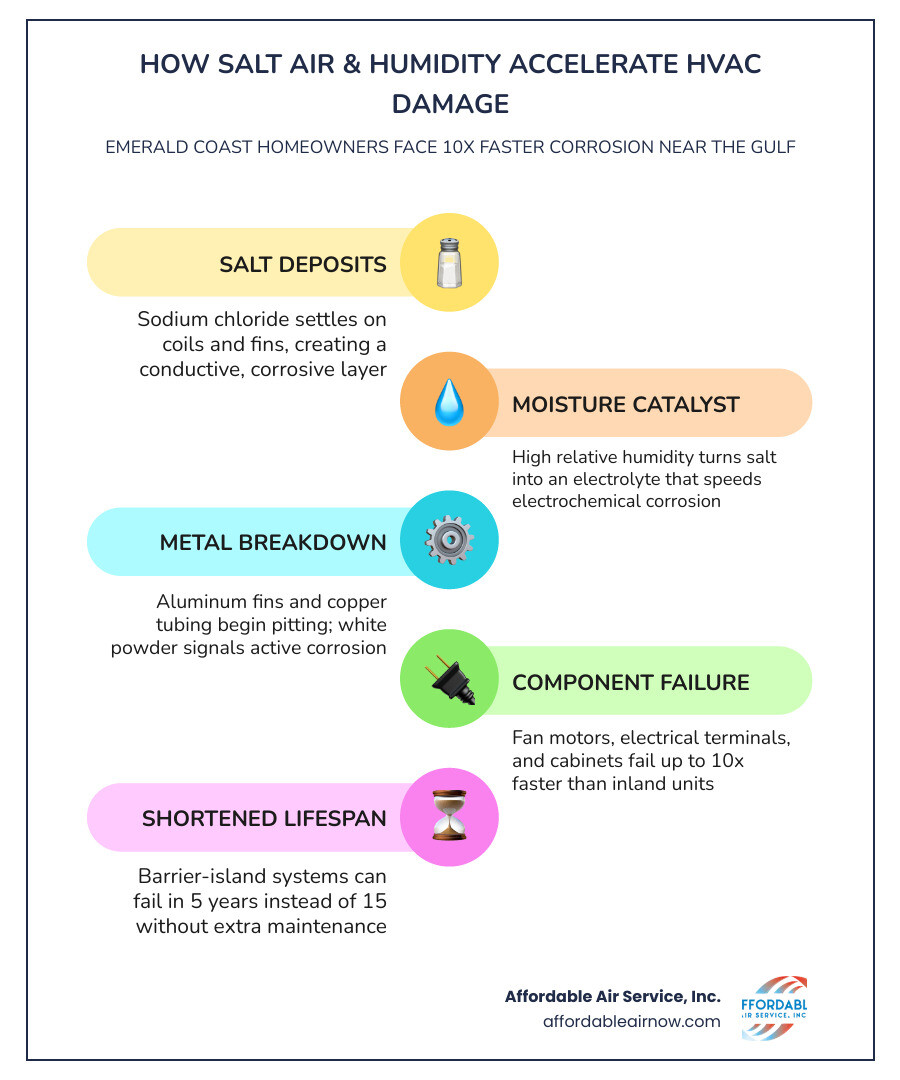
Coastal HVAC systems can corrode up to 10 times faster than inland systems. Without proper care, a system that should last 15 years may fail in as few as 5. Homes directly on or near the Gulf — including barrier islands and beachfront communities along 30A — face the harshest conditions of all.
The good news? Most of the damage is preventable with the right maintenance plan.
The Science of Coastal Corrosion: How Humidity and Salt Air Change Your Maintenance Needs
Living near the Gulf of Mexico means dealing with a unique atmospheric cocktail: high heat, relentless humidity, and salt-laden air. To truly understand how humidity and salt air change your maintenance needs, we have to look at the chemistry of what happens to metal when it meets the ocean breeze.
At the heart of the problem is salt’s “hygroscopic” nature. This is a fancy scientific way of saying that salt is a moisture magnet. When microscopic sodium chloride (salt) particles are carried by windward breezes onto your outdoor AC unit, they do not just sit there. They actively draw water molecules out of our humid Florida air.
This combination of salt and moisture forms a thin, briny film over your system’s metal components. This film acts as an electrolyte, triggering an electrochemical reaction known as galvanic corrosion. Because your outdoor unit contains different types of metals in close contact—specifically aluminum fins wrapped around copper tubing—this briny film turns your AC unit into a “slow-motion battery.” The aluminum acts as a sacrificial anode, corroding rapidly to protect the copper, leading to structural failure of the heat-exchanging fins.
If you want to dive deeper into why this happens, check out our guide on Why Salt Air Is Your HVACs Worst Enemy and learn more about The Silent AC Killer: How Salt Air Corrodes Your System.

Vulnerable Components and How Humidity and Salt Air Change Your Maintenance Needs
The corrosive chemistry of coastal air does not impact every part of your air conditioner equally. Some components bear the brunt of the damage, making them critical focus areas for your maintenance routine:
- Condenser Coils and Aluminum Fins: The delicate aluminum fins on your outdoor unit are roughly as thin as a soda can. When salt air settles on them, they undergo rapid oxidation. You will notice this as a white, powdery substance (aluminum oxide) coating the coils. Over time, the fins become incredibly brittle and will literally crumble to the touch, drastically reducing heat transfer.
- Copper Tubing: Copper is highly susceptible to “formicary” and pitting corrosion in coastal zones. This process creates microscopic, spider-web-like tunnels and pinhole leaks in the refrigerant lines. Once these tiny leaks develop, your system loses refrigerant, runs longer, and struggles to cool your home.
- Electrical Terminals and Control Boards: Moist, salty air penetrates the outdoor electrical cabinet, leading to rapid oxidation on terminal points, contactors, and control boards. This oxidation causes voltage drops, high electrical resistance, and intermittent system failures that can easily mimic a dead compressor.
- Fan Motor Bearings: Wind-blown sand and salt can work their way into the seals of the condenser fan motor, wearing down the bearings prematurely and causing loud squealing or complete motor failure.
To keep these critical parts from failing prematurely, proactive care is essential. Read our article on how to Dont Let the Gulf Coast Environment Kill Your HVAC System Early to protect your investment.
Lifespan Expectations: Barrier Islands vs. Inland Communities
Geography is destiny when it comes to HVAC longevity on the Emerald Coast. A system installed on Okaloosa Island or beachfront Destin is going to face a vastly different reality than one installed in Freeport or DeFuniak Springs.
Along the coast, systems run harder and face much higher salt concentrations. In South Walton and Destin, AC units easily log between 2,500 and 3,500 operating hours per year—nearly triple the workload of inland systems in northern states. When you combine this massive workload with constant salt exposure, the lifespan of standard equipment drops dramatically.
Here is a quick look at how proximity to the water changes HVAC lifespan and maintenance requirements:
| Location Type | Distance to Gulf | Realistic Lifespan | Recommended Professional Maintenance | Recommended DIY Rinsing |
|---|---|---|---|---|
| Beachfront / Barrier Islands (e.g., Okaloosa Island, Scenic Highway 30A) | Within 1 mile | 5 to 8 Years | Biannual (Spring & Fall) | Every 2 weeks |
| Coastal Communities (e.g., Miramar Beach, Coastal Destin) | 1 to 3 miles | 8 to 10 Years | Biannual | Monthly |
| Inland Communities (e.g., Freeport, DeFuniak Springs) | 5+ miles | 12 to 15 Years | Annual to Biannual | Quarterly |
Combating High Humidity and Indoor Air Quality Challenges
While salt air attacks your outdoor unit, high relative humidity (RH) wages war on your indoor air quality and overall comfort. In Northwest Florida, outdoor relative humidity routinely hovers between 70% and 85% for most of the year.
Your air conditioner has a dual job: it must lower the air temperature (sensible cooling) and remove water vapor from the air (latent cooling). When the air is thick with humidity, your system has to work twice as hard to remove that “latent heat” before you ever feel a drop in temperature. If your indoor humidity levels consistently climb above 60%, your home becomes a breeding ground for mold, mildew, and dust mites.
To understand how your AC handles this heavy lifting, read about The Dehumidification Solution: Why Your AC Is Your Best Defense Against Mold and explore our guide on Sweating the Small Stuff: Dehumidification and Your AC.
Managing Moisture and How Humidity and Salt Air Change Your Maintenance Needs
High humidity means your air conditioner is pulling gallons of water out of your indoor air every single day. All of this moisture drains into the evaporator coil’s condensate pan and flows out through a narrow PVC drain line.
In our warm, humid climate, this dark, wet environment is the perfect incubator for what locals affectionately call “Florida algae”—a thick, gooey buildup of bacteria, mold, and dust. If you do not maintain this drain line, it will clog, causing water to back up into your home. This can lead to ruined drywall, warped floors, and widespread mold growth.
Understanding the physics of moisture can help you manage it. Check out our quick definitions in our Glossary: Humidity, Glossary: Humidity Relative, and Glossary: Humidity Absolute to learn how these factors impact your indoor environment.
Filtration and Ventilation Strategies for Coastal Homes
Because indoor air can be 2 to 5 times more polluted than outdoor air in humid climates, your choice of air filters and ventilation strategies is incredibly important.
First, forget about those cheap, flat fiberglass filters. They lack the surface area and density to capture fine salt particles, mold spores, and marsh dust. Instead, opt for a pleated filter with a MERV 11 rating. A MERV 11 filter provides an excellent balance, capturing fine particulates without placing too much restrictive strain on your blower motor.
Additionally, standard air conditioning systems are sometimes not enough to handle the sheer volume of moisture in our area, especially during the spring and fall “shoulder seasons” when temperatures are mild but the air is still damp. In these cases, installing a dedicated whole-home dehumidifier is a game-changer. It supports your AC, allows you to feel comfortable at higher thermostat settings, and keeps your indoor relative humidity in the ideal 40% to 50% range.
For more practical tips, read about Beat the Humidity with These Smart Ways to Cool Your Coastal Home and discover How Your Homes Systems Fight the Coastal Humidity War.
Proactive Maintenance Strategies and Coastal-Rated Equipment
Because our coastal climate is so demanding, standard “builder-grade” HVAC units rarely survive past their fifth or sixth birthday without major issues. If you are replacing a system or looking to upgrade, you should look for coastal-rated equipment.
Modern coastal-rated systems feature specialized factory-applied coatings—such as Daikin’s Blue Fin or Gold Fin technology—which apply a hydrophilic, corrosion-resistant epoxy layer over the aluminum fins. These coatings prevent salt and moisture from directly contacting the raw metal, dramatically slowing down the galvanic corrosion process.
Furthermore, variable-speed systems, like the Daikin Fit, are highly recommended for the Emerald Coast. Unlike standard single-stage units that blast on and off (which can lead to “short cycling” and high indoor humidity), variable-speed systems run continuously at lower, ultra-efficient speeds. This constant, gentle airflow provides superior, non-stop dehumidification, keeping your home incredibly comfortable while saving on energy bills.
Essential DIY Maintenance Tasks for Homeowners
While professional service is irreplaceable, there are several simple, highly effective steps you can take to protect your system between our visits. Adding these tasks to your household routine will pay massive dividends in system longevity:
- The Monthly Freshwater Rinse: If you live within a mile of the beach (such as Okaloosa Island or beachfront Destin), gently rinse your outdoor condenser unit with a standard garden hose every two weeks. If you are further inland, once a month is perfect. Note: Never use a pressure washer, as the high force will flatten the delicate aluminum fins and ruin airflow.
- Keep a Clear Perimeter: Trim back sea oats, vines, and shrubs to maintain at least a two-foot clearance around your outdoor unit. This ensures maximum airflow and prevents organic debris from trapping moist, salty air against the cabinet.
- Check and Change Filters Monthly: Do not wait 90 days. Check your air filters every 30 days, especially during the peak summer cooling season when your system runs almost continuously.
- Flush Your Drain Line: Pour a cup of plain white vinegar down your condensate drain line once a month to kill off early algae and bacterial growth before it can form a clog.
The Importance of Biannual Professional Maintenance
For homeowners on the Emerald Coast, scheduling professional HVAC maintenance twice a year—once in the spring before the brutal summer heat, and once in the fall—is a necessity.
During a professional coastal tune-up, our experienced technicians perform specialized tasks that go far beyond a standard inspection:
- Deep Coil Cleaning: We use specialized, non-acidic, self-rinsing coil cleaners that safely dissolve salt crusting and grime without stripping away protective factory coatings.
- Electrical Integrity Check: We inspect all low-voltage and high-voltage connections, cleaning away oxidation and tightening terminals to prevent electrical failures.
- Refrigerant Verification: We track system pressures and temperatures to catch microscopic pinhole leaks early, preventing compressor damage.
- Storm & Hurricane Readiness: We inspect the physical tie-down straps, hurricane anchors, and electrical surge protectors to ensure your system is structurally and electrically secured before storm season hits.
Frequently Asked Questions About Coastal HVAC Care
How often should I rinse my outdoor AC unit if I live near the beach?
If your home is located within a mile of the Gulf or a salt-water bay, you should rinse your outdoor unit with fresh water every two weeks. If you live between one and five miles inland, a monthly rinse is sufficient. Always use a gentle spray from a standard garden hose—never a pressure washer—and rinse from the top down to wash away salt buildup.
Does a standard manufacturer warranty cover salt air corrosion?
Generally, no. Most standard manufacturer warranties classify salt air corrosion as environmental damage or an “act of God,” meaning they will not cover the cost of replacing corroded coils or cabinets. However, some premium brands offer specialized coastal warranties, and keeping documented proof of biannual professional maintenance is often required to keep your active parts warranty intact.
Why does my coastal home feel damp even when the AC is running?
This is typically caused by “short cycling,” which happens when an AC system is oversized for the home. The unit cools the air so quickly that it shuts off before it has run long enough to pull moisture out of the air. Upgrading to a variable-speed system like a Daikin Fit, or installing a whole-home dehumidifier, will solve this issue by providing longer, low-speed run cycles designed specifically for moisture removal.
Conclusion
Understanding how humidity and salt air change your maintenance needs is the key to protecting your home’s comfort and avoiding premature system replacements. Along the Emerald Coast, consistent, specialized care is the ultimate defense against the elements.
At Affordable Air Service, we have spent decades helping our neighbors in Santa Rosa Beach, Destin, Miramar Beach, Fort Walton Beach, Okaloosa Island, Freeport, and DeFuniak Springs keep their homes cool and comfortable. As an authorized Daikin dealer, we specialize in installing and maintaining corrosion-resistant, high-efficiency systems like the Daikin Fit, all backed by the Daikin Comfort Promise.
Whether you need a quick repair, a seasonal tune-up, or want to explore easy financing options through GoodLeap, we are here for you with prompt, friendly, 7-day service.
Protect your coastal home with professional maintenance from Affordable Air Service to schedule your coastal AC assessment!