


Why AC Bills Skyrocket on the Gulf Coast Every Summer
If you’re trying to figure out how to lower ac bills during gulf coast summers, here’s a quick answer:
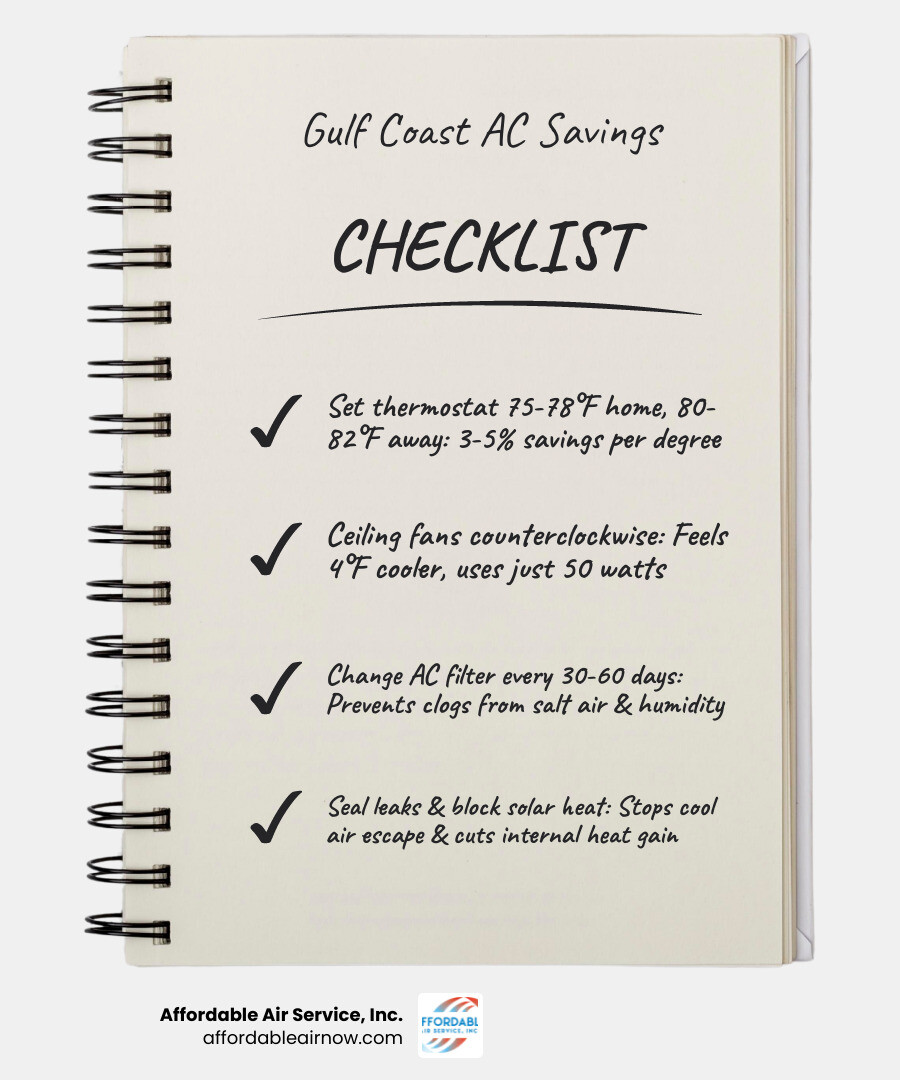
- Set your thermostat to 75-78°F when home and 80-82°F when away
- Run ceiling fans counterclockwise to feel up to 4°F cooler without touching the thermostat
- Change your AC filter every 30-60 days — salt air clogs filters faster here
- Seal air leaks around windows, doors, and ducts to stop cool air from escaping
- Block solar heat with window shades, awnings, or blackout curtains
- Upgrade to a high-SEER2 unit if yours is over 10 years old
- Schedule annual AC maintenance to keep your system running efficiently
Living on the Gulf Coast in Santa Rosa Beach means beautiful views, warm breezes, and summers that push your air conditioner to its absolute limit. From May through September, your AC runs almost nonstop against temperatures in the 90s and humidity levels that can make even a well-cooled home feel sticky and uncomfortable.
That constant workload adds up fast. During summer months, your AC can account for up to 60% of your entire energy bill. One local homeowner put it simply — bills can jump $30 to $40 in a single month just from the heat alone. And unlike most parts of the country, Gulf Coast homes don’t get much of a break. Salt air, relentless humidity, and a cooling season that stretches well beyond what most systems are designed for create a perfect storm for high energy costs and worn-out equipment.
The good news? Most of those extra dollars are recoverable. Small, smart changes to how you manage your home’s cooling can make a real difference — without sacrificing comfort.
How to Lower AC Bills During Gulf Coast Summers Through Smart Management
The first step in conquering the heat is mastering your thermostat. In the Florida Panhandle, it is tempting to “crank it down” to 68°F the moment you walk through the door, but this is a recipe for a massive utility bill. For every degree you can keep your thermostat at 75°F or higher, you can save between 3% and 5% on your total cooling costs.
The U.S. Department of Energy recommends a setting of 78°F when you are home. While that might sound high if you are used to a “meat locker” environment, your body can acclimate. Try raising the temperature by just one degree per day until you find a comfortable balance. When you are away from home for more than eight hours, aim for 80-82°F. Maintaining these adjustments daily can save you up to 10% annually on cooling.
One common mistake we see is homeowners dropping the temperature drastically to “cool the house faster.” Air conditioners don’t work like a gas pedal; they provide a steady stream of cold air until the target temperature is reached. Dropping it to 60°F just makes the compressor run longer, wasting energy. Instead, lower it two degrees at a time to reach your goal efficiently. Understanding the HVAC service process can help you realize how your system handles these loads and why steady settings are better for the equipment.
Optimizing thermostat schedules to lower ac bills during gulf coast summers
If you find it hard to remember to nudge the dial up before heading to Destin for the day, a smart thermostat is your best friend. Devices like the Nest or Ecobee can reduce cooling costs by around 15% by learning your habits.
Many of these units use geofencing—a technology that senses when your smartphone leaves the house and automatically enters “Away Mode.” When you’re five miles from home on your way back, it begins cooling down again. This ensures you never pay to cool an empty house. Furthermore, avoiding AC repairs through preventative measures starts with not overworking your system; a smart thermostat prevents the constant “on-off” cycling that wears out components.
| Feature | Manual Thermostat | Smart Thermostat |
|---|---|---|
| Energy Savings | 0-3% (User dependent) | 12-20% Average |
| Convenience | Must adjust by hand | Automatic/App-controlled |
| Humidity Control | Temperature only | Often includes humidistat |
| Maintenance Alerts | None | Reminders for filter changes |
Effective use of ceiling fans
Ceiling fans are the unsung heroes of the Gulf Coast. While a fan doesn’t actually lower the temperature of the room, it creates a “wind-chill effect” on your skin. This can make a room feel roughly 4°F cooler than it actually is.
To maximize this, ensure your fan is rotating counterclockwise during the summer. This pushes a column of air directly down. Because a high-efficiency central AC uses about 3,500 watts while a standard ceiling fan requires just 50 watts, using fans allows you to raise your thermostat by 4°F without losing comfort. This simple switch can save you up to $38 a month. Just remember: fans cool people, not rooms. Turn them off when you leave the room to save even more. Keeping your Santa Rosa Beach home breezy with proper AC maintenance ensures that your primary cooling system works in perfect harmony with these fans.
Controlling Humidity and Protecting Against Salt Air
On the Gulf Coast, it isn’t just the heat—it’s the humidity. When indoor humidity levels climb above 55%, your sweat can’t evaporate, making 75°F feel like 80°F. A properly functioning HVAC system should maintain indoor humidity between 45% and 55%.
High humidity doesn’t just make you uncomfortable; it’s hard on your equipment. Moist environments foster algae growth in condensate drain lines. If these lines clog, water can back up into your home, causing significant damage. Additionally, homes in areas like Okaloosa Island or Miramar Beach face the constant threat of salt air corrosion. Salt can eat through standard copper coils in less than five years, whereas salt-resistant models can last 10 to 15 years.
Managing moisture to lower ac bills during gulf coast summers
To keep your home from feeling “sticky,” your AC must run long enough to pull moisture out of the air. If your unit is oversized (too big for your square footage), it will “short cycle,” cooling the air quickly but leaving all the humidity behind.
Ensuring your evaporator coils are clean is vital. A clean system can slash blower energy usage by 41% to 60%. We also recommend regular inspections of the drainage system to prevent algae clogs. Following preventative HVAC maintenance tips is the best way to ensure your system is actually dehumidifying your home rather than just circulating damp air. For those with persistent moisture issues, enhancing indoor air quality with professional AC services can include the installation of whole-home dehumidifiers.
Improving Home Insulation and Blocking Solar Heat
You can have the best AC in Destin, but if your home is “leaky,” you’re essentially trying to cool the entire neighborhood. Air leaks can account for up to 40% of energy loss in a home. In our humid environment, these leaks don’t just let cold air out; they let hot, wet air in.
Start by checking the “envelope” of your home. Use caulk or weatherstripping to seal gaps around windows, doors, and electrical outlets. Don’t forget the attic. On a typical July day in Freeport, attic temperatures can reach a staggering 140°F. If your attic insulation is thin or your ducts are unsealed, that heat will radiate straight into your living space. Sealing and insulating ducts can boost your system’s efficiency by 20% or more.
Reducing internal heat gain
While we often focus on the sun, we sometimes forget the heat we generate inside. Household activities can significantly increase the load on your AC.
- Appliance Timing: Run your dishwasher and dryer at night. Clothes dryers use a massive amount of energy and exhaust hot air, while dishwashers release steam.
- LED Lighting: Traditional incandescent bulbs are essentially small heaters. Switching to LEDs reduces heat generation and energy use.
- Laundry Habits: Heating water for laundry accounts for up to 90% of the energy used per load. Using cold water can save a family of four upwards of $160 a year.
- Cooking: Avoid using the oven during the day. Use an air fryer, microwave, or grill outside to keep the kitchen cool.
Blocking the sun from the outside is even more effective. About 76% of sunlight hitting standard double-pane windows turns into heat inside your home.
- Blackout Curtains: Insulated curtains can make a room feel up to 20 degrees more comfortable.
- Window Awnings: These can block up to 65% of solar heat on south-facing windows and 77% on west-facing ones.
- Landscaping: Well-placed trees or large shrubs can lower a household’s energy use by up to 25%. Shading your outdoor AC unit itself can boost its efficiency by up to 10%, provided you leave at least two feet of clearance for airflow.
Essential Maintenance and High-Efficiency Upgrades
Maintenance is the difference between a system that lasts 15 years and one that dies in seven. In coastal climates, the “standard” advice of changing filters every 90 days doesn’t apply. Between the salt air, high pollen counts, and heavy usage, you should replace your air filters every 30 to 60 days. A clogged filter can reduce efficiency by 5-15% and is the leading cause of blower motor failure.
Strategic maintenance to lower ac bills during gulf coast summers
Beyond filters, your system needs professional attention. Salt air can cause a “crust” to form on outdoor coils, preventing heat transfer. Regular coil cleaning is essential for maintaining that 10-year lifespan we expect in places like Ft Walton Beach.
A professional tune-up ensures that refrigerant levels are exact. If your system is even slightly low on refrigerant, it will run longer and work harder, driving up your bills. Extending the life of your air conditioner requires a proactive approach, especially as the unit ages.
Identifying when to replace your unit
If your AC is more than 10 years old and has a SEER rating of 12 or lower, you are likely overpaying for every minute of cooling. Modern units now use the SEER2 (Seasonal Energy Efficiency Ratio 2) standard, which is much more rigorous.
Replacing a 10-year-old 12-SEER unit with an 18-SEER2 model in a 2,000 sq ft home can reduce electricity use by 30%, saving about $45 monthly or $540 annually. When shopping for a new unit, look for ENERGY STAR-certified models and, most importantly, salt-resistant features like coated coils. These are specifically designed for the Gulf Coast’s harsh environment.
Not sure where your current unit stands? Use a SEER Calculator to see your potential savings. Knowing the AC replacement key indicators—such as frequent repairs, rising bills, or strange noises—can help you make the move before a total breakdown occurs. If you’re seeing AC replacement warning signs, it’s often more cost-effective to upgrade than to keep patching an old, thirsty unit. When to consider AC replacement is a decision that can save you thousands in the long run.
Frequently Asked Questions about Coastal Cooling
What is the best thermostat setting for Florida summers?
The ideal balance for comfort and savings is 75-78°F when you are at home. When you head out for work or the beach, bump it up to 80-82°F. If you’re struggling with these settings, it might be time for troubleshooting common AC issues to ensure your system is actually reaching the set temperature.
How often should I change my AC filter in a coastal area?
We recommend every 30 to 60 days. The high humidity and salt air in our region make filters get “heavy” and clogged faster than in drier climates. This is one of the simplest common AC repair issues and solutions you can handle yourself.
Do ceiling fans actually lower the temperature?
No, they do not lower the air temperature. They cool you via the wind-chill effect. Because they are so much cheaper to run than an AC, they allow you to set the thermostat higher while feeling just as cool. If your home still feels hot even with fans, look for professional AC repair signs like weak airflow or warm air coming from vents.
Conclusion
Lowering your AC bills during a Gulf Coast summer doesn’t require living in the heat. By combining smart thermostat habits, moisture control, and strategic home improvements like better insulation and shading, you can keep your home comfortable while keeping your wallet full.
At Affordable Air Service, Inc., we know exactly what Santa Rosa Beach and Destin homeowners face every summer. From salt air corrosion to 100% humidity days, we’ve seen it all. We are proud to offer 7-day service, free estimates, and easy financing to ensure your family stays cool without the stress. Backed by our Daikin Comfort Promise, we are committed to providing the most efficient and affordable cooling solutions in the Panhandle.
Don’t wait for a mid-July breakdown to take action. Whether you need a quick tune-up or a full high-efficiency upgrade, our team is ready to help. Schedule your professional AC service today and start saving on your energy bills.