


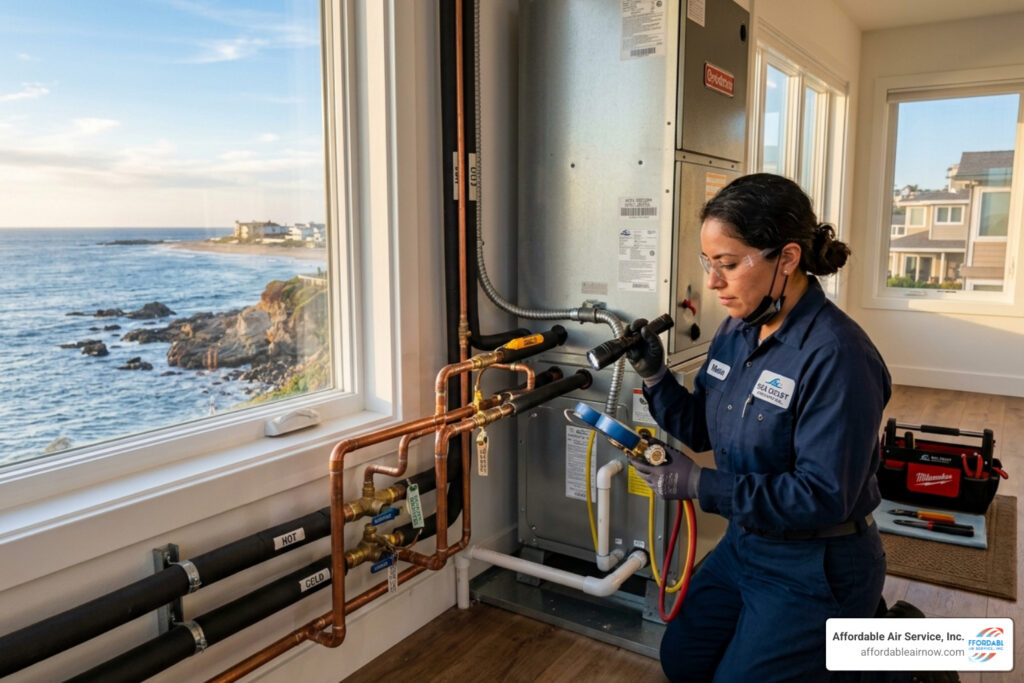
Why Salt Air, Sand, and Humidity Are Silently Damaging Your Coastal Home Systems
HVAC and plumbing maintenance tips for coastal homeowners are not the same as standard home maintenance advice — and if you live on the Emerald Coast, that difference matters a lot.
Here are the most important steps coastal homeowners should take:
- Replace HVAC filters monthly — salt air and sand clog filters far faster than in inland homes
- Rinse condenser coils regularly — to remove salt buildup that accelerates corrosion
- Schedule professional HVAC maintenance twice a year — coastal systems need more frequent attention
- Install outdoor showers or foot wash stations — to stop sand from entering your plumbing
- Flush your water heater annually — sediment and mineral buildup are more aggressive in coastal conditions
- Use mesh screens on drains and vents — to block sand intrusion before it causes erosion
- Inspect for rust, reduced airflow, and musty odors — these are early warning signs unique to coastal wear
Sand. Salt. Relentless humidity. These are the hallmarks of life on Florida’s Gulf Coast — and they’re also the biggest threats to your home’s HVAC and plumbing systems. While most homeowners think about wear and tear in terms of years of use, coastal homeowners have to think in terms of months. Salt air alone can corrode metal components like condenser coils, electrical connectors, and pipe fittings at a pace that simply doesn’t happen inland.
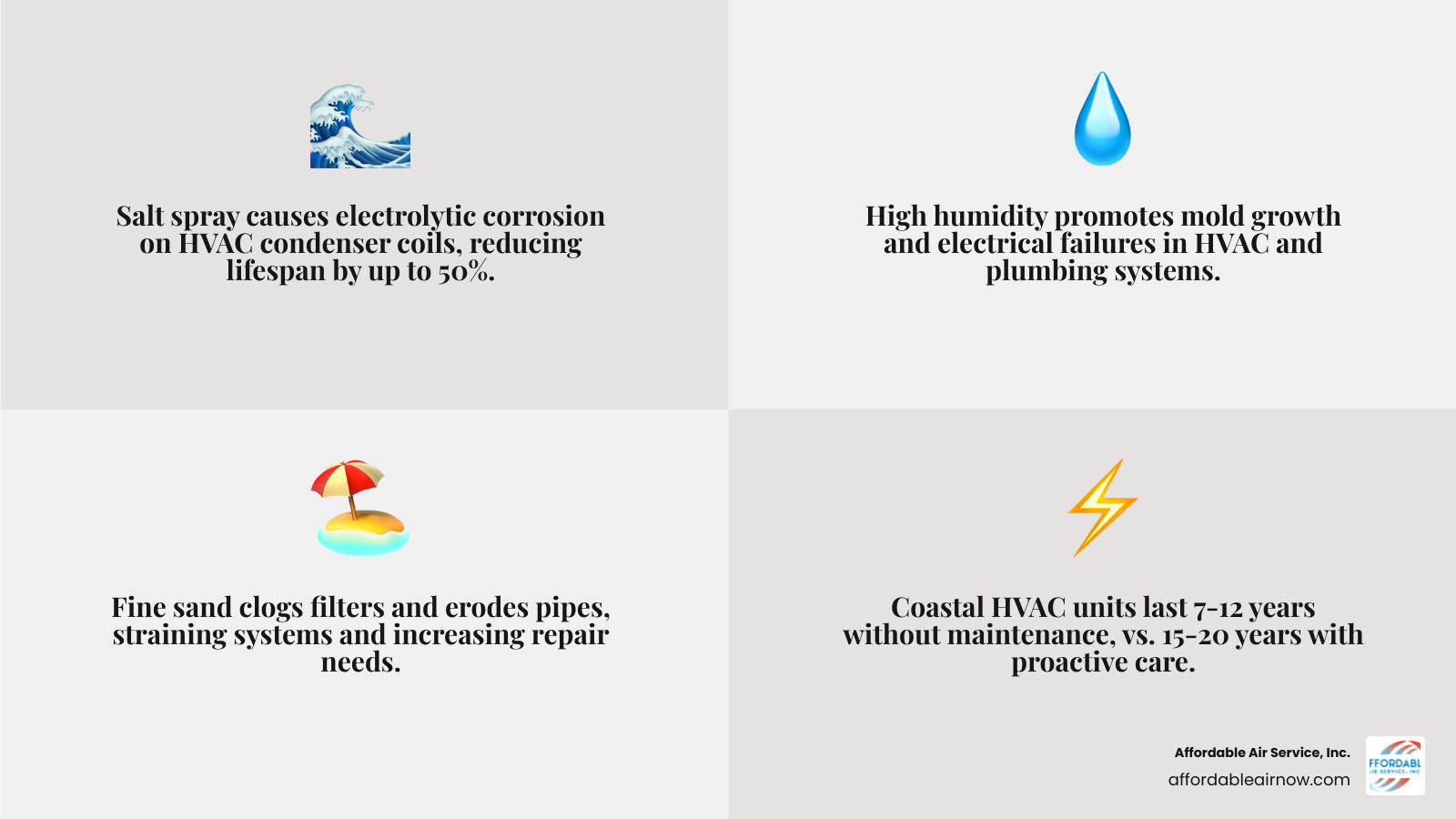
Without the right protections in place, HVAC systems in coastal regions can begin showing serious wear in as little as 7 to 12 years — roughly half the lifespan you’d expect from an inland system. The same harsh conditions that make places like Santa Rosa Beach so beautiful are working around the clock to shorten the life of your equipment.
The good news? Proactive maintenance makes a real difference. Coastal homeowners who invest in regular upkeep, corrosion-resistant materials, and professional inspections can push their systems toward the 15 to 20-year range. This guide breaks down exactly what you need to do — and when.
The Unique Environmental Challenges of Coastal Living in 2026
Living in beautiful spots like Destin or Okaloosa Island comes with a price that isn’t listed on your mortgage: the constant environmental assault on your home’s infrastructure. As we move through April 2026, we’ve seen how the combination of salt spray, extreme humidity, and fine quartz sand creates a “perfect storm” for mechanical systems.
Salt spray is perhaps the most aggressive enemy. It doesn’t just sit on surfaces; it eats them. Through a process called electrolytic corrosion, salt air accelerates the breakdown of metal. This is especially dangerous for your air conditioner’s condenser unit, which sits outside, pulling that salty air directly through its delicate fins.
Then there is the humidity. In our part of Florida, humidity levels often hover in the “sticky” zone, which forces HVAC systems to work overtime just to keep the air breathable. This constant load leads to faster mechanical wear. Furthermore, high humidity combined with salt creates a moist, corrosive film on everything it touches. To keep your home running smoothly, you must Avoid AC Repairs: Preventative Measures by understanding these local threats.
Sand intrusion is the third “menace.” Our famous white sand is beautiful on the beach but brutal on your plumbing and HVAC. Fine particles can get lodged in fan motors, clog drainage lines, and act like sandpaper inside your pipes, causing gradual erosion that eventually leads to pinhole leaks.
How Coastal Elements Shorten System Lifespan
Inland, a well-maintained HVAC system can easily hum along for 15 to 20 years. However, on the Emerald Coast, the reality is different. Without specialized care, many units start failing between years 7 and 12.
The salt air primarily targets the outdoor components. Condenser coils, which are responsible for releasing heat from your home, are often made of copper and aluminum. When salt accumulates on these coils, it creates a barrier that reduces heat transfer, making the system work harder and hotter. Eventually, the metal becomes brittle and “flaky,” leading to refrigerant leaks that are often too expensive to repair.
Electrical corrosion is another silent killer. Salt air can penetrate the control box of your AC, corroding wire connectors and circuit boards. This leads to intermittent failures, “ghost” problems that are hard to diagnose, and eventually, total system shutdown. To fight back, you need to take specific steps to Extend the Life of Your Air Conditioner by prioritizing protection over mere “fix-it” repairs.
Signs of Wear and Tear in Beachfront Properties
As a homeowner in Miramar Beach or Freeport, you need to be a bit of a detective. Coastal wear and tear often starts subtly. One of the first signs is reduced airflow. If your vents don’t seem to be blowing as hard as they used to, it might be due to salt and sand buildup on the evaporator coils or a clogged filter.
Musty odors are another red flag. High coastal humidity can lead to biological growth within the ductwork or on the cooling coils. If your home smells like a damp locker room whenever the AC kicks on, you likely have a humidity control issue.
On the plumbing side, keep an eye on your water pressure and drainage speed. Sand is heavy and abrasive; it settles in P-traps and low spots in your piping. If you notice your sinks are draining slower than usual, it’s important to know How to Tell if You Have a Clogged Drain before the sand creates a solid blockage that requires professional hydro-jetting.

Essential HVAC and Plumbing Maintenance Tips for Coastal Homeowners
Proactive care is the only way to survive the coastal climate. We always tell our neighbors in Santa Rosa Beach that maintenance isn’t just a chore — it’s an investment in property preservation. By focusing on corrosion resistance and system longevity now, you save yourself the headache of an emergency breakdown in the middle of a July heatwave.
One of the most effective ways to protect your HVAC is through the use of protective coatings. Modern marine-grade coatings can be applied to coils to provide a shield against salt air. While no coating is permanent, they significantly delay the onset of corrosion.
For plumbing, the goal is “exclusion” — keeping the salt and sand out of the system entirely. This involves a combination of hardware (filters and screens) and behavioral changes (outdoor rinsing). Following these Preventative HVAC Maintenance Tips will ensure your home remains a sanctuary rather than a source of stress.
Monthly HVAC and Plumbing Maintenance Tips for Coastal Homeowners
You don’t need a toolbox to perform the most important monthly tasks.
- Filter Replacement: In coastal areas, we recommend checking your filters every 30 days. Because our air carries more fine particles (sand and salt), filters clog much faster. A clogged filter restricts airflow, causing the motor to overheat and the coils to freeze.
- Coil Rinsing: This is a “pro tip” for beachfront living. Once a month, use a gentle stream from a garden hose to rinse the outdoor condenser unit. This washes away the salt film before it has a chance to eat into the metal. Note: Never use a pressure washer, as it will flatten the delicate fins.
- Debris Removal: Ensure there is a 2-foot “clear zone” around your outdoor unit. Trim back sea oats, shrubs, and remove any drifted sand that might be blocking the bottom of the unit.
- Drainage Checks: Pour a cup of white vinegar down your AC condensate drain to prevent algae growth, which is rampant in our humid climate.
To keep your indoor air quality high, you should Keep Your Santa Rosa Beach Home Breezy with Proper AC Maintenance. Additionally, don’t forget the kitchen; sand and shells can easily find their way into the sink, so Preventing Garbage Disposal Problems starts with being mindful of what goes down the drain.
Seasonal HVAC and Plumbing Maintenance Tips for Coastal Homeowners
Twice a year — ideally in the spring before the heat hits and in the fall after the storm season — you should perform a deeper dive into your home’s health.
For your plumbing, the water heater is the star of the show. Coastal water often has higher mineral content, and the humidity can cause the exterior tank of a standard heater to rust. We recommend an annual flush to remove sediment. This is also the time to check the anode rod. This “sacrificial” rod is designed to corrode so your tank doesn’t; in coastal areas, these rods can disappear in just a few years. Check out these Miramar Beach Water Heater Maintenance Tips for a Long and Happy Life for a detailed walkthrough.
On the HVAC side, seasonal maintenance should include thermostat calibration. With the extreme swings in Florida humidity, an accurate thermostat is essential for preventing the system from “short-cycling.” If you own a rental property, these Essential Seasonal Plumbing Tips for Your Vacation Home are crucial for ensuring your guests aren’t left with cold showers or a flooded bathroom.
Protecting Your Plumbing System from Sand and Salt
Sand is the “silent abraser” of the plumbing world. Unlike organic clogs that can be dissolved with enzymes, sand is a physical grit that sits in your pipes. Over time, as water rushes over this sand, it acts like a file, wearing down the interior of your copper or PVC pipes. This is particularly problematic for homeowners in Ft Walton Beach and Okaloosa Island, where the sand is exceptionally fine.
Salt also plays a role in plumbing degradation. While most of your pipes are hidden, the fixtures (faucets, showerheads, and handles) are constantly exposed to the salty atmosphere. This can lead to “pitting” on chrome and stainless steel finishes and can even seize up the internal cartridges of your valves. Understanding these Common Plumbing Problems is the first step toward preventing them.
Strategies to Prevent Sand Intrusion
The best way to deal with sand is to never let it enter your home.
- Outdoor Showers: This is the #1 defense. Installing a simple outdoor foot wash or full shower encourages guests and family to leave the beach at the door.
- Entryway Management: Use heavy-duty, sand-trapping mats both inside and outside main entrances. Some homeowners even keep a soft-bristled brush by the door for brushing off dry sand.
- Mesh Screens: Install fine mesh screens over all floor drains and even your laundry machine’s discharge hose. This catches the sand before it enters the main stack.
- Education: If you rent out your home, post a friendly sign reminding guests to rinse off. Most people don’t realize that a single sandy swimsuit can cause a major plumbing backup.
By implementing these habits, you reduce the need for frequent Drain Cleaning: Top Benefits and ensure your pipes stay smooth. For more advanced protection, consider Plumbing Services to Prevent Problems such as whole-home sediment filtration.
Maintaining Water Heaters in High-Humidity Zones
In our region, water heaters work in a high-stress environment. The humidity in a garage or utility closet can cause the outer casing to sweat, leading to rust.
If you have a traditional tank heater, the sediment buildup at the bottom acts as an insulator, making the burner or element work harder to heat the water. This eventually “cooks” the bottom of the tank, leading to failure. Following Electric Water Heater Maintenance Tips like checking the Temperature and Pressure (T&P) valve is vital.
Tankless water heaters are popular in Miramar Beach because they save space, but they aren’t immune to coastal issues. They require a “spa day” or a descaling flush at least once a year to remove the calcium and mineral scale that builds up in the heat exchanger. See Why Your Miramar Beach Tankless Heater Needs a Spa Day for more on why this is a non-negotiable task for coastal residents.
Maximizing System Longevity with Professional Care
While DIY tasks like rinsing coils and changing filters are great, they cannot replace the trained eye of a professional. At Affordable Air Service, we recommend a professional “check-up” twice a year. We look for the things you can’t see, like refrigerant levels, electrical draw, and the integrity of the internal components.
Strategic unit placement is also something we evaluate. If we are installing a new system, we look for areas sheltered from the direct sea breeze or use fencing that allows airflow while blocking the brunt of the salt spray. We also emphasize surge protection. Our coastal storms are famous for lightning and power fluctuations that can fry an HVAC control board in a nanosecond.
| Feature | Neglected Coastal System | Maintained Coastal System |
|---|---|---|
| Expected Lifespan | 7–10 Years | 15–20 Years |
| Energy Efficiency | Drops 10–15% annually due to salt buildup | Remains stable with regular cleaning |
| Repair Frequency | High (leaks, electrical failure) | Low (preventative part replacement) |
| Air Quality | High risk of mold/mildew | Clean and humidity-controlled |
Regular professional visits are the backbone of a healthy home. You can learn more about Why Regular HVAC Service is Essential to see how a small investment in maintenance prevents a massive investment in a premature replacement.
Specialized Services for Emerald Coast Homes
Because we live and work in areas like Ft Walton Beach and Destin, we offer services specifically designed for this environment. This includes ductwork inspections. In high-humidity zones, even a small leak in your ducts can pull in hot, moist, salty air from the attic or crawlspace, leading to mold growth and massive energy loss.
When it comes to equipment, we favor corrosion-resistant materials. This includes units with “Blue Fin” or “Gold Fin” technology, stainless steel fasteners, and marine-grade cabinets. If you’ve recently upgraded, knowing How to Maintain Your New AC Installation in Ft Walton Beach is the best way to protect that new asset. We take pride in Understanding the HVAC Service Process so you know exactly what our technicians are doing to safeguard your home.
Preparing Your Home for Storm Season
By April, we are already looking toward the upcoming hurricane season. For coastal homeowners, storm prep is about more than just window shutters.
- Secure Mounts: Ensure your outdoor HVAC unit is bolted down to a heavy concrete pad. High winds can move or even flip an unanchored unit.
- Flood Elevation: If you are in a low-lying area of Okaloosa Island, your unit should be elevated on a stand above the expected flood level.
- Post-Storm Inspections: After a major storm, even if the power is on, have your system inspected. Saltwater flooding or wind-blown debris can cause hidden damage that leads to failure weeks later.
If you use your coastal property as a vacation home, our HVAC Ready for Vacation: Emerald Coast Homeowners Guide provides a checklist for when the house is empty. For those who have already had to replace a unit, these Post-Replacement AC Maintenance Tips for Miramar Beach Homeowners will help you make this unit last twice as long as the last one.
Frequently Asked Questions
How often should I replace my HVAC filters in a coastal environment?
In a coastal setting like Santa Rosa Beach, you should replace your filters every 30 days. Unlike inland homes, coastal air is filled with fine salt crystals and sand particles that can bypass or quickly clog standard filters. This buildup restricts airflow, forcing your system to work harder and increasing the risk of the evaporator coils freezing or the blower motor burning out.
Can salt air affect my indoor plumbing fixtures?
Yes. While it is called “salt air,” it is actually an aerosolized mist that can enter your home through open windows or poor seals. Over time, this causes “atmospheric corrosion,” which appears as tiny pits or green/white crust on your faucets and showerheads. We recommend wiping down your fixtures with a damp cloth weekly and maintaining indoor humidity levels below 50% to prevent the moisture that salt needs to react with metal.
What is the typical lifespan of an HVAC unit near the ocean?
Without regular maintenance, a standard HVAC unit in a coastal area typically lasts 7 to 12 years. However, with rigorous maintenance — including monthly rinsing of the coils, twice-yearly professional inspections, and the use of corrosion-resistant coatings — you can extend that lifespan to 15 to 20 years. The key is preventing the salt from ever having a “permanent residence” on your equipment.
Conclusion
At Affordable Air Service, Inc., we understand that your home on the Emerald Coast is likely your biggest investment. Whether you are in Santa Rosa Beach, Destin, or DeFuniak Springs, the environment is working against you. But you don’t have to face it alone.
By following these hvac and plumbing maintenance tips for coastal homeowners, you can enjoy the breeze without worrying about the bill. We are here to help with 7-day service, free estimates, and the peace of mind that comes with our Daikin Comfort Promise. Don’t wait for the salt to win — take control of your home’s health today.
If you’re ready to schedule your seasonal check-up or need expert advice on coastal-rated upgrades, explore our Professional HVAC and Plumbing Services and let us keep your home comfortable for years to come.