


Why Understanding Dehumidification and Your Air Conditioner Matters This Season
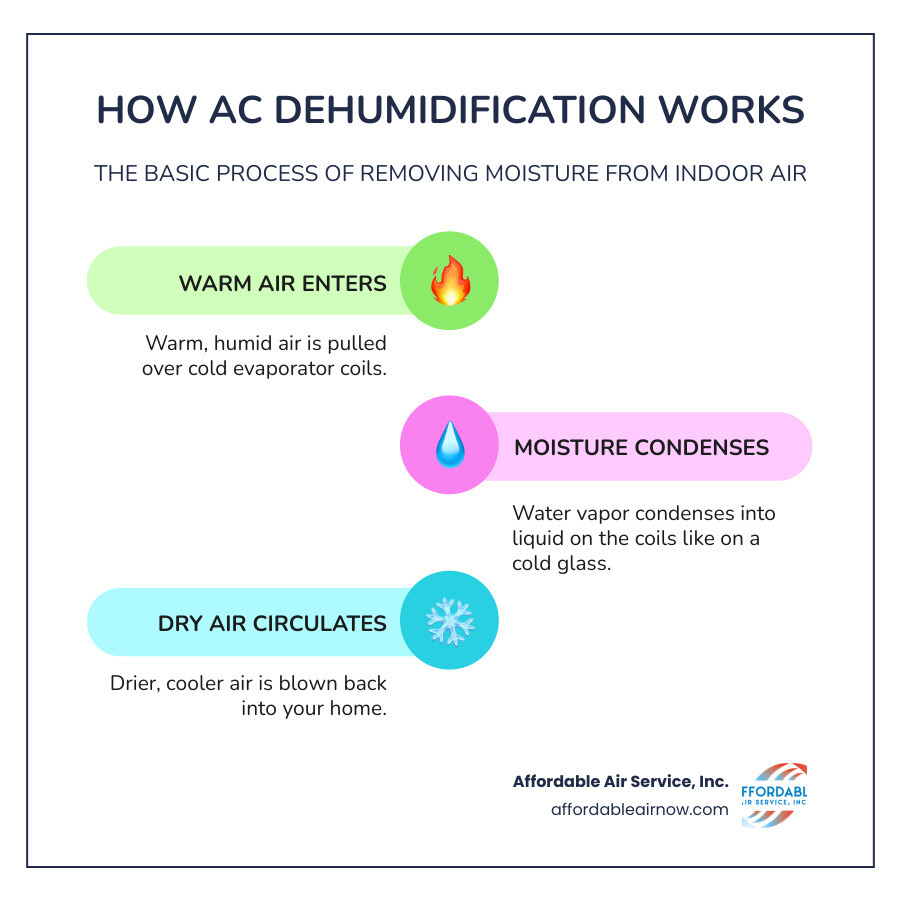
Dehumidification and your air conditioner explained simply: your AC removes moisture from the air as a natural byproduct of the cooling process, making your home feel more comfortable even before the temperature drops.
Here is a quick breakdown of how it works:
- Warm, humid air is pulled across cold evaporator coils inside your AC unit
- Moisture condenses on those coils, just like water droplets form on a cold glass
- The condensed water drains away through the condensate drain line
- Drier, cooler air is then circulated back into your living space
- The result is lower indoor humidity and a more comfortable feel at the same temperature
For most homes, the target indoor humidity sits between 30% and 50%. When humidity climbs above 60%, you start to feel sticky and uncomfortable — even if your thermostat reads a perfectly reasonable temperature.
Here on the Emerald Coast, this is not a small problem. Florida consistently ranks among the most humid states in the country, and in April 2026, that coastal moisture is already making itself known in homes across Santa Rosa Beach. Running your AC helps, but whether it handles enough of that moisture load depends on several factors — including your system’s size, age, efficiency rating, and current maintenance condition.
Dehumidification and Your Air Conditioner Explained: The Science of Comfort
To truly understand dehumidification and your air conditioner explained, we have to look at the refrigeration cycle. Many homeowners think an air conditioner “creates” cold air. In reality, it removes heat and moisture from the indoor air and moves it outside.
As your system runs, the indoor unit contains evaporator coils filled with cold refrigerant. When the blower fan pulls the warm, muggy air from your Santa Rosa Beach home over these coils, a physical change occurs. Because the coils are colder than the dew point of the air, the water vapor in the air turns into liquid. This is called moisture condensation.
This process involves two types of cooling:
- Sensible Heat Removal: This is the drop in actual temperature you see on your thermostat.
- Latent Heat Removal: This is the energy used to pull water out of the air.
In a humid climate like ours, the AC has to work hard on that latent load. If the system isn’t running long enough or the coils aren’t cold enough, you end up with “cold and clammy” air—where the temperature is low, but the moisture remains. For homeowners in Destin or Miramar Beach, ensuring your system is optimized for this process is the key to true comfort. If you’re struggling with a sticky home, our Expert AC Services for Florida can help calibrate your system for maximum moisture removal.
Dehumidification and your air conditioner explained: Understanding Dry Mode
Many modern units, especially ductless mini-splits and high-end central systems, feature a “Dry Mode” (sometimes represented by a water drop icon on your remote). But what does it actually do?
In Dry Mode, the air conditioner prioritizes dehumidification over temperature reduction. The system typically runs the fan at a lower speed and cycles the compressor in a way that keeps the evaporator coils very cold without blowing a massive volume of air into the room. By slowing down the airflow, the air stays in contact with the cold coils longer, allowing more moisture to condense and drip away.
This mode is a lifesaver during transitional seasons like April 2026. When it’s 75 degrees outside but 80% humidity, you don’t necessarily need the house to be 68 degrees, but you do need the “mugginess” gone. Using Dry Mode can be more energy-efficient because it focuses on the humidity vs. temperature balance, preventing the system from over-cooling the space just to get the water out.
Dehumidification and your air conditioner explained: The impact of system sizing
One of the biggest misconceptions in the HVAC world is that “bigger is better.” When it comes to dehumidification, an oversized AC unit is actually your worst enemy.
| Feature | Correctly Sized AC | Oversized AC |
|---|---|---|
| Cycle Length | Long, steady runs | Short, frequent bursts (Short-cycling) |
| Humidity Removal | Excellent; coils stay cold long enough | Poor; unit shuts off before moisture condenses |
| Energy Efficiency | High; less wear and tear | Low; high starting amperage draws |
| Comfort Level | Consistent and dry | Cold and clammy |
This comes down to the Sensible Heat Ratio (SHR). Modern high-efficiency units are often designed with a higher SHR, meaning they are incredibly good at dropping the temperature (sensible heat) but may have less latent capacity (moisture removal) than older, less efficient 10 SEER units.
If your unit is too large for your square footage, it will reach the temperature setpoint in 10 minutes and shut off. However, it takes about 10 to 15 minutes of runtime for the evaporator coils to get cold enough to start pulling significant moisture from the air. This is why proper sizing during an AC Installation Guide Florida is so critical for coastal residents.
Why Proper Humidity Control is Vital in Santa Rosa Beach
Living in Santa Rosa Beach, DeFuniak Springs, or Ft Walton Beach means we are constantly battling the Gulf’s moisture. Maintaining that 30% to 50% humidity range isn’t just about feeling “less sticky”; it’s a health and safety necessity.
High humidity (above 60%) is an invitation for mold prevention issues and dust mites, both of which thrive in damp environments. For those seeking asthma relief, controlling indoor moisture is the first line of defense. In fact, high-quality air conditioning systems that manage humidity effectively are often the preferred choice for those with respiratory sensitivities.
Beyond health, excess moisture attacks your home’s building integrity. It can cause wood floors to cup, paint to peel, and structural beams to weaken over time. By keeping your indoor air within the ideal range, you are protecting your investment. For more tips on keeping your air healthy, check out our guide on Enhancing Indoor Air Quality with Our Professional AC Services.
Maximizing Efficiency and Improving Moisture Removal
If you feel like your AC isn’t doing its job lately, it might not be a broken part—it might just need a little TLC. Dehumidification relies on airflow and temperature differentials. If either is blocked, the process fails.
- Air Filter Maintenance: A clogged filter restricts airflow. When air can’t move freely over the coils, the system can’t remove moisture effectively. We recommend checking your filters every month, especially during the high-pollen Florida spring.
- Condensate Drain Lines: Your AC pulls gallons of water from the air every day (sometimes 5 to 20 gallons!). If the drain line is clogged with algae or debris, that water has nowhere to go, which can lead to leaks or even shut your system down.
- Refrigerant Levels: If your refrigerant is low, the coils won’t get cold enough to reach the dew point. This results in a system that runs forever but never actually makes the air feel “dry.”
- Coil Cleaning: Dust and salt air in coastal areas like Okaloosa Island can coat your coils, acting as an insulator that prevents the air from touching the cold metal.
Regular maintenance is the only way to ensure these components are working in harmony. You can find more details in our Preventative HVAC Maintenance Tips or learn how to Keep Your Santa Rosa Beach Home Breezy with Proper AC Maintenance.
When Your AC Isn’t Enough: Dedicated Dehumidifiers vs. Cooling Systems
Sometimes, even a perfectly maintained AC unit can’t keep up with the Florida panhandle. This is because of peak latent loads.
Research shows that the highest humidity levels often occur around 5 AM, when the outside air is coolest. Because it’s cool outside, your AC isn’t running. If the AC isn’t running, it isn’t dehumidifying. This is why you might wake up feeling “clammy” even if the house is cool.
In these cases, a whole-home dehumidifier is the ultimate solution. These units are integrated into your existing ductwork and operate independently of the cooling cycle. While a standard AC removes moisture as a byproduct, a dedicated unit like those from top-tier brands can remove up to 38 liters (about 80 pints) of moisture per day.
Signs you need a dedicated dehumidifier:
- You see condensation on the inside of your windows.
- Your home has a persistent “musty” or “old basement” smell.
- You have to set the thermostat to 68 degrees just to feel comfortable.
- You notice damp spots on walls or ceilings.
- Your skin feels “tacky” or “sticky” while indoors.
Frequently Asked Questions about AC Dehumidification
Can my air conditioner dehumidify while in heating mode?
The short answer is no. In the heating cycle, the roles of the indoor and outdoor coils are reversed. The indoor coil becomes the “hot” coil to warm your home. Because the coil is hot, moisture will not condense on it; in fact, heating the air actually lowers the relative humidity, which can sometimes make the air feel too dry in the winter. If you have high humidity in the winter, you’ll need a dedicated dehumidifier or a ventilation solution.
What are the common signs that my home has poor dehumidification?
Aside from the “sticky” feeling, look for window condensation or fogging glass. If your wood furniture or floors seem to be warping or if you notice musty odors in closets, your humidity is likely above the 60% humidity threshold. This is a signal that your AC is either oversized, under-maintained, or simply overwhelmed by the local climate.
Do all air conditioners dehumidify the air equally?
Not at all. Systems with variable-speed compressors are vastly superior at dehumidifying because they can run at lower speeds for longer periods, maintaining a steady “pull” of moisture without over-cooling the room. Portable and window units are generally the least effective, as they often lack the sophisticated drainage and coil surface area found in central or ductless systems.
Conclusion
Managing the climate in your home is about more than just a number on a thermostat; it’s about the balance of temperature and moisture. Dehumidification and your air conditioner explained boils down to this: your AC is your first line of defense, but it needs to be the right size and in peak condition to win the battle against Florida’s humidity.
At Affordable Air Service, Inc., we’ve been serving the Santa Rosa Beach community and surrounding areas like Freeport and Destin with expert HVAC care. Whether you need a seasonal tune-up to clear those drain lines or a new system backed by the Daikin Comfort Promise, we are here for you. We offer 7-day service, easy financing, and free estimates to ensure your home remains a sanctuary from the April 2026 heat and humidity.
Ready to stop “sweating the small stuff” and start enjoying a truly comfortable home? Contact us for our full range of services today.