


The Real Answer to How Old Is Too Old for an AC on the Gulf Coast
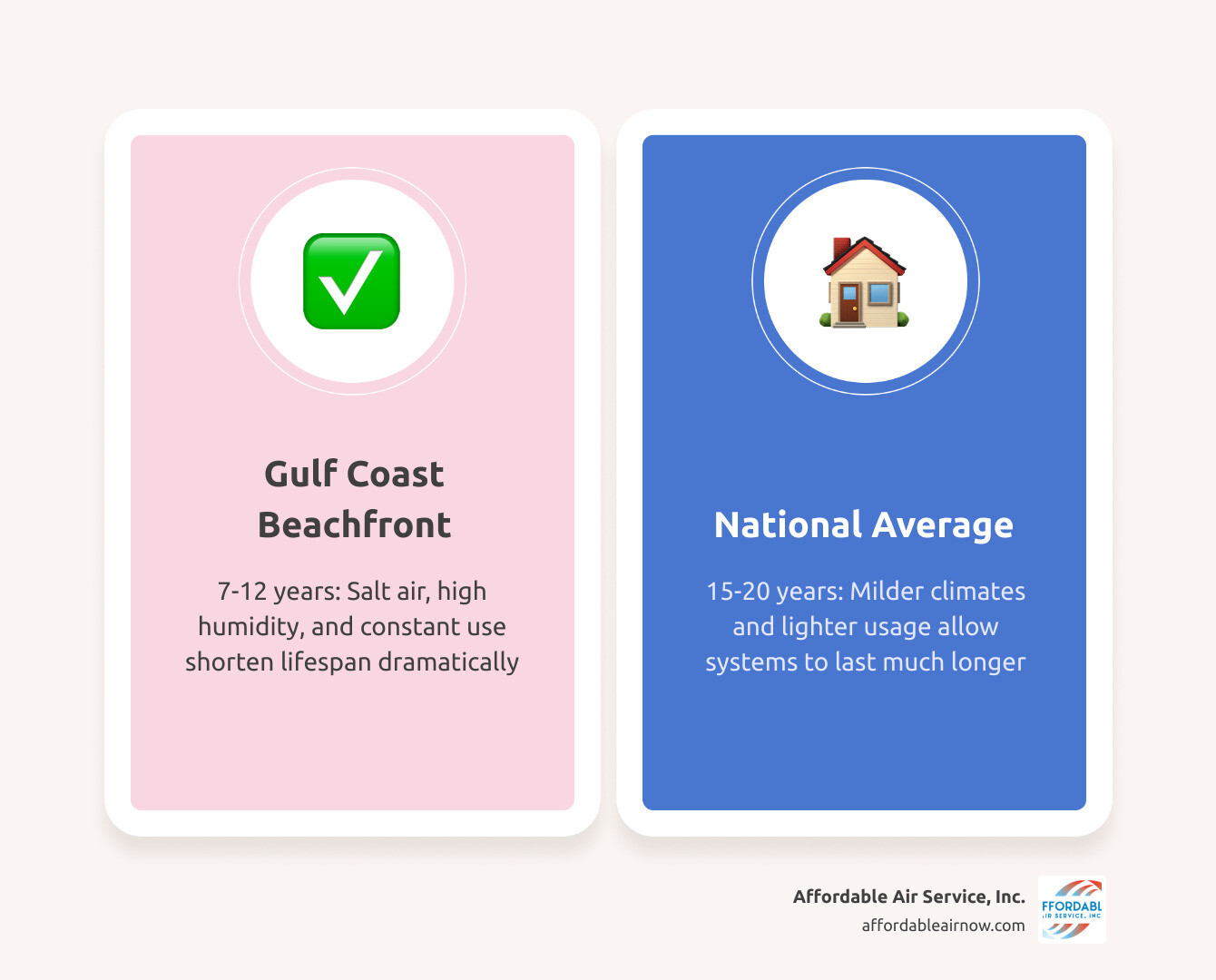
If you’ve been wondering how old is too old for an AC on the Gulf Coast, here’s the short answer: most systems in this region are on borrowed time by age 10, and many don’t make it past 12 to 15 years — significantly sooner than the national average of 15 to 20 years.
Quick Answer by Location:
| Location | Expected AC Lifespan |
|---|---|
| Beachfront / within 1 mile of Gulf | 7-12 years |
| General Gulf Coast / Emerald Coast | 10-14 years |
| Inland Florida | 12-15 years |
| National Average | 15-20 years |
Living along Florida’s Emerald Coast — from Santa Rosa Beach and Destin to Fort Walton Beach and 30A — means your AC works harder, runs longer, and faces conditions that simply don’t exist in most of the country. Salt air, extreme humidity, and near-constant operation wear systems down fast. A unit that might last 18 years in Ohio could fail in 10 years here, or even sooner if it sits close to the water.
This guide walks you through exactly when to start watching your system closely, what warning signs mean it’s time to act, and how to make a smart repair-versus-replace decision before you’re stuck without cool air in the middle of a Gulf Coast summer.
Understanding Lifespan: How Old Is Too Old for an AC on the Gulf Coast?
When you live inland, an air conditioner is an appliance that runs for a few months of the year and sits quietly in mild weather. On the Gulf Coast, your AC is a high-performance athlete running a triple marathon 365 days a year. Because of this relentless workload, we have to look at system age through a completely different lens.
In our humid marine environment, we refer to the ten-year mark as the beginning of a system’s “golden years”—and not always in a relaxing way. If you want to understand the unique toll our climate takes on equipment, it helps to read up on The 10-Year Itch: Average AC Lifespan in Humid Coastal Climates.

While the national average lifespan of a central air conditioner sits comfortably at 15 to 20 years, a system operating along the Emerald Coast has a much shorter life expectancy. Proximity to the salt water of the Gulf of Mexico is the primary driver of this discrepancy.
To help you visualize how location impacts the longevity of your cooling system, we’ve broken down the average lifespans across our service areas:
| Location | Expected Lifespan | Primary Environmental Threat |
|---|---|---|
| Beachfront (e.g., Okaloosa Island, Scenic Highway 30A) | 7 to 12 Years | Severe salt spray and galvanic corrosion |
| Coastal Communities (e.g., Destin, Miramar Beach) | 10 to 14 Years | Humid salt air and heavy summer workloads |
| Inland Towns (e.g., Freeport, DeFuniak Springs) | 12 to 15 Years | High humidity and prolonged cooling seasons |
| National Average (Inland US) | 15 to 20 Years | Standard wear and tear |
If your system is approaching or has passed these thresholds, it is highly recommended to start planning for the future. To protect your home and prevent unexpected breakdowns during the hottest months, check out our guide on how to Don’t Let the Gulf Coast Environment Kill Your HVAC System Early.
Environmental Factors That Shorten Coastal AC Lifespan
Why does our beautiful coastal paradise treat machinery so harshly? The very things that make the Emerald Coast a wonderful place to live—the refreshing sea breeze, the warm sun, and the tropical moisture—are highly destructive to mechanical and electrical equipment.
The combination of salt air, high humidity, and intense storm activity creates a harsh environment for outdoor condenser units. To understand why coastal systems degrade so rapidly, it helps to explore Why Salt Air Is Your HVAC’s Worst Enemy.
How Salt Air Acts as a Silent AC Killer
The primary threat to any coastal air conditioner is salt air. Salt is highly corrosive, but the damage it causes is more complex than simple rusting. When salt deposits settle on an outdoor condenser, they trigger an electrochemical process known as galvanic corrosion.
Your AC condenser relies on two different metals working closely together: copper tubing and aluminum heat-exchanger fins. When salt water or moisture bridges the gap between these two metals, it creates a tiny, slow-motion battery. This electrical reaction degrades the aluminum fins, causing them to turn to dust and crumble away.
Without these critical fins, your system cannot release heat efficiently, which strains the compressor and eventually causes a total system failure. For a deeper look into this process, read about The Silent AC Killer: How Salt Air Corrodes Your System.
The Panhandle Struggle with Humidity and Heavy Runtime
The second major challenge is our heavy cooling workload. In Northwest Florida, summer temperatures regularly hover around 90°F with relative humidity levels exceeding 70%. This forces air conditioners to run almost continuously to keep indoor spaces comfortable.
While a northern AC unit might log 500 to 1,000 compressor hours a year, a system in Destin or Santa Rosa Beach can easily run for 2,500 to 3,500 hours annually. This constant operation accelerates mechanical wear and tear, meaning a 10-year-old coastal unit has often done the equivalent work of a 20-year-old northern system.
Managing this high moisture load is a constant challenge for local cooling systems. You can learn more about this regional issue in our detailed article on The Panhandle Struggle and Your Cooling System.
Key Indicators That Your System Is Nearing Its End
Knowing how old is too old for an AC on the Gulf Coast is only part of the equation. You also need to recognize the physical warning signs that your system is beginning to fail.
When an air conditioner reaches the end of its functional life, it rarely stops working without warning. Instead, it typically displays a series of warning signs, such as reduced airflow, rising utility bills, and more frequent breakdowns. If you notice these symptoms in a system that is over a decade old, it is often a sign that replacement is necessary. For a comprehensive list of these indicators, refer to our guide on AC Replacement Warning Signs.
Performance Failures and How Old Is Too Old for an AC on the Gulf Coast
As an air conditioner ages in our humid climate, its cooling capacity naturally declines. You might notice that your home feels slightly warmer or more humid than it used to, or that the system runs constantly without ever reaching your thermostat’s set temperature.
Common performance warning signs include:
- Inconsistent Temperatures: Some rooms feel cool while others remain warm and humid.
- High Indoor Humidity: The air feels heavy and sticky, which can lead to mold or mildew growth.
- Unusual Noises: Squealing, grinding, or loud clicking sounds from the outdoor unit often indicate failing bearings or a struggling compressor.
- Skyrocketing Energy Bills: A sudden increase in your monthly power bill suggests the system is losing efficiency and working harder to deliver the same amount of cooling.
If you are experiencing these performance issues, it is a good idea to review our checklist of AC Replacement Key Indicators to help determine your next steps.
Refrigerant Phase-Outs and How Old Is Too Old for an AC on the Gulf Coast
Environmental regulations also play a major role in determining whether an older AC is worth keeping. The EPA has phased out several older refrigerants in favor of more environmentally friendly options.
If your system was installed before 2010, it likely uses R-22 (often called Freon), which is now completely banned from production and import. This makes repairs involving refrigerant leaks extremely expensive. Furthermore, older R-410A systems are also facing phase-downs as the industry transitions to newer, highly efficient refrigerants like R-32 and R-454B in 2026.
If your aging unit experiences a major refrigerant leak, the high cost of sourcing legacy refrigerants often makes a complete system replacement the most practical choice. You can learn more about how these regulations affect your home in our guide on When to Consider AC Replacement.
The Repair vs. Replace Decision Framework
When an older air conditioner breaks down, homeowners are faced with a difficult decision: should you pay for a repair, or is it time to invest in a new system?
To make an objective, practical decision, we recommend using a structured framework rather than relying on guesswork. There are two reliable industry standards that can help guide your choice: the 50% Rule and the $5,000 Rule.
The 50% Rule is straightforward: if the cost of a single repair exceeds 50% of the value of a new, modern system, replacement is almost always the smarter financial decision. If you want to explore this choice in more detail, read our article on When It Makes More Sense to Replace Your AC Than Fix It.
Applying the Age-to-Repair Formula (The 5,000 Rule)
The $5,000 Rule is a simple mathematical formula designed to help you evaluate the financial practicality of a repair based on the age of your equipment.
To use this formula, multiply the age of your air conditioning system by the repair quote you received:
$$\text{Age of System (Years)} \times \text{Cost of Repair} = \text{Decision Index}$$
- If the result is under 5,000: A repair is generally a reasonable option, assuming the system has been well-maintained and is otherwise reliable.
- If the result is over 5,000: Investing in a replacement is usually the more practical choice, as you are likely dealing with a system near the end of its life.
For example, if you have a 12-year-old system in Destin that needs a mid-range repair, multiplying those numbers will likely put you well over the 5,000 threshold. In this scenario, spending money on an aging, out-of-warranty unit is often a temporary fix for a system that will likely need more repairs soon.
To learn how to avoid spending money on a failing system, check out our guide: Stop Pouring Money Down the Drain and Replace Your AC.
Proactive Steps to Extend Your AC’s Service Life
While the Gulf Coast climate is tough on air conditioners, you can take proactive steps to protect your system and extend its lifespan.
With consistent care, you can help your unit resist corrosion and maintain its efficiency for as long as possible. If you want to maximize the life of your equipment, we recommend reading our expert advice on how to Extend the Life of Your Air Conditioner.
To keep your system running smoothly, here is a monthly checklist of basic maintenance tasks you can perform at home:
- Change Your Air Filters: Replace your filters every 30 to 90 days, especially during high-use summer months, to maintain proper airflow and reduce strain on the blower motor.
- Wash the Outdoor Condenser: Gently rinse the outdoor unit with a garden hose once a month to wash away salt deposits, sand, and debris from the coils. Never use a pressure washer, as this can bend and damage the delicate aluminum fins.
- Maintain Clearances: Keep a 2-foot clear zone around your outdoor unit. Trim back any bushes, vines, or tall grass that could restrict airflow.
- Clear the Condensate Drain: Flush your indoor drain line with a cup of white vinegar every few months to prevent algae buildup and water damage.
- Install Surge Protection: Coastal storms and lightning are common along the Panhandle. A dedicated HVAC surge protector can shield your system’s electronics from sudden power spikes.
Frequently Asked Questions About Coastal AC Lifespan
Does salt air really shorten AC life?
Yes, salt air significantly shortens the lifespan of air conditioning systems. The salt particles carried by coastal breezes settle on the metal components of your outdoor condenser, initiating galvanic corrosion. This process breaks down the aluminum fins and copper coils, reducing heat transfer and forcing the compressor to work harder. Without specialized protective coatings, beachfront units can experience critical failures in as little as 5 to 7 years.
Can I rinse my outdoor unit to remove salt?
Yes, rinsing your outdoor condenser unit is one of the most effective ways to combat salt corrosion. We recommend gently spraying the coils with a standard garden hose once a month. Make sure the system is turned off before you begin, and avoid using pressure washers or harsh chemical cleaners, as these can easily damage the delicate aluminum fins.
Does a new HVAC system help sell a home faster on the Gulf Coast?
Absolutely. Buyers along the Emerald Coast understand how critical a reliable air conditioner is to home comfort and safety. A new, energy-efficient system with a transferable warranty provides peace of mind, lowers expected utility bills, and eliminates the immediate worry of an expensive replacement. To learn more about how a system upgrade can affect your property’s market appeal, read Does a New HVAC Help Sell Your Home Faster? The Cold Hard Truth.
Conclusion
Determining how old is too old for an AC on the Gulf Coast is all about understanding our unique local climate. While a system inland might last up to two decades, our humid, salt-heavy environment along the Emerald Coast means a unit is typically considered old once it reaches double digits.
Whether you need a quick repair in Fort Walton Beach, routine maintenance in Destin, or are ready to explore a high-efficiency replacement in Santa Rosa Beach, our team at Affordable Air Service is here to help. As a locally owned and operated company, we understand the unique demands that coastal life places on your home’s HVAC system.
We are proud to offer dependable 7-day service, free estimates on system replacements, and flexible financing options through GoodLeap to make your upgrade as smooth as possible. As an authorized Daikin dealer, we specialize in durable, corrosion-resistant systems like the Daikin Fit, backed by the Daikin Comfort Promise to ensure your home remains a cool, comfortable sanctuary year-round.
Don’t wait for your aging system to fail during the hottest part of the year. Contact us today or visit our Affordable Air Service page to schedule your system evaluation and keep your home comfortable through every season.