


How a New HVAC System Increases Home Value: What Emerald Coast Sellers Need to Know
How a new HVAC system increases home value is one of the most practical questions a homeowner can ask before listing a property — and the answer matters more than most people expect.
Here’s a quick summary of what the data shows:
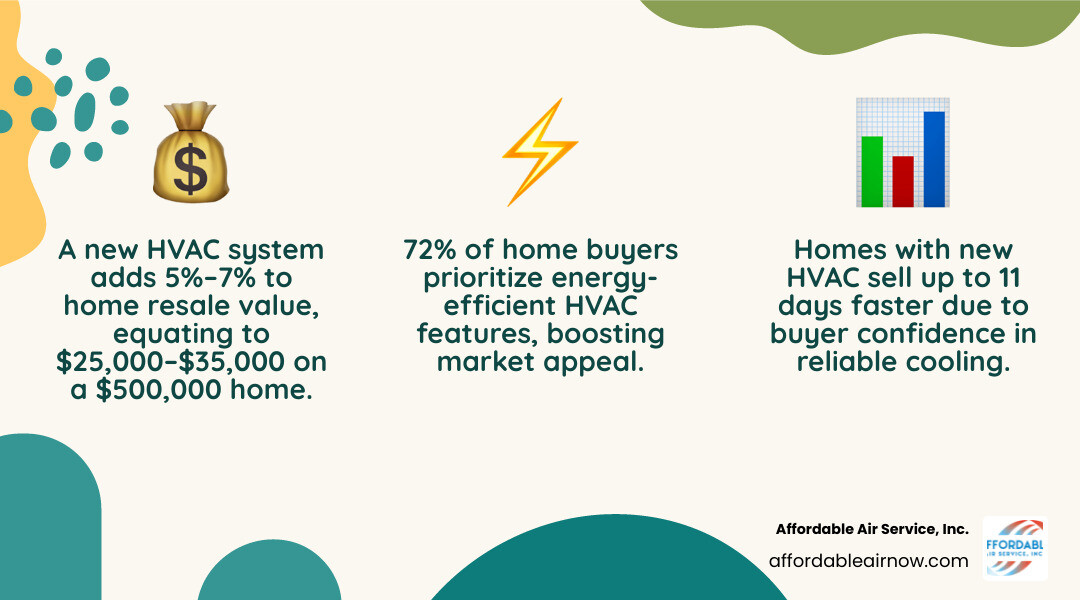
- Value added: A new HVAC system typically adds 5%–7% to a home’s resale value
- Dollar impact: For a $500,000 home, that’s roughly $25,000–$35,000 in added value
- ROI range: Most homeowners see a return of around 30%–50% on their HVAC investment
- Sale speed: Homes with a new or recently upgraded HVAC system can sell up to 11 days faster
- Buyer appeal: 72% of buyers actively look for energy-efficient features when shopping for a home
- Appraisal boost: Appraisers can adjust valuations upward by $2,000–$5,000 for documented, high-efficiency systems
- Financing requirement: Lenders often won’t approve loans for homes with non-functional HVAC — making a working system essential, not optional
On the Emerald Coast, where summer heat and humidity push HVAC systems hard year-round, buyers pay close attention to the age and condition of heating and cooling equipment. An outdated or failing system can stop a deal in its tracks — or hand buyers serious negotiating leverage during inspections.
The good news? A properly installed, high-efficiency system does more than just keep the house comfortable. It signals to buyers that the home has been well cared for, reduces their worry about near-term repair costs, and can genuinely move the needle on your final sale price.
For a deeper look at keeping your system in peak shape, see Why Regular HVAC Service is Essential.
The Real Numbers: How a New HVAC System Increases Home Value
When we talk about property equity, we often focus on the “pretty” things—granite countertops, fresh LVP flooring, or a coastal-themed kitchen. But in 2026, the “invisible” bones of the house are carrying more weight than ever. Data shows that how a new hvac system increases home value isn’t just a marketing claim; it’s a reflected reality in closing statements across Santa Rosa Beach and Destin.
While a kitchen remodel might offer a “wow” factor, it’s a subjective choice. A new HVAC system, however, is a universal win. For a mid-sized home in our area, a modern installation can boost the total value of your home by 5% to 10% in markets where reliable air conditioning is a non-negotiable necessity.
Beyond the raw percentage, there is the “Peace of Mind” factor. Buyers in 2026 are wary of “surprise” expenses. When a listing highlights a brand-new system with a transferable warranty, it removes a massive financial question mark from the buyer’s mind. This often leads to stronger initial offers and a much smoother path through the inspection period.
How a New HVAC System Increases Home Value Through Energy Efficiency
In our humid Florida climate, the air conditioner isn’t just a luxury; it’s the hardest-working appliance in the house. This is where SEER2 (Seasonal Energy Efficiency Ratio) ratings become a major selling point. Older units often struggle with ratings below 13, whereas modern high-efficiency systems can reach 18 to 21 or higher.
For a buyer, a high-efficiency system translates to monthly utility savings of $50 to $300. In a world of rising energy costs, showing a history of low power bills—backed by a new unit—is a powerful closing tool. We always recommend following Preventative HVAC Maintenance Tips to keep those efficiency numbers high, ensuring your home remains competitive against newer builds in Freeport or Miramar Beach.
How a New HVAC System Increases Home Value During the Appraisal Process
Appraisers don’t just look at how a house looks; they look at how it functions. A professional appraiser uses a checklist that specifically notes the age and condition of major mechanical systems. If your neighbor’s house sold for a premium but had a 15-year-old furnace, and your home has a brand-new, high-efficiency heat pump, the appraiser can justify a positive adjustment to your home’s valuation.
Documentation is your best friend here. Providing the appraiser with receipts, permit records, and Understanding the HVAC Service Process documentation proves the upgrade was done professionally. This turns a “working AC” into a “documented capital improvement,” which is exactly what you need to see that equity growth on paper.
Choosing the Best System Type for Santa Rosa Beach Resale
Not all HVAC systems are created equal when it comes to resale. In the Florida Panhandle, the type of system you choose can dictate how much value you actually recoup.
| HVAC System Type | Typical Home Value Boost | Best Use Case |
|---|---|---|
| Air Source Heat Pumps | $1,260 – $2,280 | Most versatile for Florida’s mild winters and hot summers. |
| Central Air Conditioning | $1,170 – $2,370 | The “gold standard” for traditional single-family homes. |
| Ductless Mini-Splits | $600 – $4,350 | Perfect for Florida rooms, additions, or older homes without ducts. |
| Geothermal Systems | $1,300 – $7,300 | High-end luxury market; maximum energy efficiency. |
For many homeowners in Santa Rosa Beach, a high-efficiency heat pump offers the best balance of cost and return. These systems provide both heating and cooling efficiently, which is a major draw for eco-conscious buyers. If you are looking for specific regional advice, checking out HVAC Resources Santa Rosa Beach FL can help you align your choice with local market expectations.
Signs Your Current Unit is Tanking Your Property Value
If you’re planning to sell in the next year, your old HVAC unit might be a “red flag” in disguise. Even if it’s currently blowing cold air, certain factors can make a buyer (and their inspector) nervous.
- The Age Factor: Most systems have a lifespan of 10 to 15 years in coastal environments. If yours is pushing 12, buyers will already be calculating the cost of a replacement into their offer.
- R-22 Refrigerant: If your unit was manufactured before 2010, it likely uses R-22 (Freon), which has been phased out. Repairs on these units are incredibly expensive, and savvy buyers know it.
- Inconsistent Cooling: Are there “hot spots” in the master bedroom? These are AC Replacement Warning Signs that suggest the ductwork or the unit itself is failing.
- The “Clunk”: If your unit sounds like a freight train every time it kicks on, it’s one of the most obvious HVAC System Repair Needs Signs that will scare off potential buyers during a walkthrough.
Knowing When to Consider AC Replacement before you list can save you from a collapsed deal later on.
Strategic Timing: Should You Replace Before Listing?
The “Cold Hard Truth” is that you shouldn’t always replace your HVAC right before selling. If your system is only 7 years old and has been well-maintained, a full replacement won’t give you a 1:1 return. In that case, it’s better to invest in a professional tune-up and cleaning to Extend the Life of Your Air Conditioner and provide the service records to the buyer.
However, if your system is failing or over 15 years old, replacing it before you list gives you the upper hand. You control the cost and the choice of system. If you wait for the buyer’s inspection to reveal a dead unit, you’ll likely end up paying for the most expensive “emergency” replacement or giving a massive price credit that exceeds the actual cost of the unit.
Does a new HVAC system increase home value more than a kitchen remodel?
In terms of pure ROI percentage, HVAC often wins. While a kitchen remodel might recoup 60-70% of its cost, a functional necessity like a new HVAC system—especially when the old one was broken—can essentially “save” the sale. In 2026, buyers are prioritizing “move-in ready” mechanicals over cosmetic upgrades because they can finance the home, but they might not have $15,000 in cash to replace an AC unit the month after they move in.
What are the tax benefits for installing a new system in 2026?
The financial landscape for HVAC has changed significantly thanks to the Inflation Reduction Act. Homeowners in 2026 can often take advantage of federal tax credits that cover up to 30% of the cost of energy-efficient heat pumps (up to a $2,000 annual limit). When you combine these federal incentives with local utility rebates, the net cost of the system drops, which significantly improves your overall ROI when you sell.
How does a new HVAC affect the speed of a home sale?
Speed is often as important as price. Homes with new HVAC systems sell faster because they pass inspections with flying colors. You avoid the “negotiation slog” where buyers ask for $10,000 off the price because the furnace is old. By checking off AC Replacement Key Indicators early, you present a “low-risk” property that attracts more offers.
Conclusion
At the end of the day, your HVAC system is the engine of your home. You wouldn’t try to sell a luxury car with a smoking engine, and you shouldn’t try to sell an Emerald Coast home with a failing AC. How a new hvac system increases home value is through a combination of higher appraisals, lower utility bills for the new owner, and the ultimate “peace of mind” that comes with a Daikin Comfort Promise.
At Affordable Air Service, Inc., we’ve spent years helping homeowners in Santa Rosa Beach, Destin, and Fort Walton Beach maximize their home’s potential. Whether you need a free estimate for a replacement or a thorough tune-up to impress potential buyers, we are here 7 days a week to help.
Ready to boost your home’s market value? More info about our professional HVAC services is just a click away.