


How Long Does an AC Last on the Gulf Coast? (The Short Answer)
How long does an ac last on the Gulf Coast is one of the most common questions homeowners here ask — and the answer is shorter than most people expect.
Here’s a quick breakdown:
| Location | Expected AC Lifespan |
|---|---|
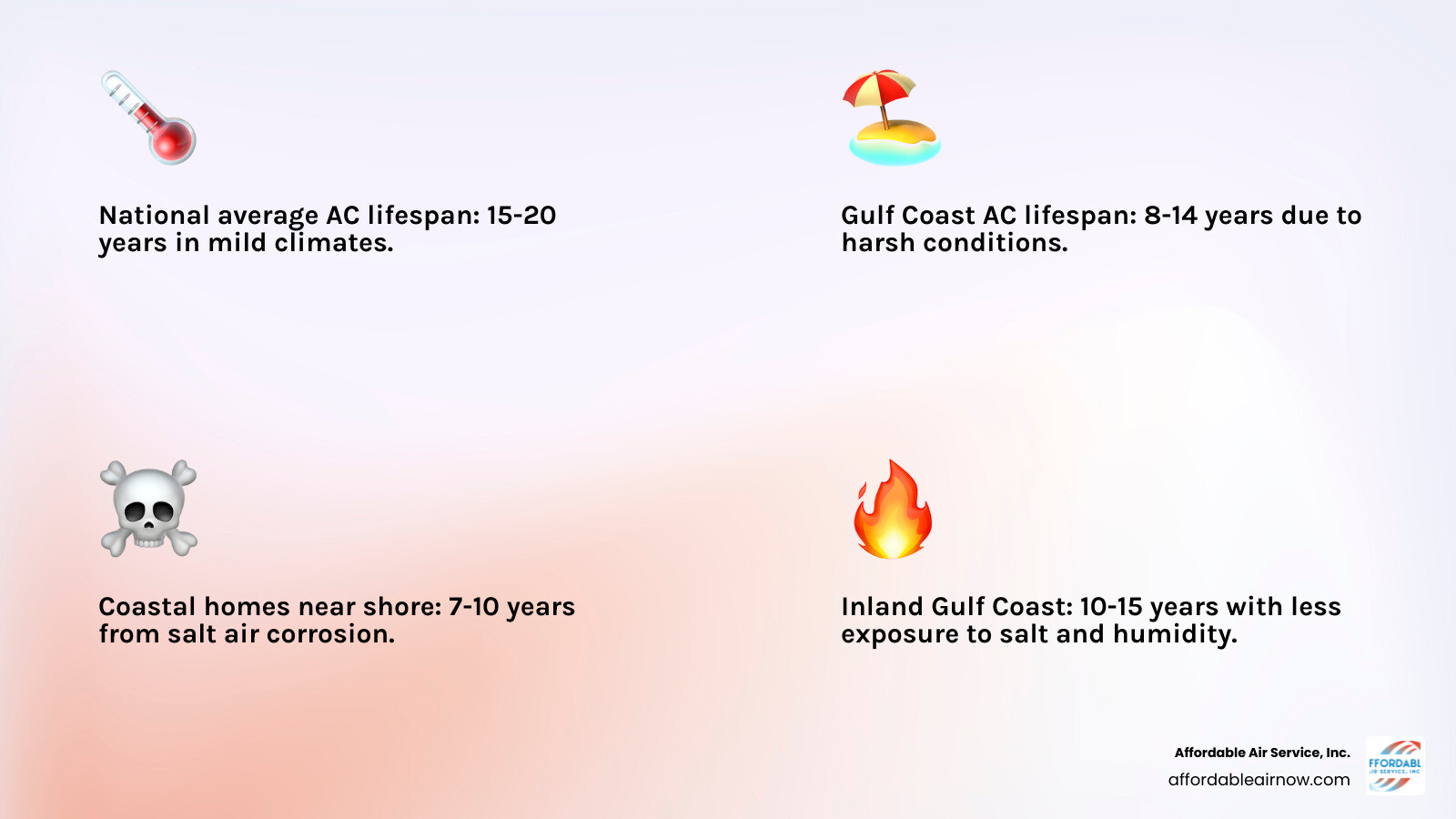
| National average (mild climate) | 15-20 years |
| Florida Gulf Coast (general) | 8-14 years |
| Coastal homes (within miles of shore) | 7-10 years |
| Inland Gulf Coast homes | 10-15 years |
If you live near the water in places like Santa Rosa Beach, Destin, or Miramar Beach, your AC is fighting salt air, extreme humidity, and near-constant heat every single day. That combination adds up fast.
Nationally, a well-maintained central AC system can run for 15 to 20 years. On the Gulf Coast, that same unit often wears out in 8 to 14 years — sometimes sooner if it sits close to the shore without proper protection. Coastal homes without protective coatings on their AC components can see systems fail in as little as 7 years.
The good news? Knowing what shortens your system’s life is the first step to doing something about it.
Understanding How Long Does an AC Last on the Gulf Coast
When we talk about the “average” lifespan of an air conditioner, we have to look at the context. In a temperate climate where the AC only runs from June to August, a unit is barely breaking a sweat. But here in Florida, our systems are the marathon runners of the appliance world.
The national average for a central AC unit is typically cited as 15 to 20 years. However, the Florida reality is much different. On the Gulf Coast, we usually see systems reaching their “retirement age” between 8 and 14 years. If you are living right on the water in Okaloosa Island or Destin, that window can shrink even further to 7 or 10 years.
Why the massive gap? It comes down to proximity. The closer you are to the Gulf, the more “environmental stress” your unit endures. Salt air is a silent killer of metal components, and the sheer volume of work the machine does to keep up with our 90-degree days with 80% humidity is staggering.
We often tell our neighbors that at the 10-year mark, it’s time to start keeping a close eye on performance. This is the period we call the “10-year itch,” where repairs start becoming more frequent and efficiency begins to nose-dive. Knowing When To Consider Ac Replacement/ can save you from a mid-July breakdown when the heat index is in the triple digits.
| Factor | Inland Florida (e.g., DeFuniak Springs) | Coastal Florida (e.g., Santa Rosa Beach) |
|---|---|---|
| Average Lifespan | 12-15 Years | 7-10 Years |
| Salt Exposure | Low to Moderate | High |
| Annual Run Time | ~2,500 Hours | ~3,000+ Hours |
| Primary Threat | Heat/Usage | Salt Corrosion/Humidity |
Environmental Factors That Shorten AC Lifespan in Florida
It isn’t just one thing that wears down your AC; it’s a tag-team effort by the Florida climate. One of the biggest technical reasons for shorter lifespans is “thermal cycling fatigue.” In cooler states, an AC unit might cycle on and off a few times a day. In Florida, your system might log over 3,000 compressor hours in a single year. To put that in perspective, that is more than double the runtime of a unit in the Midwest.
This high heat load means the internal parts—the fan motor, the compressor, and the capacitors—are under constant electrical and mechanical stress. When a machine works that hard, parts simply wear out faster. We see this manifest in several ways, and staying ahead of Ac Replacement Warning Signs/ is essential for every homeowner from Freeport to Ft Walton Beach.
The Impact of Salt Air on How Long Does an AC Last on the Gulf Coast
If heat is the brute force, salt air is the “silent killer.” For those of us living near the coast, the air is filled with microscopic salt particles. When your outdoor condenser unit pulls in air to cool the refrigerant, it also pulls in those corrosive particles.
Salt causes rapid metal oxidation. It eats away at the delicate aluminum fins on your coils, leading to “coil perforation.” Once the coils are pitted and thin, they can’t transfer heat efficiently, and eventually, they will leak refrigerant. Without protective coatings (like epoxy or specialized coastal sprays), a standard unit can look like it’s 20 years old after just five years of coastal exposure. This is why we emphasize that you should Keep Your Santa Rosa Beach Home Breezy With Proper Ac Maintenance/ specifically designed for salt mitigation.
Humidity and Usage Patterns
Humidity is the other half of the battle. An air conditioner has two jobs: lowering the temperature and removing moisture from the air. In our humid Gulf Coast climate, the dehumidification load is massive.
When humidity levels stay above 70%, your AC has to run longer cycles just to make the air feel comfortable. This constant moisture also creates a breeding ground for mold and biological growth inside the air handler and on the evaporator coils. If these coils aren’t cleaned regularly, the buildup acts as an insulator, forcing the system to work even harder and shortening its life. This is exactly Why Regular Hvac Service Is Essential/ in our region—it isn’t just about comfort; it’s about preventing the system from literally working itself to death.
Maximizing Longevity Through Strategic Maintenance
While the environment is harsh, you aren’t powerless. The difference between an AC that lasts 8 years and one that lasts 14 years usually comes down to maintenance. We have seen systems in Miramar Beach that reached 15 years because the homeowners were diligent.
The most basic step is the one most often forgotten: filter changes. In Florida, we recommend checking your filters every 30 days. A clogged filter restricts airflow, which causes the evaporator coil to freeze and puts immense strain on the compressor. Beyond the basics, following Preventative Hvac Maintenance Tips/ like keeping the outdoor unit clear of debris can add years to your system’s life.
Essential Tips for How Long Does an AC Last on the Gulf Coast
For our coastal neighbors, we have a few “secret weapons” for longevity:
- Freshwater Rinsing: Once a month, use a gentle stream from a garden hose to rinse the salt off your outdoor condenser coils. Don’t use a pressure washer (that will bend the fins!), but a light rinse helps wash away the salt before it can eat into the metal.
- Clearance Zones: Ensure there is at least 2 to 3 feet of clear space around your outdoor unit. Overgrown bushes or stored items trap heat and moisture, accelerating rust.
- Surge Protection: Our coastal storms bring lightning and power surges. A dedicated HVAC surge protector can save your expensive control boards and compressor from a sudden death.
By taking these steps, you can Extend The Life Of Your Air Conditioner/ and delay the need for a major investment.
System Specifics: Central AC vs. Mini-Splits
Not all systems age the same way. Central AC units are the standard, but we are seeing more homeowners opt for ductless mini-splits. Interestingly, mini-splits often have a slightly longer lifespan in coastal areas—sometimes 12 to 20 years. This is partly because they don’t suffer from duct leakage (which can account for 30% of energy loss in central systems) and their components are often designed with high-efficiency, variable-speed technology that reduces the “thumping” stress of traditional on/off cycles.
Whether you have a traditional split system or a modern heat pump, The Secret To Long Lasting Ac Installation Maintenance In Destin Fl/ is consistent, professional attention twice a year.
When to Repair vs. Replace Your Coastal HVAC System
Eventually, every system reaches a point of no return. But how do you know when you’ve hit it? We generally recommend two rules of thumb:
- The 50% Rule: If the cost of a single repair is more than 50% of the value of a new system, it’s time to replace.
- The $5,000 Rule: Multiply the age of the unit by the cost of the repair. If the result is more than $5,000, replacement is usually the smarter financial move. (For example, a $600 repair on a 10-year-old unit equals $6,000—time to replace).
Another major factor in April 2026 is refrigerant. If your older system still uses R-22 (Freon), repairs have become prohibitively expensive due to the environmental phase-out. Investing in a new system often pays for itself through lower energy bills and fewer emergency calls. We encourage homeowners to look at Ac Replacement Key Indicators/ before the unit fails completely.
Features to Look for in a New Unit
If you are shopping for a new unit on the Gulf Coast, don’t just buy the cheapest model. You need a system built for the “Salt Life.” Look for:
- High SEER2 Ratings: In Florida, a higher efficiency rating (16 or higher) is a must to keep energy bills manageable during the long summer.
- Variable-Speed Compressors: These units can “throttle down” to run at lower speeds, which provides superior dehumidification and less wear and tear than older single-speed models.
- Corrosion-Resistant Coatings: Many manufacturers now offer “coastal” models with epoxy-coated coils or all-aluminum “Spine Fin” coils that resist salt better than traditional copper/aluminum combos.
Learning How To Maintain Your New Ac Installation In Ft Walton Beach/ starts with choosing the right equipment from day one.
Frequently Asked Questions about Gulf Coast AC Lifespan
Can an AC unit last 20 years in Florida?
While it is technically possible, it is extremely rare on the Gulf Coast. A unit reaching 20 years would likely need to be located far inland (like DeFuniak Springs), be meticulously maintained with bi-annual service, and have several major parts (like the fan motor or capacitors) replaced along the way. Most systems are mechanically “tired” by year 15.
Does salt air really destroy air conditioners?
Yes. Salt air acts as a corrosive catalyst. It creates a chemical reaction that pits the metal of the condenser coils. Once those coils are compromised, the system loses its ability to transfer heat, the compressor has to work harder, and eventually, the refrigerant leaks out. It is the leading cause of premature AC failure in coastal neighborhoods.
What is the best month to replace an AC on the Gulf Coast?
April is arguably the best month. It is the “shoulder season” before the extreme summer heat hits. By replacing in April, you avoid the “summer rush” when HVAC companies are backed up with emergency repairs. You’ll also ensure your home is ready for the first 90-degree day of the year.
Conclusion
Living on the Gulf Coast is a dream, but it requires a realistic approach to home maintenance. Understanding how long does an ac last on the Gulf Coast helps you plan ahead so you’re never left sweating in your own living room. Whether you are in Santa Rosa Beach, Miramar Beach, or Destin, your air conditioner is your home’s most important appliance.
At Affordable Air Service, Inc., we specialize in helping our neighbors navigate these coastal challenges. From our Daikin Comfort Promise to our specialized maintenance plans, we are dedicated to keeping your home comfortable for as long as possible. Once you have a new system, be sure to check out Post Replacement Ac Maintenance Tips For Miramar Beach Homeowners/ to keep it running strong.
Don’t wait for your unit to give up the ghost. Avoid Ac Repairs Preventative Measures/ by staying proactive. If your unit is hitting that “10-year itch,” we can help you evaluate its health and plan for the future.
Schedule your professional AC assessment today and let us help you keep your cool on the Coast!