


How to Decide Between AC Repair and Replacement (And Save Money Doing It)
How to decide between AC repair and replacement comes down to a few key factors: your system’s age, the cost of the repair, how often it breaks down, and how well it’s still cooling your home.
Here’s a quick breakdown to guide your decision:
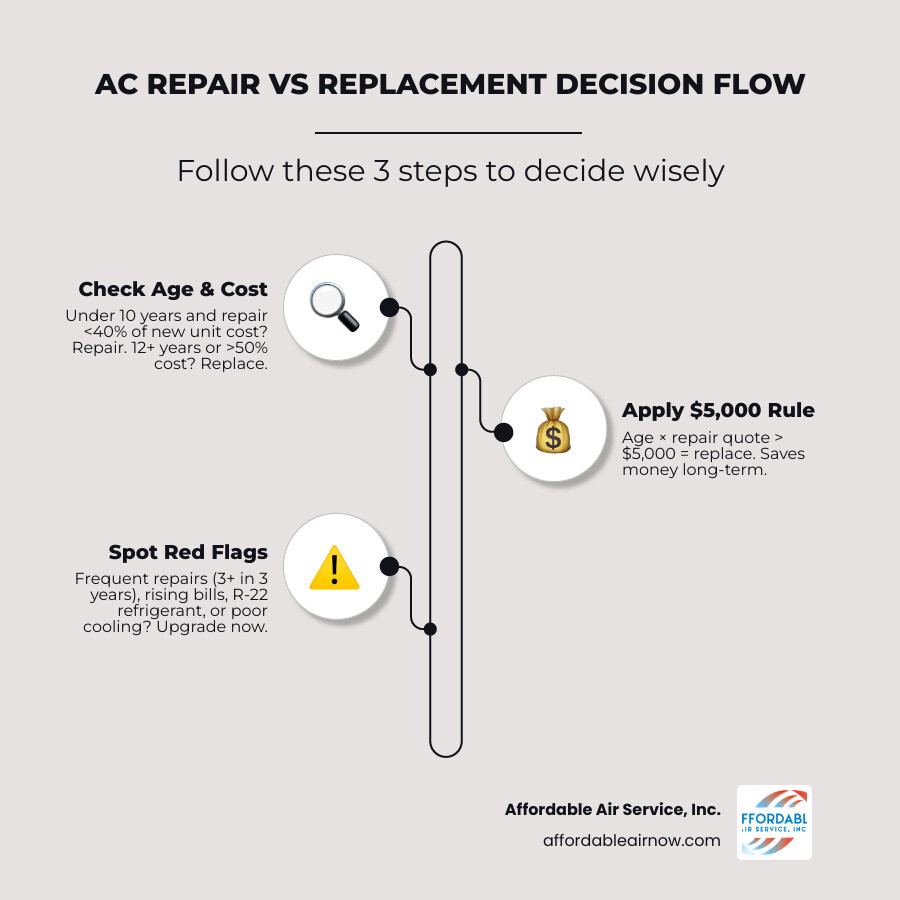
- Repair your AC if it’s under 10 years old, the issue is minor, and the repair cost is less than 30–40% of a new unit’s price
- Replace your AC if it’s 12–15+ years old, needs frequent repairs, uses R-22 refrigerant, or repair costs exceed 50% of replacement cost
- Use the $5,000 Rule: Multiply your AC’s age by the repair quote — if the result is over $5,000, replacement is usually the smarter move
- Use the 50% Rule: If the repair costs half or more of what a new system would cost, replace it
- Watch for red flags: Rising energy bills, uneven cooling, strange noises, or 3+ repairs in the last 3 years all point toward replacement
For most Santa Rosa Beach homeowners, the decision isn’t always obvious. Your AC works hard in Florida’s heat and humidity almost year-round — and when it starts struggling, the cost of doing nothing can quietly add up. A unit that’s “mostly working” but running inefficiently could be costing you more each month than a new system would over time.
The sections below walk you through each decision factor in detail so you can make a confident, informed choice.
The Financial Formulas: How to Decide Between AC Repair and Replacement
When we visit homes in Miramar Beach or Destin, the first question we usually get isn’t “Can you fix it?” but “Is it worth fixing?” To take the guesswork out of it, the HVAC industry uses two primary financial formulas. These aren’t just guesses; they are mathematical ways to see if you are “throwing good money after bad.”
The first is the $5,000 Rule. This is a simple multiplication trick: take the age of your AC unit and multiply it by the repair estimate you just received. If the total is more than $5,000, it is statistically better to invest that money into a new system. For example, if you have a 10-year-old unit and the repair is $600, that equals $6,000. In this case, we would recommend replacement. If the repair was only $300, the total would be $3,000, making the repair a reasonable gamble.
The second is the 50% Rule. This one is even more straightforward. If the cost of the repair is 50% or more of the price of a brand-new unit, you should almost always choose the replacement. Why? Because a repair only fixes one specific part. It doesn’t reset the “clock” on the rest of the aging components. You could pay for a major repair today only to have a different expensive part fail next month.
Beyond the immediate quote, we look at the AC Repair Key Indicators like repair frequency. If you’ve had three or more service calls in the last three years, your “repair” costs are actually a down payment on a new unit—you just haven’t realized it yet.
Evaluating System Age and Performance in Santa Rosa Beach
In our corner of Florida, from Freeport to Okaloosa Island, the environment is tough on machinery. Between the high humidity and the salt air near the Gulf, the typical lifespan of a central AC unit is roughly 10 to 15 years. While units in drier climates might last 20 years, our local systems work much harder for much longer.
As of April 2026, the standards for efficiency have changed significantly. If your unit was installed before 2015, it is likely reaching the end of its reliable life. ENERGY STAR guidelines suggest that if your AC is over 10 years old, you should start planning for its retirement. Waiting for a total system failure in the middle of a July heatwave is never a good strategy. By knowing when to consider AC replacement, you can shop for a new system on your own terms rather than in an emergency.
How to Decide Between AC Repair and Replacement Based on Efficiency
Efficiency isn’t just a buzzword; it’s a direct reflection of your monthly budget. Older units typically have lower SEER (Seasonal Energy Efficiency Ratio) ratings, often around 8 or 10. Modern SEER2 standards, which became the baseline in 2023, mean that new units are significantly more efficient.
If you notice your utility bills rising every summer even though you haven’t changed your habits, your AC is likely struggling. It’s losing the ability to remove humidity and heat efficiently, which means it runs longer to do the same job. New high-efficiency units can save you 20% to 40% on your monthly energy costs. Over the course of a few Florida summers, those savings can actually pay for a significant portion of the new unit. Watching for these AC replacement warning signs can save you from months of overpaying the electric company.
How to Decide Between AC Repair and Replacement When Major Parts Fail
Not all repairs are created equal. Some are “maintenance” repairs, while others are “catastrophic” failures.
| Minor Repair (Usually Fix It) | Major Failure (Consider Replacing) |
|---|---|
| Clogged condensate drain line | Failed Compressor |
| Blown Capacitor | Leaking Evaporator Coils |
| Faulty Thermostat | Burned-out Blower Motor |
| Dirty Air Filter or Coils | Corroded Condenser Coils |
If your compressor fails and the unit is out of warranty, that is the “heart” of the system. Replacing it is expensive and doesn’t guarantee the rest of the aging system won’t fail soon. Similarly, leaking coils are a sign of systemic wear. We often find that common AC repair issues and solutions work great for younger units, but for older systems, these major failures are a signal that the equipment is tired.
Critical Indicators for Immediate System Upgrades
Sometimes, the decision is made for us by regulations or safety concerns. The most significant factor for older homes in Miramar Beach and DeFuniak Springs is the type of refrigerant the system uses.
If your unit was built before 2010, it likely uses R-22 (often called Freon). The production and import of R-22 were phased out completely by 2020 because it harms the ozone layer. Today, R-22 is extremely scarce and incredibly expensive. If an old R-22 system develops a leak, the cost of the refrigerant alone can be staggering. Most current units use R-410A, which is also beginning a transition toward newer, even more eco-friendly refrigerants like R-454B. If you are still running an R-22 unit, any major refrigerant-related issue is a clear sign to upgrade.
Safety is the other non-negotiable factor. While AC units are generally safe, electrical issues can pose fire hazards, and if you have a packaged system that includes gas heating, carbon monoxide leaks are a critical danger. If we detect cracked heat exchangers or significant electrical melting, we will recommend immediate replacement to protect your family. Recognizing these HVAC system repair needs signs is essential for home safety.
Maximizing Your Investment with Modern HVAC Technology
If you do decide to replace, you aren’t just getting a “new version” of what you had—you are getting a massive technology upgrade. Modern HVAC systems offer features that simply didn’t exist 15 years ago.
Variable-speed technology is a game-changer for Florida. Instead of being “all on” or “all off,” these units can run at lower speeds to maintain a constant temperature and, more importantly, constantly pull humidity out of the air. This makes your home feel cooler at a higher temperature setting.
Zoning systems allow you to cool the living room during the day and the bedrooms at night without wasting energy on empty rooms. When choosing professional AC installation, you also gain the peace of mind that comes with a 10-year manufacturer warranty, something a repair can never provide.
Frequently Asked Questions About AC Decisions
What is the $5,000 rule for air conditioners?
The $5,000 rule is a financial guideline used to determine if a repair is worth the investment. You multiply the age of the unit by the cost of the repair. If the result is over $5,000, it’s time to replace. For example, a 12-year-old unit needing a $500 repair ($6,000) should be replaced. This helps homeowners look past the immediate “cheap” fix and see the long-term cost of keeping an old machine running. Recognizing professional AC repair signs early can sometimes help you catch issues before they reach this expensive threshold.
How many repairs are too many for an old AC?
A good rule of thumb is “three strikes and you’re out.” If you have needed three or more significant repairs in the last three years, the system’s reliability is gone. Frequent breakdowns are a sign of systemic wear and tear. Constant common HVAC repair issues eventually add up to more than the cost of a new, reliable system that won’t leave you sweating on a Sunday afternoon.
Should I replace my indoor and outdoor units at the same time?
Yes, absolutely. HVAC systems are designed to be “matched systems.” The indoor evaporator coil and the outdoor condenser are engineered to work together to achieve a specific efficiency rating (SEER2). If you replace the outdoor unit but keep an old indoor coil, the system will operate at a much lower efficiency, may fail prematurely, and will likely void the manufacturer’s warranty. Understanding the AC installation process helps you see why a complete, matched system is the only way to ensure the performance you’re paying for.
Conclusion
Living in Santa Rosa Beach and the surrounding areas means relying on your air conditioner for comfort and health. Deciding how to decide between AC repair and replacement doesn’t have to be a stressful experience. By using the $5,000 rule, checking your system’s age, and considering the long-term energy savings of a new unit, the right path usually becomes clear.
At Affordable Air Service, Inc., we understand that a new AC is a big investment. That’s why we offer the Daikin Comfort Promise, easy financing options, and 7-day service to ensure you’re never left in the heat. Whether you need a simple fix to get through the season or a full system upgrade to lower your bills, our team is here to provide honest, expert guidance.
Schedule your professional AC assessment today and let us help you find the most cost-effective way to keep your home cool and comfortable.