


Understanding the Main Florida Energy Rebate Programs
Knowing how to apply for energy rebates in Florida can put thousands of dollars back in your pocket — but most homeowners never claim a cent because the process feels overwhelming. Here’s a quick look at how it works:
How to Apply for Energy Rebates in Florida — Quick Steps:
- Identify your program — Federal (HEAR or HOMES), utility (Duke Energy, FPL, Florida Public Utilities), or both
- Check eligibility — Income level, home type, and equipment requirements vary by program
- Register or create an account — For federal programs, sign up at the Florida Energy Saver Program portal
- Schedule an energy assessment — Required for HOMES program; confirms your projected savings
- Choose qualified equipment and a licensed contractor — Equipment must meet minimum SEER/SEER2 ratings and be AHRI-certified
- Collect your documents — Installation invoice, AHRI certificate, proof of residence, utility account number, and photos
- Submit your application — Online or by mail, depending on the program
Florida has been approved to receive $346 million in federal funding through the Inflation Reduction Act’s Home Energy Rebates Program. That money flows through two main federal channels — the HEAR program (up to $14,000 for low- and moderate-income households) and the HOMES program (up to $16,000 for qualifying energy efficiency upgrades) — plus additional rebates from local utilities like Duke Energy and Florida Public Utilities.
Air conditioners older than 10 years can use up to 60% more energy than newer models, according to the U.S. Department of Energy. For homeowners on Florida’s Emerald Coast dealing with year-round heat and humidity, upgrading to a high-efficiency system isn’t just about comfort — it’s one of the smartest ways to reduce monthly energy bills. And with the right rebates stacked together, the upfront cost becomes a lot more manageable.
This guide breaks down every program, every step, and every document you need to claim what you’re owed.
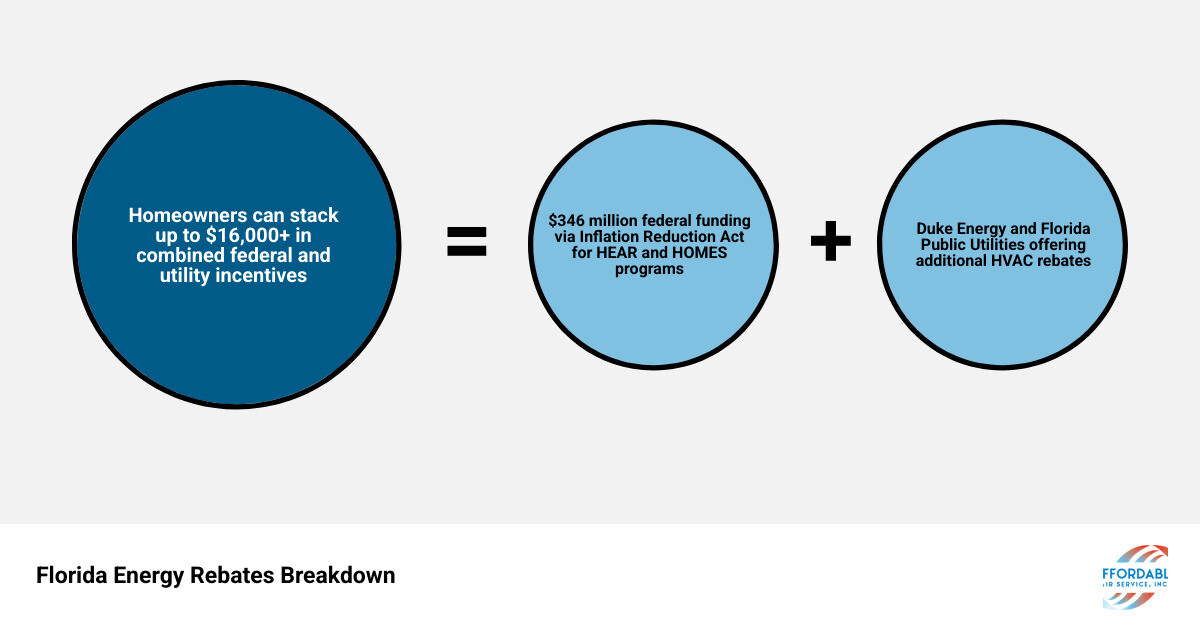
Navigating the energy efficiency landscape in Florida requires looking at both federal and local opportunities. By learning How to Score Florida Energy Rebates for HVAC Upgrades, you can position yourself to maximize your savings. The primary programs available to Florida residents are split between federally funded state-administered programs and utility-specific rebates.
| Program Name | Source | Maximum Rebate | Key Eligibility Requirements |
|---|---|---|---|
| HEAR Program | Federal (IRA) | Up to $14,000 | Income under 150% Area Median Income (AMI); specific electric equipment purchases |
| HOMES Program | Federal (IRA) | Up to $8,000 (standard) / $16,000 (low-income) | Modeled energy savings of 20% or more; whole-home approach |
| Duke Energy Rebates | Local Utility | Up to $3,800 (combined) | Must be a residential customer; pre-upgrade Home Energy Check required |
| Florida Public Utilities (FPU) | Local Utility | $100 customer rebate + dealer incentive | Electric customer; ducted system; minimum 15.0 SEER/SEER2 equipment |
Understanding these distinctions is the first step toward mapping out your home upgrades. While federal initiatives focus heavily on income levels and modeled home performance, local utility programs are open to almost all customers who install equipment meeting specific technical criteria.
Federal HEAR and HOMES Programs in Florida
The Inflation Reduction Act has funded two distinct federal rebate pathways in Florida. Both programs are designed to lower energy consumption, but they target different types of upgrades and household demographics.
The Home Electrification and Appliance Rebates (HEAR) program is highly focused on low- and moderate-income households. If your household income is less than 150% of your county’s Area Median Income (AMI), you can qualify for up to $14,000 in point-of-sale discounts. For households making less than 80% AMI, these rebates can cover 100% of the purchase and installation costs for qualifying electric appliances.
These upgrades are perfect for local homeowners looking into Why You Should Consider Heat Pump Installation in Ft. Walton Beach FL. Under the HEAR guidelines, a heat pump HVAC system can qualify for up to an $8,000 rebate, while heat pump water heaters can secure up to $4,000.
The Home Efficiency Rebates (HOMES) program, on the other hand, is performance-based. Instead of matching specific appliances to income levels, HOMES measures how much energy your entire household saves after a series of retrofits.
- If your upgrades achieve 20% to 34% modeled energy savings, you can receive up to $2,000 (or up to $8,000 for low-income households earning under 80% AMI).
- If your upgrades achieve 35% or more modeled energy savings, the maximum rebate jumps to $4,000 (or up to $16,000 for low-income households).
Florida Utility Rebates from Duke Energy and FPU
If you do not qualify for federal income-based programs, local utility rebates are your best alternative. These rebates are often easier to apply for and can be claimed quickly after installation.
For Duke Energy residential customers in North Florida, the utility offers up to $3,800 in combined rebates. Homeowners can stack savings across multiple categories:
- High-efficiency HVAC upgrades: up to $1,000
- Energy-efficient windows: up to $800
- Attic insulation: up to $800
- Duct testing and repair: up to $450
Additionally, enrolling in Duke’s EnergyWise Home program can earn you up to $141 in annual bill credits just for allowing the utility to shift minor energy use during peak demand periods.
For customers of Florida Public Utilities (FPU), the utility provides a $100 customer rebate paired with a $25 to $75 dealer incentive for qualifying heat pump or straight AC replacements. To qualify, the system must meet a minimum 15.0 SEER (or equivalent SEER2) rating. This is an excellent incentive to stop wasting money on outdated, inefficient systems. If your system is reaching the end of its useful life, it is time to Stop Pouring Money Down the Drain and Replace Your AC with a modern, high-efficiency model.
Step-by-Step Guide: How to Apply for Energy Rebates in Florida

Now that you know what programs are available, let’s walk through the actual application process. Claiming your money requires following a precise sequence of steps to avoid common pitfalls like missing deadlines or using unapproved contractors.
Because some high-efficiency upgrades require an upfront investment before the rebate is processed, checking out your options for Financing can help keep your project on budget while you wait for your rebate to arrive.
Step 1: How to Apply for Energy Rebates in Florida Through Federal Programs
The federal HEAR and HOMES programs in Florida are administered through the state’s official Florida Energy Saver Program Portal. Unlike traditional post-purchase rebates, these are designed to be delivered as point-of-sale discounts by qualified contractors.
- Register on the Portal: Visit the official Florida Energy Saver Program website. Create an account and fill out your household profile.
- Verify Your Income: Submit the required documentation (such as tax returns or proof of participation in other assistance programs) to establish your AMI percentage.
- Get an Energy Assessment: For the HOMES program, a certified energy auditor must perform a modeled energy assessment of your home before any work begins to establish your baseline energy use.
- Choose a Participating Contractor: Select an approved contractor licensed to participate in the state program.
- Install Approved Equipment: Select high-efficiency systems. For instance, discovering Why Your Home and Your Wallet Will Love the Daikin Fit will show you how variable-speed inverter systems meet the strict energy-saving thresholds needed to secure maximum rebates.
- Claim Your Discount: The participating contractor applies the rebate directly to your invoice, reducing your out-of-pocket costs instantly. The contractor then submits the technical documentation to the state for reimbursement.
Step 2: How to Apply for Energy Rebates in Florida Through Local Utilities
Utility rebates are typically post-installation reimbursements, meaning you pay for the upgrade first and then submit a claim to your utility provider.
- Verify Utility Eligibility: Confirm that you are an active residential electric or gas customer in good standing with the utility.
- Schedule a Pre-Upgrade Audit (If Required): Duke Energy requires a free Home Energy Check within the past two years to qualify for their home improvement rebates.
- Hire a Licensed Contractor: Ensure your HVAC or insulation contractor is fully licensed. For FPU rebates, the contractor must often submit a dealer portion of the application to trigger the incentive.
- Keep Your Systems Maintained: If you are upgrading an older system, keep in mind The 10-Year Itch: Average AC Lifespan in Humid Coastal Climates. Coastal salt air degrades systems faster, making high-efficiency replacements a smart financial move.
- Gather Your Documents: Collect your utility account number, the finalized contractor invoice showing the model and serial numbers, and the AHRI certificate.
- Submit the Application:
- Online: Most utilities process online applications in 4 to 6 weeks.
- Mail: Paper forms are accepted but can take 8 to 12 weeks to process.
- Deadlines: Submit all utility rebate applications within the specified window (typically 90 days to one year from the installation date).
Technical Requirements and Stacking Incentives
To ensure your application isn’t rejected, your new equipment must meet strict technical standards. The HVAC industry transitioned to SEER2 and HSPF2 testing standards to more accurately reflect real-world operating conditions.
When shopping for a new system, always ask your contractor for the AHRI (Air-Conditioning, Heating, and Refrigeration Institute) certificate. This document proves that the specific outdoor condenser and indoor coil combination you installed meets the efficiency ratings claimed by the manufacturer. If the matched system isn’t registered in the AHRI directory, you will lose your rebate.
To maximize your return on investment, we highly recommend stacking your incentives. You can combine:
- Federal Tax Credits: The Section 25C Energy-Efficient Home Improvement Credit allows you to claim up to 30% of the cost (up to $2,000 annually) for qualifying heat pumps on your federal income taxes.
- State Rebates: Point-of-sale discounts from the HEAR or HOMES programs.
- Utility Rebates: Cash-back incentives from Duke Energy or Florida Public Utilities.
For a complete breakdown of how these modern systems operate and why Northwest Florida homes benefit so much from them, consult The Emerald Coast Guide to Heat Pump Efficiency and Benefits.
To keep your high-efficiency system operating at peak performance and ensure you don’t void any manufacturer warranties, regular upkeep is vital. Familiarize yourself with Why Regular HVAC Service is Essential and implement these Preventative HVAC Maintenance Tips to protect your investment.
For long-term peace of mind, signing up for The Real Benefits of an AC Maintenance Agreement ensures your system remains compliant with all rebate and warranty terms year after year.
If you want to know more about the best equipment options, explore these resources:
- Top Reasons to Install a Heat Pump
- Daikin Fit Efficiency and Performance Explained
- Daikin Fit Benefits Over Conventional Systems Explained
Upgrading your home’s comfort system is also a proven way to increase your property value. If you are planning to sell your home down the road, read Does a New HVAC Help Sell Your Home Faster? The Cold Hard Truth to see how a new energy-efficient system appeals to modern buyers.
Frequently Asked Questions About Florida Energy Rebates
What is the current status of the Florida Energy Saver Program in 2026?
As of May 2026, the Florida Energy Saver Program is executing its phased rollout. Following federal Department of Energy (DOE) approvals, the state’s registration portal is fully active. Homeowners and landlords are encouraged to register their profiles online to verify their income levels and find approved contractors before scheduling installations.
Can I combine utility rebates with federal tax credits?
Yes! Stacking utility rebates with the federal Energy-Efficient Home Improvement Credit (Section 25C) is highly encouraged. For example, you can claim a rebate from Duke Energy for installing a high-efficiency heat pump and still claim up to 30% of the remaining installation cost as a credit on your federal tax return.
What equipment qualifies for the maximum $14,000 HEAR rebate?
The HEAR program offers tiered point-of-sale discounts for low- and moderate-income households. Qualifying equipment includes:
- Heat pump HVAC systems (up to $8,000)
- Heat pump water heaters (up to $4,000)
- Electric stoves, cooktops, ranges, or ovens (up to $840)
- Heat pump clothes dryers (up to $840)
- Electric load service center (electrical panel) upgrades (up to $4,000)
- Insulation, air sealing, and ventilation (up to $1,600)
Conclusion
Taking advantage of Florida’s energy rebates doesn’t have to be a headache. By understanding the guidelines, choosing the right equipment, and keeping your documentation organized, you can easily claim your share of the state’s $346 million federal funding pool along with local utility incentives.
At Affordable Air Service, we are proud to serve homeowners and property managers across the Emerald Coast, including Santa Rosa Beach, Destin, Fort Walton Beach, Miramar Beach, Freeport, DeFuniak Springs, and Okaloosa Island. As a trusted local Daikin dealer, we specialize in high-efficiency systems like the Daikin Fit. We also understand The Perks of Being Local: Why Combined HVAC and Plumbing Services Win, providing our neighbors with reliable, comprehensive home care.
We make upgrading easy with affordable pricing, 7-day service, free estimates, and flexible financing options through GoodLeap. Let us help you select eligible equipment, maximize your rebates, and handle the professional installation.
Ready to make your home more comfortable and energy-efficient? Get Professional HVAC Services from our expert team today!