


Florida Energy Incentive Programs for Homeowners: What You Need to Know Right Now
Florida energy incentive programs for homeowners are available right now — and if you’re on the Emerald Coast, you could be leaving real money on the table by not taking advantage of them.
Here’s a quick overview of the main programs available as of April 2026:
| Program | Who It’s For | What You Can Get |
|---|---|---|
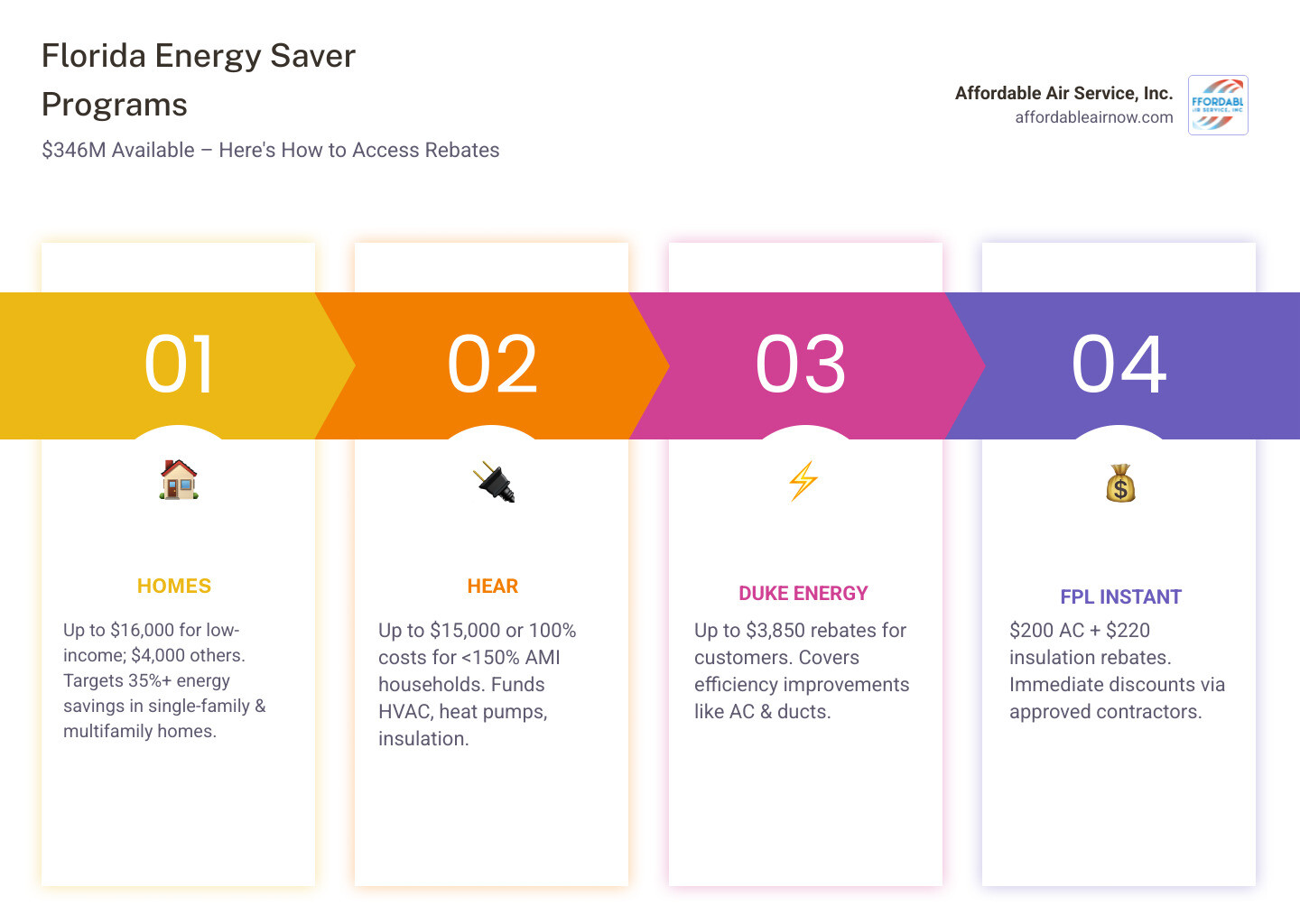
| HOMES (Florida Energy Saver) | All income levels, single-family and multifamily | Up to $16,000 for low-income; up to $4,000 for others |
| HEAR (Florida Energy Saver) | Households below 150% Area Median Income | Up to $15,000; up to 100% of upgrade costs |
| Duke Energy Home Energy Improvement | Duke Energy customers | Up to $3,850 in rebates |
| FPL Instant Rebates | FPL customers | $200 for new A/C; $220 for ceiling insulation |
| LIHEAP / Weatherization | Low-income households | Energy bill assistance and efficiency improvements |
Florida has been allocated $346 million under the federal Inflation Reduction Act — split between home efficiency improvements and energy-efficient appliances. That’s a significant pool of funding designed to help homeowners like you reduce monthly energy bills, improve home comfort, and make upgrades that last for years.
The catch? The rollout has been slower than expected. A vetoed state grant and federal approval requirements have pushed timelines back. But the application portal reopened in August 2025, and programs are now moving forward in phases. If you haven’t registered or started planning yet, now is the time.
Whether you’re considering a new high-efficiency HVAC system, better attic insulation, or a heat pump upgrade, understanding these programs can help you make smarter decisions — and potentially save thousands in the process.
Understanding the Florida Energy Saver Program (HOMES and HEAR)
When we talk about the big-ticket florida energy incentive programs for homeowners, we are usually referring to two primary federal initiatives: the Home Efficiency Rebates (HOMES) and the Home Electrification and Appliance Rebates (HEAR). Together, these form the core of the Florida Energy Saver Program.
The HOMES program is performance-based. This means the amount of money you get back depends on how much energy your home saves after the upgrades. To qualify, we use energy savings modeling to predict how much lower your consumption will be. Usually, you need to hit at least a 20% reduction in energy use to see a check.
The HEAR program, on the other hand, is specifically for low-to-moderate-income households. It focuses on point-of-sale discounts for high-efficiency electric equipment, such as heat pumps and electric stoves. Because these are “upfront” discounts, you don’t have to wait months for a check in the mail; the savings are applied directly to the cost of the project by qualified contractors.
As of April 2026, Florida is moving through a phased rollout. Following the reopening of the application portal in late 2025, the state has been working closely with the U.S. Department of Energy (DOE) to ensure all funds are distributed correctly. If you are curious about how much a new system could save you before you even apply, you can check your potential savings with our SEER Calculator.
Eligibility for Florida Energy Incentive Programs for Homeowners
One of the most common questions we hear in Santa Rosa Beach and Destin is: “Do I actually qualify for this?” The answer depends largely on your household income and the type of home you live in.
Eligibility for these florida energy incentive programs for homeowners is often tied to the Area Median Income (AMI). Here is how the tiers generally break down:
- Low-Income Households: Those earning less than 80% of the AMI. These neighbors often qualify for the highest rebate amounts, sometimes covering 100% of the project costs.
- Moderate-Income Households: Those earning between 80% and 150% of the AMI. These households are the primary target for the HEAR program.
- All Other Homeowners: Even if you earn more than 150% of the AMI, you can still participate in the HOMES program, though your rebate caps will be lower (usually up to 50% of the project cost).
Both single-family homes and multifamily buildings are eligible. For multifamily owners in places like Okaloosa Island or Miramar Beach, the rebates can be substantial when scaled across several units. If the upfront cost of a high-efficiency system still feels like a hurdle even with a rebate, don’t worry—you can explore flexible financing options to bridge the gap.
Maximum Rebate Amounts for HVAC and Efficiency Upgrades
The amount of money available through these programs is staggering. Florida’s $346 million allocation is designed to make a real dent in our state’s energy consumption.
| Rebate Tier | Energy Savings Target | Low-Income (<80% AMI) | Non-Low-Income |
|---|---|---|---|
| HOMES Single-Family | 20% – 34% Savings | Up to $8,000 | Up to $2,000 |
| HOMES Single-Family | 35%+ Savings | Up to $16,000 | Up to $4,000 |
| HEAR Maximum | N/A (Equipment based) | Up to $14,000+ | Up to 50% of cost |
Under the HOMES program, a single-family home achieving 35% or more in modeled energy savings can secure a $16,000 rebate if they fall into the low-income bracket. For everyone else, that cap is $4,000.
The HEAR program offers specific caps for different items. For example, a heat pump HVAC system could net you an $8,000 rebate, while a heat pump water heater might offer $1,750. To make your upgrade even more affordable, be sure to view our current discounts to see how state rebates and local offers can work together.
Utility-Specific Florida Energy Incentive Programs for Homeowners
While the federal programs get the most headlines, Florida’s major utility companies offer immediate “instant” rebates that are much easier to access.
- Duke Energy Florida: Duke Energy has significantly expanded its program, now offering up to $3,850 in total home improvement rebates. This includes $1,000 for HVAC replacement, $800 for energy-efficient windows, and $800 for attic insulation. They even offer $800 for heat pump water heaters.
- Florida Power & Light (FPL): FPL provides instant rebates that are deducted right from your invoice. You can get $200 for a new energy-efficient A/C and $220 for upgrading your ceiling insulation.
- ENERGY STAR: Use the ENERGY STAR Rebate Finder to locate additional localized incentives for certified appliances.
These utility programs are often the best “first step” because they don’t require the same level of complex energy modeling as the federal HOMES program.
How to Apply for Florida Energy Incentive Programs for Homeowners
Applying for these rebates doesn’t have to be a headache, but it does require organization. Here is the general workflow for the Florida Energy Saver Program:
- Register: Visit the official Florida Energy Saver Portal and create a profile. This ensures you get notified the moment application windows open for your specific income tier.
- Energy Assessment: For the HOMES program, you’ll need a professional energy assessment to model your home’s current usage and projected savings.
- Hire a Qualified Contractor: This is critical. Many of these rebates are only valid if the work is done by a state-approved contractor who can verify the installation meets federal standards.
- Documentation: Keep every receipt. You will need proof of installation, contractor certifications, and detailed invoices to claim your funds.
- Submit: Upload your documentation to the portal. For HEAR rebates, your contractor may handle the discount at the point of sale, but you’ll still need to verify your income eligibility.
Common Challenges and Documentation Requirements
The road to energy efficiency in Florida hasn’t been without a few bumps. A major challenge was the initial delay caused by a vetoed $5 million administrative grant, which slowed the state’s ability to set up the necessary infrastructure. However, with $346 million on the line, the program is now back on track.
To avoid the common pitfalls that lead to denied applications, keep these tips in mind:
- Verify Contractor Status: Ensure your HVAC team is authorized to participate in the Florida Energy Saver Program.
- Mind the Timeline: Most utility programs, like Duke Energy’s, require you to complete improvements within 24 months of your initial home energy check.
- Income Verification: Low-income households looking to maximize benefits (getting 100% of costs covered) must provide clear proof of income, such as tax returns or participation in programs like LIHEAP.
- Save Everything: From the initial energy audit report to the final signed contract, digital and physical copies of all records are your best friend.
Frequently Asked Questions about Florida Energy Rebates
What is the difference between the HOMES and HEAR programs?
The HOMES program is based on how much energy you save (performance-based), whereas HEAR is based on what you buy (equipment-based) and is reserved for low-to-moderate-income families. HOMES is open to everyone, but HEAR offers higher upfront discounts for those who qualify.
Can I combine utility rebates with federal energy incentives?
In many cases, yes! You can often take an instant rebate from FPL or Duke Energy and still apply for federal tax credits. However, “stacking” two different federal grants for the same exact upgrade is usually not allowed. We always recommend checking the specific “stacking” rules on the Florida Energy Saver Portal before starting.
What specific HVAC upgrades qualify for the highest rebate amounts?
Heat pump HVAC systems are the “gold standard” for these programs. Because they are incredibly efficient at both cooling and heating, they offer the highest energy savings potential, often qualifying homeowners for the maximum $8,000 or $16,000 rebate tiers under the HOMES and HEAR programs.
Conclusion
Navigating florida energy incentive programs for homeowners might seem complex, but the financial rewards are well worth the effort. With hundreds of millions of dollars available to help Florida residents upgrade their homes, there has never been a better time to invest in a high-efficiency HVAC system.
At Affordable Air Service, Inc., we’ve been serving our neighbors in Santa Rosa Beach, Freeport, Destin, and the surrounding areas with a commitment to quality and affordability. Whether you need a free estimate on a new Daikin system or want to learn more about how our 7-day service can help you stay cool, we are here for you. We stand by the Daikin Comfort Promise, ensuring your home remains a sanctuary of comfort through every Florida summer.
Ready to start saving? Discover our full range of professional HVAC services and let us help you maximize your Florida energy rebates today!