


Why Summer Energy Bills Hit Hard on the Emerald Coast — and What Actually Helps
Understanding how high efficiency systems reduce summer costs is one of the smartest moves you can make as a homeowner on Florida’s Emerald Coast. When temperatures climb into the 90s and humidity never lets up, your air conditioner runs hard — and your utility bill shows it. Air conditioning alone accounts for roughly 19% of a typical U.S. household’s electricity use, but in a hot, humid coastal climate like Santa Rosa Beach or Destin, that share climbs even higher. If your system is more than 10 years old and still running at SEER 10–12, you’re likely paying far more than you need to every single summer month.
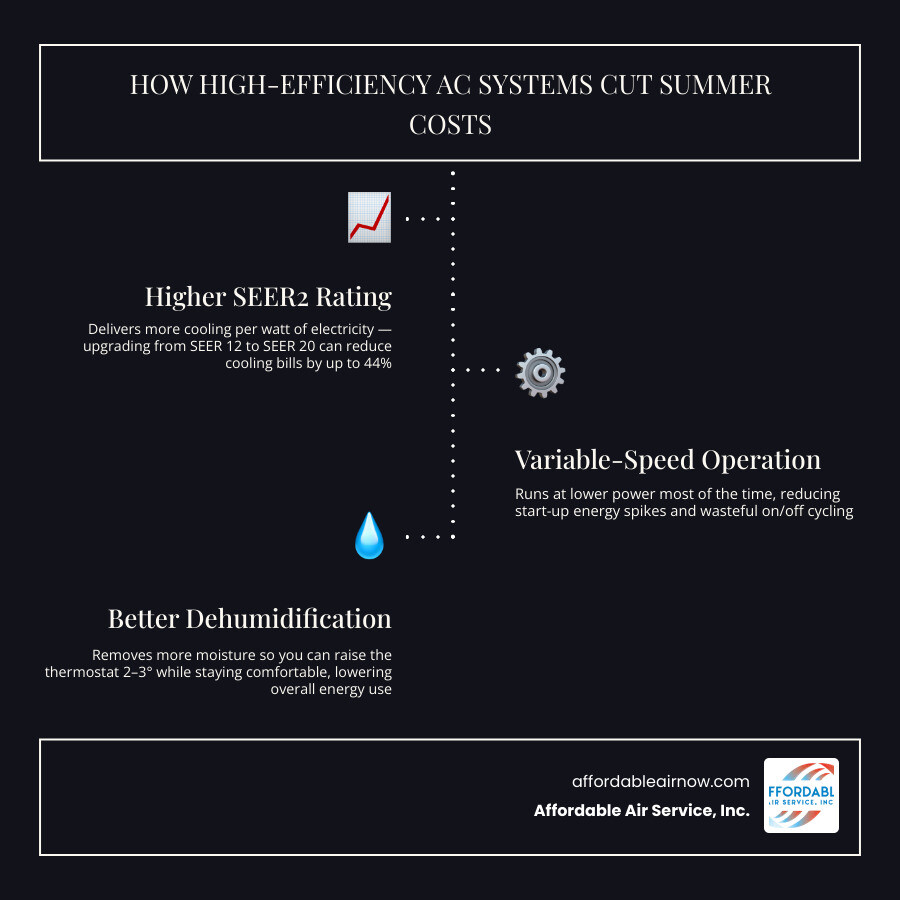
Here’s a quick look at how high-efficiency systems cut cooling costs:
- Higher SEER2 ratings mean the system delivers more cooling per watt of electricity used
- Variable-speed compressors run at lower power most of the time instead of blasting on and off at full wattage
- Better dehumidification lets you set the thermostat a few degrees higher while still feeling comfortable
- Fewer start-up cycles reduce the energy spikes that happen every time a standard unit kicks on
- Duct sealing and smart thermostats compound the savings from the equipment itself
- Upgrading from SEER 12 to SEER 20 can cut your monthly cooling bill by up to 44%
The difference between a standard unit and a high-efficiency system isn’t just about the equipment — it’s about how all the pieces work together. This guide breaks down exactly what drives those savings and what you can do to maximize them.
What is High-Efficiency Cooling and How is it Measured?
To understand how high efficiency systems reduce summer costs, it helps to know how the HVAC industry measures cooling efficiency. Just like shopping for a new car, you want to know the “miles per gallon” of your cooling system. In the HVAC world, this is measured using standardized efficiency ratings.
The most common rating you will see is the Seasonal Energy Efficiency Ratio (SEER), which has recently been updated to SEER2. SEER measures the total cooling output of an air conditioner over a typical cooling season divided by the total electrical energy it consumes. The higher the number, the more efficient the unit.
- SEER/SEER2: This is the seasonal average. Older systems in coastal Florida homes often have ratings between 10 and 13. Modern high-efficiency systems, like the Daikin Fit, easily reach 18 to 22+ SEER2.
- EER/EER2 (Energy Efficiency Ratio): This measures a system’s efficiency at a specific, high outdoor temperature (usually 95°F). This is highly relevant during peak July and August afternoons along the Emerald Coast.
- ENERGY STAR Certification: To earn this government-backed label, central air conditioners must meet strict energy efficiency guidelines. New ENERGY STAR certified AC units are about 20% to 30% more efficient than standard models.
For a deeper dive into how these metrics translate to actual performance, you can read more about Daikin Fit Efficiency and Performance Explained.
The Shift from SEER to SEER2 in 2026
If you are researching a system upgrade, you will notice that the industry has fully transitioned to SEER2. This isn’t just a marketing change; it represents a fundamental shift in how air conditioners are tested.
In the past, legacy SEER ratings were calculated under laboratory conditions that didn’t account for the actual static pressure of a home’s ductwork. In reality, pushed air meets resistance as it travels through your ducts. The Department of Energy introduced SEER2 using the “M1” testing protocol, which subjects systems to five times higher external static pressure. This makes SEER2 ratings a much more accurate representation of how an AC performs in a real home.
This standard is particularly important when evaluating The 10-Year Itch: Average AC Lifespan in Humid Coastal Climates. In our salty, humid coastal air, systems degrade faster. Knowing how a system handles real-world static pressure helps ensure you select a unit that won’t lose its efficiency edge after just a few seasons of heavy coastal use.
How High Efficiency Systems Reduce Summer Costs
The fundamental explanation of how high efficiency systems reduce summer costs comes down to reduced power consumption. Standard, single-stage air conditioners operate on an “all-or-nothing” principle. When your home warms up, the system turns on at 100% capacity, blasts cold air until the thermostat is satisfied, and then shuts off.
This constant cycling is incredibly wasteful. It takes a massive amount of electrical current to start up a stationary compressor motor. A standard system can draw 4,000 to 6,000 watts of electricity just to start up, compared to only 2,000 to 3,000 watts for a high-efficiency system. Because high-efficiency units run continuously at lower speeds, they avoid these frequent start-up spikes. This can reduce your daily electricity consumption from 72,000 watts (for a traditional unit) down to 24,000 watts.
To explore how these operational dynamics save you money, check out Why Your Home and Your Wallet Will Love the Daikin Fit.
How High Efficiency Systems Reduce Summer Costs in Humid Coastal Climates
In places like Santa Rosa Beach, Miramar Beach, and Destin, summer heat is only half the battle. The real culprit behind summer discomfort is the intense humidity.
Air conditioners cool your home in two ways:
- Sensible Cooling: Lowering the actual air temperature.
- Latent Cooling: Removing moisture (humidity) from the air.
Standard single-stage systems cool a home so quickly that they run short cycles. Because they turn off after only 10 or 15 minutes, they don’t run long enough to pull moisture out of the air. This leaves your home feeling damp and clammy, often prompting you to lower the thermostat even further just to feel comfortable.
High-efficiency systems are designed to run longer, gentler cycles. By continuously circulating air over the cold evaporator coils, they act as powerful dehumidifiers. Because dry air feels significantly cooler than damp air, you can comfortably set your thermostat to 78°F instead of 72°F. Since every degree you raise your thermostat saves you roughly 3% to 6% on your cooling bill, the humidity control of a high-efficiency system is a massive cost-saver.
For a detailed breakdown of how this technology keeps you comfortable while saving money, read about Daikin Fit Benefits Over Conventional Systems Explained.
How High Efficiency Systems Reduce Summer Costs Compared to Standard Units
To put these savings into perspective, let’s look at how a high-efficiency system compares to a standard unit during a typical Emerald Coast summer.
| Feature | Standard Unit (SEER 14) | High-Efficiency Unit (SEER2 18+) |
|---|---|---|
| Compressor Type | Single-Stage (On/Off) | Variable-Speed (Inverter) |
| Startup Wattage | 4,000 – 6,000 Watts | 2,000 – 3,000 Watts |
| Daily Power Consumption | ~72,000 Watts | ~24,000 Watts |
| Humidity Control | Poor (due to short-cycling) | Excellent (long, continuous runs) |
| Average Monthly Bill Reduction | Baseline | 30% to 44% Savings |
| Operational Noise | Loud (75+ decibels) | Quiet (as low as 55 decibels) |
By upgrading from an older, inefficient unit to a modern high-efficiency system, a typical homeowner on the Emerald Coast can realistically save hundreds of dollars over the course of a single summer.
Key Technical Features and Maintenance Strategies for Maximum Savings

High-efficiency systems don’t achieve these incredible savings by accident. They rely on advanced technology and smart design features to optimize every watt of electricity they draw.
Variable-Speed Motors and Inverter Technology
The primary driver behind high-efficiency savings is inverter technology. Traditional compressors are either 100% on or 100% off. In contrast, an inverter-driven compressor can modulate its speed in increments of 1%, operating anywhere from 30% to 100% capacity.
Think of it like driving a car. A standard AC is like driving in stop-and-go traffic — slamming on the gas, then slamming on the brakes. An inverter system is like setting your cruise control on the highway. It gently adjusts its speed to maintain a perfectly consistent temperature, using only the exact amount of energy required. This eliminates the massive power surges associated with compressor startups and keeps your home at a steady, comfortable temperature.
This “cruise control” behavior is a hallmark of premium systems. You can learn more about these operational advantages by reading about Daikin Fit Benefits Over Conventional Systems Explained.
The Role of Regular Professional Tune-Ups and Duct Sealing
Even the most advanced high-efficiency system will struggle to save you money if your home’s infrastructure is working against it. To squeeze every drop of efficiency out of your investment, you must address the entire home comfort system.
- Duct Sealing: Leaky ductwork is one of the biggest energy drains in Florida homes. In fact, typical duct systems lose up to 20% to 30% of conditioned air to unconditioned spaces like your attic or crawlspace. Sealing and insulating your ducts ensures that the cold air you pay for actually reaches your living areas.
- Air Filters: A dirty air filter restricts airflow, forcing your system’s fan motor to work harder and draw more electricity. Changing your filters every 30 to 60 days (especially during high-pollen seasons on the Emerald Coast) is the easiest way to protect your system’s efficiency.
- Professional Tune-Ups: Annual maintenance keeps your system running at peak performance. During a tune-up, a technician will clean the coils, check refrigerant levels, and inspect electrical connections.
To keep your system running in top shape, review our Preventative HVAC Maintenance Tips and learn about The Real Benefits of an AC Maintenance Agreement. Taking these steps is the best way to Extend the Life of Your Air Conditioner.
Financial Incentives, Rebates, and Long-Term ROI
While a high-efficiency system requires a larger initial investment than a standard unit, the long-term return on investment (ROI) is substantial. Beyond the monthly utility savings, there are several financial incentives available to help offset the upfront cost.
- Federal Tax Credits: Under the Inflation Reduction Act, homeowners can claim tax credits up to $2,000 for qualifying high-efficiency heat pumps and up to $600 for qualifying central AC units.
- Utility Rebates: Many local Florida utility companies offer rebates for upgrading to high-efficiency systems that meet specific SEER2 thresholds.
- Increased Property Value: A modern, high-efficiency HVAC system is a major selling point for potential buyers, protecting your home’s equity.
To learn more about how to capture these savings, read about How the Inflation Reduction Act Makes Florida Homes Cheaper to Run and How to Score Florida Energy Rebates for HVAC Upgrades. If you are wondering how this investment impacts your home’s market appeal, we break down Does a New HVAC Help Sell Your Home Faster? The Cold Hard Truth.
Frequently Asked Questions About High-Efficiency AC Systems
What is the difference between SEER and SEER2?
SEER2 is the updated testing standard mandated by the Department of Energy as of 2023. While the old SEER rating tested systems under idealized laboratory conditions, SEER2 uses a higher static pressure testing protocol (M1) to better simulate the real-world ductwork of a typical home. A SEER2 rating is generally slightly lower than a SEER rating for the same unit, but it is a much more accurate reflection of actual performance.
Can a high-efficiency system really lower my summer bills by 30% or more?
Yes. Upgrading from an older SEER 10–12 system to a modern SEER2 18+ system can reduce your cooling-related electricity usage by 30% to 44%. Because high-efficiency systems use variable-speed technology and manage humidity exceptionally well, they draw far less power and allow you to keep your thermostat set higher without sacrificing comfort.
Do high-efficiency systems require more maintenance than standard units?
No, high-efficiency systems require the same basic maintenance as standard units. You should still change your air filters every 1 to 2 months and schedule a professional preventative maintenance tune-up once a year. However, because high-efficiency systems run more consistently and avoid the harsh wear-and-tear of frequent on/off cycles, they often experience fewer emergency breakdowns over their lifespan.
Conclusion
Investing in a high-efficiency cooling system is one of the most effective ways to protect your comfort and your wallet from brutal Florida summers. By combining advanced variable-speed technology, superior dehumidification, and smart system design, these modern systems deliver consistent comfort while slashing your monthly power bills.
If you are ready to upgrade your home’s comfort and start saving, our team at Affordable Air Service is here to help. We proudly serve homeowners across Santa Rosa Beach, Destin, Miramar Beach, DeFuniak Springs, Freeport, Fort Walton Beach, and Okaloosa Island. As an authorized Daikin dealer, we offer state-of-the-art Daikin Fit systems, flexible financing options through GoodLeap, and the peace of mind of the Daikin Comfort Promise.
Start saving on your summer cooling bills with Affordable Air Service today. You can visit us at 116 Bishop-Tolbert Road, Santa Rosa Beach, FL 32459 to learn more about our services and schedule an appointment.