


Why Your Water Heater Choice Matters More in Florida Than You Think
This water heater options guide for Florida homeowners covers everything you need to compare the most common types available in the Sunshine State:
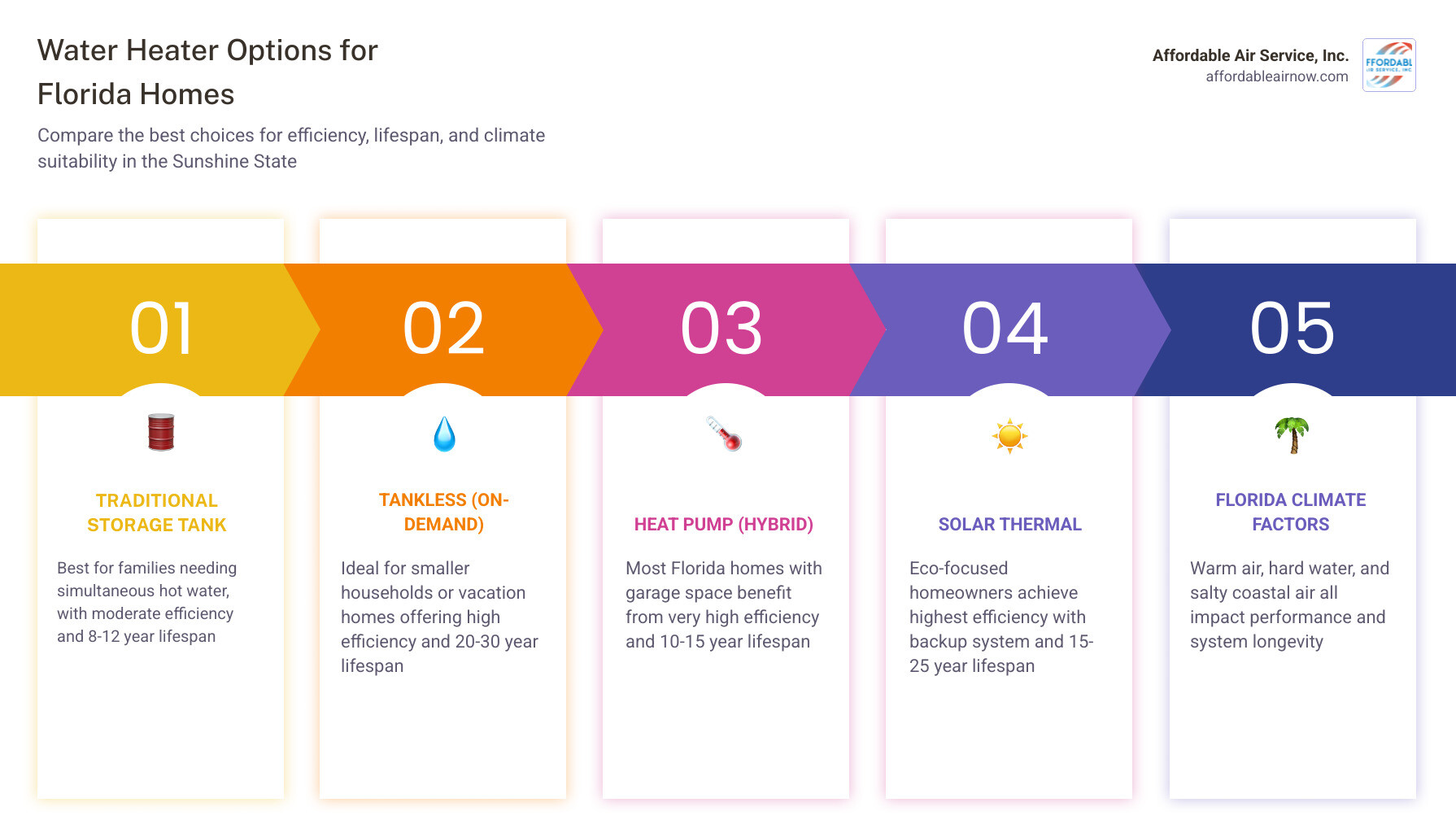
| Water Heater Type | Best For | Energy Efficiency | Typical Lifespan |
|---|---|---|---|
| Traditional Storage Tank | Families needing simultaneous hot water | Moderate | 8-12 years |
| Tankless (On-Demand) | Smaller households or vacation homes | High | 20-30 years |
| Heat Pump (Hybrid) | Most Florida homes with garage space | Very High | 10-15 years |
| Solar Thermal | Eco-focused homeowners | Highest (with backup) | 15-25 years |
Heating water accounts for roughly 18% of your home’s energy use — and in Florida’s heat, that number can climb even higher with an older, inefficient unit. A typical household along the Emerald Coast uses between 60 and 80 gallons of hot water every day, covering everything from morning showers to laundry and dishes.
Florida’s warm climate, salty coastal air, and hard water in many areas all affect how a water heater performs — and how long it lasts. Choosing the wrong type or size doesn’t just mean cold showers. It means wasted energy, higher utility bills, and a system that wears out faster than it should.
Whether you’re replacing a failing unit or planning ahead, understanding your options is the first step toward a smarter decision.
Exploring the Main Water Heater Options Guide for Florida Homeowners
Florida homeowners usually compare four main options: traditional storage tanks, tankless systems, heat pump water heaters, and solar thermal systems. Each one can work well, but the right fit depends on your household size, installation space, fuel availability, and how you actually use hot water day to day.
If you want a broader look at system basics, our Essential Guide to Home Plumbing Hot Water Heater Options and The Great Water Heater Showdown: Gas vs. Electric vs. Tankless are helpful next reads.

Traditional Storage Tank Systems
Storage tank water heaters are still the most common choice in Florida homes. They keep a reservoir of water heated and ready to use, which makes them simple and reliable for households that often need hot water in more than one place at once.
Common residential tank sizes run from about 30 to 80 gallons. In general:
- 30-40 gallons often works for 1-2 people
- 50 gallons is common for 3-4 people
- 75-80 gallons may fit larger families or homes with high simultaneous demand
Why homeowners choose them:
- Familiar technology
- Lower upfront equipment complexity
- Good performance for simultaneous showers, laundry, and dishes
- Widely available in electric and gas models
Potential drawbacks:
- Standby heat loss because water is kept hot all day
- Larger footprint than tankless systems
- Shorter typical lifespan than tankless models
Electric tank models are especially common in Florida. If you’re comparing electric units, see Electric Water Heater Options for Homes and Best Electric Water Heaters.
A storage tank can still be the best pick when your household has heavy peak demand. If two people shower while the dishwasher runs and a load of beach towels is in the wash, a properly sized tank may feel less stressful than a too-small on-demand unit.
On-Demand Tankless Water Heater Options Guide for Florida Homeowners
Tankless water heaters heat water only when you need it. There is no stored tank of hot water waiting around, which means less standby energy loss and a much smaller footprint.
That makes tankless systems appealing for:
- Smaller households
- Vacation homes
- Homes where hot water use is spread out instead of all at once
- Utility closets or tight installation spaces
Tankless units are known for long life. With proper maintenance, they often last 20 years or longer, and many systems can reach 20-30 years. They can also cut energy use significantly. Research shows tankless systems may reduce energy costs by 24-34% in homes using less than 41 gallons of hot water per day, and by 27-50% in homes using 86 gallons or more.
Why tankless works well in Florida:
- Warmer groundwater means the unit has less temperature rise to achieve than in colder states
- That can improve efficiency and performance
- Vacation properties can avoid heating a full tank when the home is unoccupied
Things to watch:
- Flow rate matters more than gallons
- A unit may struggle if multiple showers and appliances run at once
- Some homes need electrical, venting, or gas line upgrades
- Hard water can cause scale buildup without regular descaling
For a deeper look, visit Tankless Water Heaters Installation Benefits and No Tank, No Problem: A Guide to On-Demand Heating.
In plain English: tankless is great, but “endless hot water” only feels endless when the unit is correctly sized. Otherwise, it is less “spa day” and more “who turned on the dishwasher?”
Maximizing Efficiency with Heat Pump and Solar Technology
For many homes along the Emerald Coast, the highest-efficiency choices are heat pump and solar water heating systems. These options cost less to operate over time because they move or capture heat rather than creating all of it directly.
| Water Heater Type | Relative Efficiency | Typical Lifespan | Florida Climate Suitability |
|---|---|---|---|
| Traditional Electric Tank | Moderate | 8-12 years | Good |
| Tankless | High | 20-30 years | Very good |
| Heat Pump (Hybrid) | Very high | 10-15 years | Excellent |
| Solar Thermal | Highest with backup | 15-25 years | Excellent |
Why Heat Pump Water Heaters Excel in the Florida Climate
If we had to name the best all-around efficiency option for many Florida homes in 2026, it would usually be the heat pump water heater.
Heat pump water heaters are often two to four times more energy-efficient than conventional electric water heaters. Instead of generating heat the old-fashioned way, they pull heat from the surrounding air and transfer it into the water tank. Florida’s warm, humid climate gives these systems a natural advantage.
Why they fit Florida so well:
- They perform best in warm ambient air
- Garages and utility rooms often provide good installation locations
- They can slightly cool and dehumidify the surrounding space
- They align well with today’s push toward higher-efficiency electric equipment
Pros of heat pump water heaters in Florida:
- Excellent energy efficiency
- Lower operating costs than standard electric tanks
- Good match for warm coastal climates
- Useful in homes running cooling much of the year
Cons to consider:
- Need enough air volume and clearance around the unit
- Usually larger than standard tanks
- Can produce some operating noise
- Recovery may be slower in certain modes than gas systems
For homeowners in Santa Rosa Beach, Destin, Miramar Beach, Fort Walton Beach, Freeport, Okaloosa Island, and DeFuniak Springs, a garage-installed hybrid water heater is often a strong fit if space allows.
Solar Water Heating for the Sunshine State
Florida did not get the nickname “Sunshine State” by accident, so yes, solar water heating deserves a serious look.
Solar thermal water heaters use roof-mounted collectors to absorb the sun’s heat and transfer it to water stored in a tank. Because weather and demand vary, these systems usually include a backup heating source.
Benefits of solar water heating:
- Very high efficiency
- Reduced reliance on conventional energy
- Strong environmental benefits
- Excellent climate match in sunny Florida
Limitations:
- Performance depends on sun exposure
- Roof orientation and shading matter
- Backup heat is still important for cloudy periods or heavy demand
- Installation is more specialized than standard systems
Solar can be a smart option for homeowners focused on long-term efficiency and sustainability, especially when the home has strong sun access and room for the supporting equipment.
How to Determine the Right Size for Your Household
Choosing the right type matters, but sizing is just as important. A water heater that is too small leaves you racing your family to the shower. One that is too large wastes energy and space.
A typical Florida household uses about 40 to 86 gallons of hot water per day, and the average annual hot water consumption ranges from about 14,600 to 31,390 gallons. Along the Gulf Coast, many homes land around 60-80 gallons daily. Beach living can push that higher thanks to extra showers, swimsuit washing, and endless towel laundry.
When sizing a water heater, we look at:
- Number of people in the home
- Number of bathrooms
- Whether hot water is used simultaneously
- Appliance habits
- Shower frequency
- Laundry volume
- Whether the home is a full-time residence or vacation property
For tank systems, focus on first-hour rating, which tells you how much hot water the unit can deliver in an hour starting with a full tank.
For tankless systems, focus on gallons per minute, or GPM, and the expected temperature rise.
You can also compare tank and tankless sizing logic in The Great Water Heater Debate: Tank vs. Tankless.
Sizing a Tankless Water Heater Options Guide for Florida Homeowners
Tankless sizing is all about how many fixtures may run at the same time.
Start by estimating simultaneous demand:
- Shower: about 2 GPM
- Bathroom sink: about 0.5-1 GPM
- Dishwasher: roughly 1-2 GPM during fill cycles
- Washing machine: often around 1.5-3 GPM during fill
Example:
- Two showers running together: about 4 GPM
- Add a dishwasher fill: about 5-6 GPM total
That means a small unit may be fine for a condo or vacation home, but a larger family home with multiple bathrooms may need a higher-capacity model or even more than one unit.
Florida’s warmer incoming groundwater helps tankless performance compared to colder climates, but that does not remove the need for proper sizing. Bathroom count and simultaneous use still matter a lot.
Tankless may be a great fit if:
- Your hot water use is staggered
- You want to save space
- You have a smaller household
- You own a vacation rental with irregular occupancy
Calculating Tank Capacity for Large Families
For storage tanks, a good starting point is household size and peak-use timing.
General rules of thumb:
- 1-2 people: 30-40 gallons
- 3-4 people: 50 gallons
- 5+ people: 75-80 gallons
But numbers alone do not tell the whole story. A family of four with staggered schedules may do fine with less capacity than a family of four with two back-to-back showers, laundry, and breakfast dishes all happening before 8 a.m.
Things that increase needed capacity:
- Multiple bathrooms
- Frequent laundry
- Teenagers with championship-level shower times
- Guests or short-term rental turnover
- High-use mornings and evenings
If your household regularly uses 60-80 gallons per day, or more during peak periods, choosing based on first-hour rating instead of tank size alone usually leads to a better result.
Maintenance and Safety for Long-Term Performance
No water heater is truly “install it and forget it.” Even the best system needs regular care to stay efficient, safe, and long-lasting.
Basic maintenance varies by type:
- Storage tank: flush sediment, inspect anode rod, check pressure relief valve
- Tankless: descale periodically, clean inlet screens, inspect venting and burners where applicable
- Heat pump: clean air filter, check condensate drainage, inspect standard tank components
- Solar: inspect collectors, pumps, sensors, and backup heating components
You can learn more about professional setup and replacement at Water Heater Installation.
Florida-Specific Performance Factors
Florida conditions can be tough on water heaters in ways many homeowners do not realize.
Key local factors include:
- Hard water in some areas, which increases scale buildup
- Salt air in coastal communities, which can speed corrosion
- Humidity, which affects installation environments
- Sediment that collects in tank bottoms over time
- Hurricane strapping and local installation requirements
For homes near Santa Rosa Beach, Miramar Beach, Destin, Fort Walton Beach, and Okaloosa Island, coastal exposure is especially important. Corrosion resistance, proper installation materials, and routine inspection matter more when salt air is part of daily life.
A few best practices:
- Flush tank-style units regularly to remove sediment
- Inspect anode rods every few years
- Descale tankless units on schedule, especially with harder water
- Keep the installation area clean and dry
- Make sure any replacement follows local Florida code requirements
Ensuring Safe Operation and Efficiency
Safe operation starts with proper installation and continues with routine inspection.
Important safety items include:
- Temperature and pressure relief valve checks
- Correct venting for gas-fired equipment
- Secure electrical connections
- Leak detection around fittings and pans
- Proper temperature settings
- Expansion tank installation when required
- Earthquake straps are not the main issue in Florida, but hurricane strapping and secure mounting can be
A moderate water temperature setting helps reduce scald risk while avoiding unnecessary energy use. If you notice inconsistent water temperature, popping sounds from the tank, visible rust, leaks, or reduced hot water supply, it is time for a professional inspection.
Professional help is especially important when:
- Replacing an older unit
- Switching from tank to tankless
- Adding a heat pump water heater
- Dealing with gas lines or venting
- You need a permit or code-compliant replacement
- Your current setup has space or drainage limitations
Frequently Asked Questions about Florida Water Heaters
Which water heater type is the most energy-efficient for Florida homes?
Heat pump water heaters are generally the most energy-efficient practical option for most Florida homes. They extract heat from warm surrounding air, which is why they can operate two to four times more efficiently than a standard electric water heater. Solar thermal systems can be even more efficient in the right setup, but they usually need a backup heat source and more specialized installation. For many homeowners, heat pump offers the best balance of efficiency, reliability, and Florida climate compatibility.
How long do tankless water heaters last compared to traditional tanks?
With proper maintenance, tankless water heaters often last 20 to 30 years. Traditional storage tank water heaters usually last about 8 to 12 years. That longer service life is one reason many homeowners consider tankless when replacing an aging unit. The tradeoff is that tankless systems need correct sizing and regular descaling to deliver their best performance over time.
When should I consult a professional plumber for water heater selection?
You should bring in a professional when:
- Your current water heater is more than 10 years old
- You are running out of hot water
- Water temperature is inconsistent
- You are choosing between tank, tankless, heat pump, or solar
- You are unsure about size, first-hour rating, or GPM
- Your home may need venting, drainage, or electrical updates
- You want the installation done safely and to Florida code
A professional can calculate your household’s real peak demand, evaluate the installation area, and recommend a system that fits your home’s layout and usage patterns instead of guessing based on the old unit’s label.
Conclusion
The best water heater is not simply the newest or the fanciest one on the shelf. It is the one that matches your household size, your usage habits, your available space, and Florida’s unique climate.
For many Emerald Coast homes, a heat pump water heater is the efficiency leader. A traditional tank still makes sense for homes with heavy simultaneous demand. Tankless can be excellent for smaller households, tighter spaces, or vacation properties. Solar may be worth exploring for homeowners focused on maximum long-term efficiency.
If you need help comparing options for your home in Santa Rosa Beach, Destin, Miramar Beach, Freeport, Fort Walton Beach, Okaloosa Island, or DeFuniak Springs, we are here to help. At Affordable Air Service, we believe homeowners should get clear guidance, practical recommendations, and honest service without the mystery. We offer free estimates, 7-day service, and trusted support across the Emerald Coast.
Explore our services here: https://affordableairnow.com/services/