


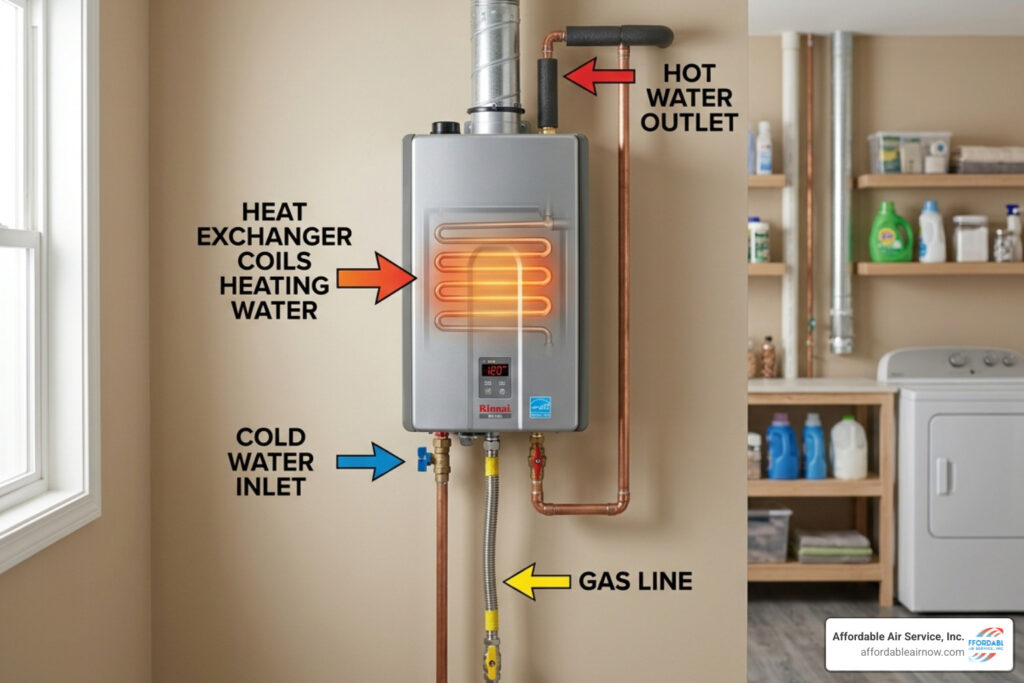
Tankless vs. Traditional: Understanding the Core Differences
When we talk to homeowners in Santa Rosa Beach and Destin, the first question is usually about the physical change. A traditional water heater is a giant, cylindrical landmark in your garage or closet, typically holding between 20 and 80 gallons of water. A tankless unit, by contrast, is about the size of a carry-on suitcase and mounts directly to the wall.
The most significant functional difference is standby heat loss. A traditional tank is constantly firing up to keep those 50 gallons of water at 120°F, even when you are sleeping or at work. This is like leaving your car idling in the driveway just in case you need to run an errand. Tankless systems eliminate this waste entirely. According to Department of Energy data for April 2026, homes using 41 gallons or less of hot water daily can be 24%–34% more energy efficient with a tankless system.
Beyond efficiency, there is the matter of longevity. While a standard tank usually lasts 10 to 15 years before the bottom rusts out, a well-maintained tankless unit has a life expectancy of more than 20 years. Because they use replaceable parts rather than a single giant vessel, they are often a better long-term investment. If you are considering the switch, exploring tankless water heaters installation benefits can help you weigh the space-saving and durability factors for your specific home layout.
| Feature | Traditional Tank Heater | Tankless Water Heater |
|---|---|---|
| Space Required | 9–12 sq. ft. (Floor space) | 2–3 sq. ft. (Wall space) |
| Energy Efficiency | Lower (Standby loss) | Higher (On-demand only) |
| Hot Water Supply | Limited to tank size | Continuous (Endless) |
| Average Lifespan | 10–15 Years | 20+ Years |
| Maintenance | Minimal flushing | Annual descaling required |
The Step-by-Step Process: How Does a Tankless Water Heater Work?
To truly answer how does a tankless water heater work, we have to look under the hood. It isn’t magic; it’s a highly orchestrated dance of sensors and heat transfer. When you crack open that shower handle, a sequence of events happens in milliseconds.
First, the brain of the unit (the control board) waits for a signal. That signal comes from the flow sensor. Once water starts moving through the internal piping, the unit calculates exactly how much heat is needed based on the incoming water temperature and your desired output (usually 120°F).
In a gas unit, the fan turns on, the gas valve opens, and the burner ignites. In an electric unit, staged heating elements begin to glow. The water then travels through the heat exchanger, a series of tightly looped pipes that soak up the heat from the burners or elements and transfer it to the cold water. This process is measured in BTUs (British Thermal Units) for gas or kilowatts for electric. To see how this fits into your overall home plumbing, check out our general guide on tankless water heaters.
The Role of the Flow Sensor in How Does a Tankless Water Heater Work?
The flow sensor is the “ignition switch” of the entire system. Most modern units require a minimum flow rate of approximately 0.4 gallons per minute (GPM) to activate. This is a safety and efficiency feature; if the water isn’t moving fast enough, the unit won’t fire to prevent overheating the internal pipes.
This can occasionally create a “cold water sandwich” if you have ultra-low-flow fixtures. If you’re rinsing a single plate with a tiny trickle of water, the sensor might not trip, and the heater stays off. If you find yourself struggling with consistent heat, it might be time to dont get cold feet finding the best tankless water heater services in santa rosa beach to ensure your fixtures and heater are properly calibrated.
Heat Exchangers and Burners: The Mechanics of How Does a Tankless Water Heater Work?
The heat exchanger is where the heavy lifting happens. Most high-quality units use copper because of its incredible thermal conductivity — it moves heat into the water faster than almost any other metal. Some high-end models use stainless steel to better resist the acidic “condensate” produced by high-efficiency gas burners.
In a gas-fired unit, the burners are incredibly powerful, ranging from 120,000 to 200,000 BTU. To put that in perspective, a standard gas grill is usually around 30,000 BTU. That massive burst of energy is what allows the unit to take 50°F groundwater and turn it into 120°F water instantly. For more on the different types of heating technology we install, you can browse our section on water heaters.
Gas vs. Electric: Different Mechanisms for On-Demand Heat
Choosing between gas and electric isn’t just about your utility bill; it’s about the infrastructure of your home.
Gas Tankless Heaters: These are the powerhouses of the industry. They generally provide higher flow rates (GPM), making them better for larger families in Ft Walton Beach or Miramar Beach. However, they require complex venting to safely move combustion gases outside. They also often require a larger gas line than a standard tank heater because of that high BTU demand.
Electric Tankless Heaters: These units are often smaller and don’t require venting, making them easier to tuck into a bathroom closet or under a sink. They use “staged heating,” meaning if you’re only washing your hands, only one element turns on. If you’re taking a hot shower, all elements activate. The catch? They pull a massive amount of electricity. You may need to upgrade your electrical panel to handle the 60 to 120 amps these units can require. You can learn more about these specific requirements on our page dedicated to electric water heaters.
Condensing vs. Non-Condensing Units
If you go the gas route, you’ll choose between condensing and non-condensing technology.
- Non-Condensing: These units vent very hot exhaust (up to 300°F), requiring expensive stainless steel venting. They are roughly 80% efficient.
- Condensing: These are the “pro” models. They feature a secondary heat exchanger that captures heat from the exhaust before it leaves the unit. This pre-heats the incoming cold water, boosting efficiency to 90% or higher. Because the exhaust is cooled down, we can often vent these units with inexpensive PVC pipe. To dive deeper into maximizing your system, read about how to improve efficiency tankless water heater.
Factors Affecting Performance and Sizing
A tankless heater is only “endless” if it is sized correctly for your climate. In the Florida Panhandle, our groundwater is relatively warm (around 70°F). This means the heater only has to “lift” the temperature by 50 degrees to reach 120°F. In Minnesota, where groundwater might be 40°F, the same heater would produce much less hot water per minute.
When we size a unit for a home in Destin or Freeport, we look at your Peak GPM Demand.
- A standard shower head uses about 2.5 GPM.
- A dishwasher uses about 1.5 GPM.
- A bathroom sink uses about 0.5 GPM.
If you want to run two showers and the dishwasher at the same time, you need a unit capable of at least 6.5 GPM at a 50-degree temperature rise. If the unit is undersized, you won’t run out of water, but it will come out lukewarm because the water is moving through the heat exchanger too fast to get fully heated. For a deeper look at sizing for our local area, see our tankless water heaters installation guide destin fl.
Essential Maintenance and Installation Requirements
While tankless units last longer, they aren’t “set it and forget it” appliances. Because the water passages inside the heat exchanger are so small, they are highly susceptible to scale buildup (calcium and magnesium deposits from our local water).
Think of scale like cholesterol in an artery; it restricts flow and makes the unit work harder, eventually leading to a shutdown or a cracked heat exchanger. We recommend an annual “spa day” for your heater. This involves flushing the unit with a food-grade descaling solution for about an hour to dissolve those minerals.
If you live in Miramar Beach or Santa Rosa Beach, you might notice your unit showing an error code if the scale gets too thick. We’ve written a fun but practical guide on why your miramar beach tankless heater needs a spa day to explain this further. Ignoring this can lead to serious tankless water heater scaling issues that could void your warranty.
Frequently Asked Questions about Tankless Systems
Can a tankless water heater truly provide endless hot water?
Yes, but with a caveat. It provides an endless supply, but not an infinite flow. As long as you stay within the unit’s GPM (Gallons Per Minute) capacity, you can shower for three hours straight and the water will stay 120°F. However, if you try to run four showers at once on a unit designed for two, the temperature will drop. If you’re having trouble with consistency, our guide on solving tankless water heater issues can help troubleshoot the cause.
Why is there a delay in getting hot water with a tankless unit?
This is the most common complaint. The delay isn’t usually the heater’s fault — it’s the “dead” water sitting in your pipes. When you turn on the tap, the heater has to activate, and then that hot water has to push all the cold water out of the pipes between the garage and your bathroom. This can take 30 to 60 seconds. If this bothers you, we can often install a small recirculation pump to keep hot water moving through the lines. Don’t worry about the wait; dont get cold feet finding electric water heaters in destin fl is all about finding the right setup to minimize that lag.
Can I replace my 40-gallon tank with a tankless unit?
Absolutely. In fact, most of our installations in Okaloosa and Walton counties are retrofits. However, it’s not a “plug and play” swap. We have to ensure your gas lines are large enough to feed the high-BTU burner and that your venting meets modern safety codes. For a full breakdown of your choices, check out our essential guide to home plumbing hot water heater options.
Conclusion
Understanding how does a tankless water heater work is the first step toward a more efficient, comfortable home. By heating water only when you need it, you save money, save space, and ensure that the last person in the house to shower gets the same hot water as the first.
At Affordable Air Service, Inc., we’ve been helping our neighbors in Santa Rosa Beach, Destin, Ft Walton Beach, and the surrounding areas navigate these upgrades since we opened our doors. Whether you need a free estimate on a new installation or your current unit needs a professional descaling flush, we are here for you with 7-day service and our Daikin Comfort Promise.
Ready to reclaim your closet space and enjoy endless hot water? Learn more about our professional HVAC and water heater services and see why so many Emerald Coast homeowners are making the switch to tankless.