


The Tank vs. Tankless Water Heater Comparison Every Homeowner Should Know
A tankless vs tank water heater comparison comes down to five key factors most homeowners care about: cost, lifespan, energy use, hot water supply, and maintenance. Here’s a quick side-by-side to help you decide:
| Factor | Tank Water Heater | Tankless Water Heater |
|---|---|---|
| How it works | Stores and reheats hot water 24/7 | Heats water on demand only |
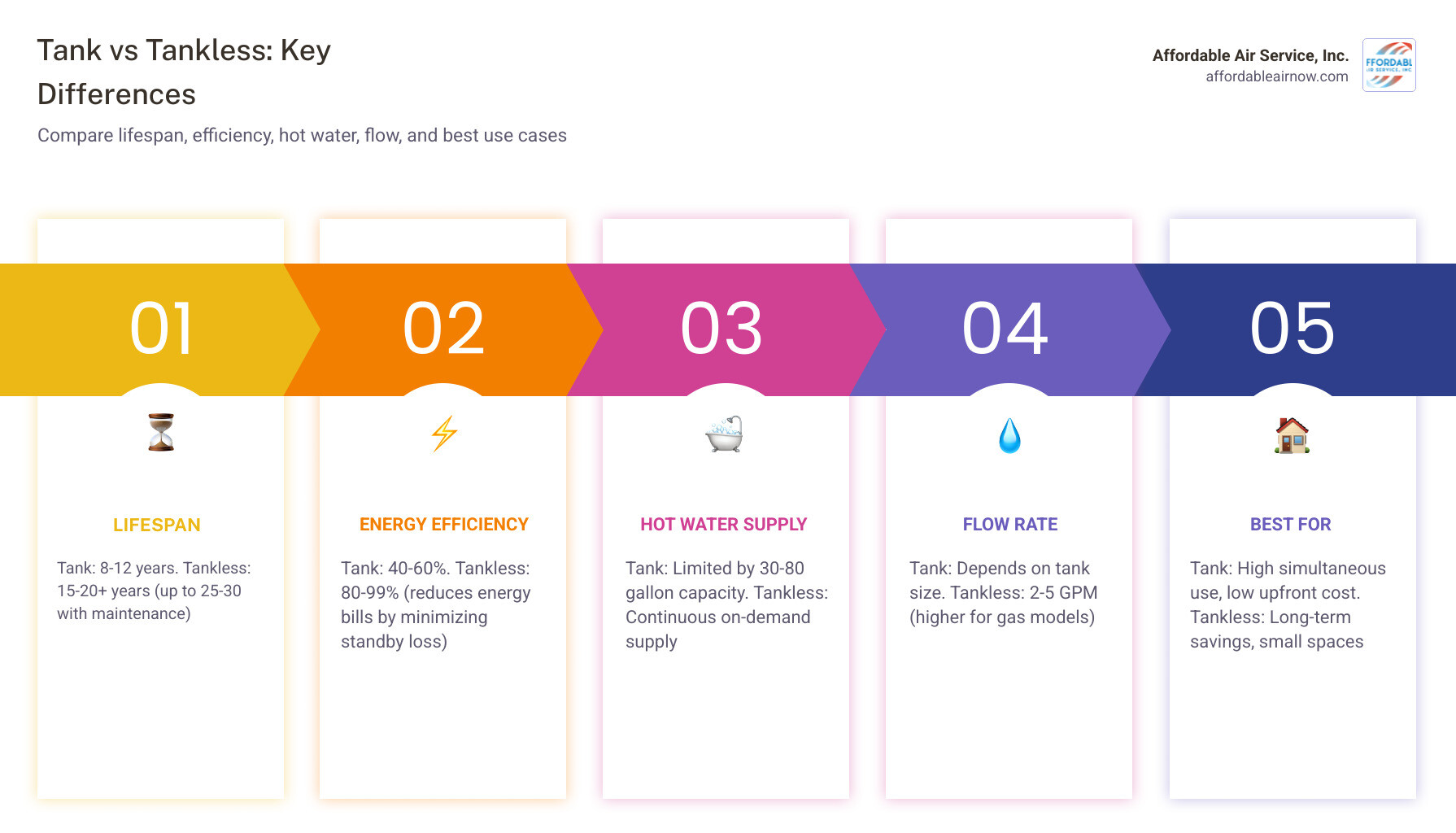
| Average lifespan | 8–12 years | 15–20+ years (up to 25–30 with care) |
| Energy efficiency | 40–60% | 80–99% |
| Hot water supply | Limited by tank size | Continuous |
| Flow rate | Based on tank capacity | 2–5 GPM (gas models higher) |
| Upfront cost | Lower | Higher |
| Best for | High simultaneous demand, tight budgets | Long-term savings, space efficiency |
Water heating accounts for roughly 13% of the average American household’s annual energy bill. That makes your choice of water heater one of the most impactful decisions you can make for home comfort and monthly costs — yet most homeowners only think about it when the old one fails.
Traditional tank water heaters store 30 to 80+ gallons of hot water and keep it heated around the clock, even when nobody is home. Tankless systems work the opposite way — they fire up only when you turn on a faucet, heating water instantly as it flows through. Both approaches have real advantages, and neither is the right fit for every household.
Whether you’re replacing an aging unit or planning a new installation on Florida’s Emerald Coast, understanding the differences clearly can save you money and headaches for years to come.
How Tank and Tankless Systems Work Differently
To make an informed tankless vs tank water heater comparison, we first have to look under the hood. While both systems aim to give you a comfortable shower, they take very different paths to get there.
The Traditional Storage Tank
A standard tank water heater is essentially a large, insulated kettle. It uses a “dip tube” to bring cold water to the bottom of the tank, where a gas burner or electric element heats it. This hot water sits in the tank, waiting for you to turn on a faucet. Because it holds water 24/7, it suffers from “standby heat loss.” This means the unit must periodically turn back on to reheat the water as it naturally cools down, even if you aren’t using it. In fact, traditional tanks account for about 18% of a home’s total energy usage largely due to this constant cycle.
The On-Demand Tankless System
Tankless heaters, often called “demand-type” heaters, skip the storage phase entirely. When you turn on the hot water tap, cold water travels through a pipe into the unit. A high-powered heat exchanger (either gas-fired or electric) flashes the water to your desired temperature instantly.
For those exploring Essential Guide To Home Plumbing Hot Water Heater Options, it is important to note that gas tankless models often use an “intermittent ignition device” (IID) rather than a standing pilot light. This prevents the energy waste associated with a flame that burns all day long. By heating water only when needed, these systems can be 24%–34% more energy efficient for homes using 41 gallons or less of hot water daily.
Performance and Lifestyle: Tankless vs Tank Water Heater Comparison
When we talk about performance, we are really talking about how your morning routine feels. Does the water go cold halfway through your shower? Can you run the dishwasher while the kids are bathing?
| Performance Metric | Tank Water Heater | Tankless Water Heater |
|---|---|---|
| Endless Hot Water | No (Limited by tank size) | Yes (Continuous flow) |
| Recovery Time | 60–120 minutes | Instant |
| Simultaneous Use | High (Handles multiple taps well) | Limited (Flow rate capped) |
| Wait Time for Heat | Short (Water is already hot) | Slightly longer (Needs to “fire up”) |
The “endless hot water” promise is the biggest selling point for tankless units. If you have a large soaking tub, a tankless unit is often a dream come true because it won’t run out of steam halfway through the fill. However, tankless units have a limited flow rate, typically providing 2–5 gallons per minute (GPM). If you try to run three showers, the laundry, and the dishwasher at once, a single tankless unit might struggle to keep up.
If you are tired of the “cold water sandwich” or running out of steam, you might want to Stop The Tank And Start The Flow With Professional Installation In Santa Rosa Beach to ensure your system is sized correctly for your specific GPM needs.
Choosing the Right Tankless vs Tank Water Heater Comparison for Large Families
For a family of four or more, peak demand is the decider. If everyone showers at the same time in the morning, a large 50-to-80-gallon tank provides a massive “buffer” of hot water that can be drawn all at once. Conversely, a high-capacity gas tankless unit can provide endless water for back-to-back showers, but you may need to stagger appliance use. If your family is growing, a professional Water Heater Installation can help determine if a high-recovery tank or a “cascade” system of multiple tankless units is better for your Miramar Beach or Destin home.
Managing Hard Water in a Tankless vs Tank Water Heater Comparison
In our area of Florida, water quality is a major factor. Hard water contains minerals like calcium and magnesium that “cook” onto heating elements. In a tank heater, this creates sediment at the bottom, which makes the unit work harder and can eventually cause the tank to overheat or pop.
Tankless heaters are even more sensitive to Tankless Water Heater Scaling Issues. Because the heat exchanger has very small passages, mineral buildup can quickly restrict flow and reduce efficiency. If you choose tankless in a hard water area, a water softener or annual descaling is non-negotiable to protect your investment.
Longevity and Maintenance for Long-Term Homeownership
If you plan on staying in your home for the next two decades, the tankless vs tank water heater comparison shifts heavily toward tankless.
- Tank Lifespan: 8–12 years. Because they hold water constantly, corrosion is an ever-present threat. Nearly 75% of tank water heaters eventually burst or leak, often spilling 30 to 80 gallons of water into your garage or closet.
- Tankless Lifespan: 15–20+ years. Some well-maintained units can even reach 30 years. Because they don’t store water, they don’t corrode in the same way. Furthermore, tankless units are built with serviceable parts; if a component fails, we can often replace just that part rather than the whole machine.
Maintenance is the “secret sauce” for longevity. For tank owners, this means checking the anode rod (a sacrificial rod that “eats” corrosion so the tank doesn’t have to) every 3 years and flushing sediment annually.
For tankless owners, it’s about a “spa day” for the heat exchanger. Why Your Miramar Beach Tankless Heater Needs A Spa Day explains how a simple vinegar flush once a year can keep the system running like new. Ignoring Home Water Heater Check Up Signs like reduced flow or strange noises can lead to an early grave for either system.
Maximizing Energy Efficiency and Space Savings
One of the most visual differences in a tankless vs tank water heater comparison is the footprint. A traditional 50-gallon tank takes up about 10 to 15 square feet of floor space. In smaller homes in Ft Walton Beach or Okaloosa Island, that’s valuable real estate. A tankless unit is roughly the size of a carry-on suitcase and mounts to the wall, freeing up floor space for storage or shelving.
From an efficiency standpoint, tankless is the clear winner. By eliminating standby loss, a tankless unit can save the average family at least $100 per year on utility bills. Over a 20-year lifespan, a family of four could save up to $1,800. If you want to Improve Efficiency Tankless Water Heater, look for ENERGY STAR-certified models, which may also qualify for federal tax credits or local rebates. The Tankless Water Heaters Installation Benefits go beyond just the monthly bill; they also reduce your home’s overall carbon footprint.
Frequently Asked Questions about Water Heaters
Is it worth switching to tankless for a vacation home in Destin?
Absolutely. Vacation homes often sit empty for weeks at a time. A tank heater will continue to heat and reheat that water 24/7 while you’re away, wasting money. A tankless unit stays completely dormant until your guests arrive. If you’re Dont Get Cold Feet Finding Electric Water Heaters In Destin Fl, consider how much you’ll save by not heating water for an empty house.
How does the Florida climate affect water heater performance?
In Florida, our groundwater is relatively warm (often 70°F or higher). This is a huge advantage for tankless heaters. In cold northern climates, a tankless unit has to work incredibly hard to raise 40°F water to 120°F, which can lower the GPM. Here, the “temperature rise” is much smaller, meaning your tankless unit can often provide a higher flow rate than the same model would in the North. The Homeowners Guide To Tankless Water Heaters Installation In Miramar Beach provides more localized insights into how our environment impacts your system’s thermal efficiency.
What are the signs that my current heater needs a professional check-up?
Don’t wait for a flood to take action. If you hear Water Heater Making Popping Sounds, it’s usually a sign of heavy sediment buildup. If your unit is Tankless Water Heater Showing Error Codes, it might be struggling with scale or a failing sensor. Rusty water, slow recovery times, or dampness around the base of the tank are all “red alerts” that a replacement is imminent.
Conclusion
Choosing between a tank and a tankless system is a major decision for any homeowner in Santa Rosa Beach, DeFuniak Springs, or Ft Walton Beach. While tank heaters offer a lower upfront cost and simpler installation, tankless systems provide unparalleled longevity, energy savings, and the luxury of endless hot water.
At Affordable Air Service, Inc., we specialize in helping Florida homeowners navigate the tankless vs tank water heater comparison based on their unique household needs and budget. Whether you need a quick repair in Miramar Beach or a full system upgrade in Destin, our team is here to provide expert guidance backed by our Daikin Comfort Promise.
Ready to find the perfect hot water solution for your home? More info about our services is just a click away, or call us for a free estimate today!