


Why Your AC Is Running But Your House Still Feels Warm and Muggy
If your ac is running but your house is still warm and muggy, you’re not alone — and the fix is often simpler than you think. Here are the most common reasons this happens:
Quick Answer: Why Is My House Still Humid With the AC On?
| Cause | What’s Happening |
|---|---|
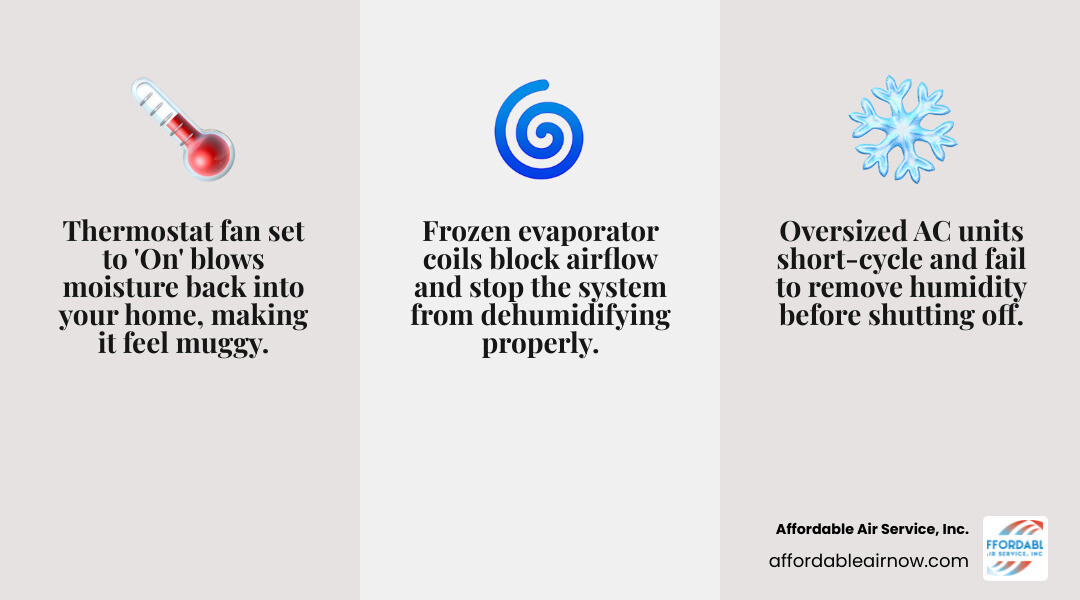
| Thermostat fan set to “On” | Fan runs constantly, blowing moisture back into your home |
| Dirty air filter | Restricted airflow prevents proper cooling and dehumidification |
| Oversized AC unit | Cools too fast, short-cycles before removing humidity |
| Frozen evaporator coils | Ice buildup blocks moisture removal |
| Low refrigerant | Leak reduces the system’s ability to cool and dehumidify |
| Leaky ductwork | Humid attic air gets pulled into your living spaces |
| High outdoor humidity | Overwhelms even a well-maintained system |
Florida’s Emerald Coast summers are no joke. When humidity sits at 80% or higher outside, your air conditioner has to work twice as hard — cooling the air and pulling moisture out of it. Most homeowners assume a running AC means a comfortable home. But temperature and humidity are two different problems, and your AC has to tackle both at the same time.
When something goes wrong with that process, your home can hit the right temperature on the thermostat but still feel sticky, stuffy, and uncomfortable. That damp, heavy feeling isn’t just unpleasant — it can signal a real issue with your system that needs attention.
The good news? Most causes are diagnosable and fixable. This guide walks you through exactly what to look for.
Why Is Your AC Running But House Still Warm and Muggy?
It is June 2026, and the heat along the Emerald Coast is in full swing. You come inside from a beautiful day at Miramar Beach, looking forward to a crisp, refreshing blast of cool air. Instead, you walk into a living room that feels like a swamp. The AC is humming, the vents are blowing, but you feel instantly sticky.
Why is your ac running but house still warm and muggy?
To understand this, we have to look at the dual job of any central air conditioning system. Your AC is not just a cold air machine; it is also a giant dehumidifier. In fact, in our coastal Florida climate, a massive portion of your system’s cooling capacity is spent simply pulling water out of the air. When your system loses its ability to balance temperature and moisture control, you get the worst of both worlds: a system that runs constantly, high energy bills, and a home that feels like a sauna.
If you are trying to understand how these two functions interact, you can read more about it in our guide on Sweating the Small Stuff: Dehumidification and Your AC.
The Science of AC Dehumidification
To fix the mugginess, we first have to understand how your system removes moisture. The process relies on thermodynamics and a few basic components:
- The Evaporator Coil: Located inside your indoor air handler, this coil is filled with freezing-cold refrigerant.
- Heat Transfer: Your system pulls warm, humid air from your home and blows it across this cold coil. As the warm air meets the cold metal, heat is absorbed by the refrigerant.
- Condensation: Just like a cold glass of sweet tea “sweats” on a hot day at a Destin harbor restaurant, the moisture in your home’s air condenses onto the cold evaporator coil.
- The Condensate Drain: This condensed water drips down into a drain pan and flows out of your home through a condensate drain line.
If the air moves too fast, if the coil is dirty, or if the system cycles off too quickly, this condensation process is cut short. The moisture stays suspended in your air, leaving you feeling sticky even if the air temperature drops slightly. For a deeper look into this battle, check out How Your Home’s Systems Fight the Coastal Humidity War.
How Outdoor Climate Impacts an AC Running But House Still Warm and Muggy
Living in places like Santa Rosa Beach, Fort Walton Beach, and Okaloosa Island means dealing with extreme humidity. On a typical summer afternoon, the outdoor relative humidity can easily exceed 80% or 90%.
When the outdoor air is saturated, your home’s structural integrity becomes your first line of defense. High outdoor humidity forces its way inside through a process called air leakage. Tiny gaps around your windows, deteriorated weatherstripping under doors, and unsealed penetrations in your attic allow hot, wet air to seep in constantly.
If your home has poor air barriers, your AC is forced to fight an endless supply of incoming moisture. This is why sealing your home is just as important as maintaining your equipment. To discover practical ways to protect your property, read our tips on how to Beat the Humidity with These Smart Ways to Cool Your Coastal Home.
Thermostat Settings and Airflow Bottlenecks
Sometimes, the reason your ac running but house still warm and muggy has nothing to do with broken machinery. Often, it comes down to a simple thermostat setting or a neglected maintenance chore. Before assuming you need a costly replacement, we always recommend checking these two common culprits. You can also explore our checklist on Troubleshooting Common AC Issues for more DIY steps.
Thermostat Fan Settings: Auto vs. On
One of the most common mistakes we see along the Emerald Coast is setting the thermostat fan to “On” instead of “Auto”.
- The “On” Setting: This tells your blower fan to run continuously, 24 hours a day, regardless of whether the system is actively cooling the air.
- The “Auto” Setting: This tells the fan to run only when the system is actively running a cooling cycle to lower the temperature.
Why does this matter for humidity? When your AC finishes a cooling cycle, the evaporator coil is soaking wet with condensed water. If your fan is set to “On,” it will keep blowing air across that wet coil even after the compressor shuts off. Instead of that water draining outside, the continuous airflow evaporates the water right back into your ductwork and distributes it throughout your home.
By switching your thermostat to “Auto,” you give the water time to drip down the coil and escape through the drain line. If you are struggling with lukewarm or humid air, read more in our guide: Don’t Sweat It: Troubleshooting Your Lukewarm Air Conditioner.
Clogged Air Filters and Restricted Airflow
An air conditioner needs steady, unrestricted airflow to do its job. A dirty air filter acts like a wall, creating an airflow bottleneck that starves your system of air.
When airflow is restricted, your system cannot pull enough warm, humid air across the evaporator coil. This causes the static pressure within your ductwork to rise and prevents the system from properly dehumidifying your home.
Aside from a dirty filter, several other common blockages can choke your system’s airflow:
- Furniture or drapes blocking return air grilles.
- Closed interior doors, which disrupt the balanced air pressure in your home.
- Closed or blocked supply vents in unused rooms (which actually increases duct pressure and causes system strain).
- Accumulated pet dander and dust on the blower wheel.
We recommend checking your air filter every 30 days, especially during the peak summer months in Florida when your system runs almost continuously.
Mechanical Failures and Sizing Issues
If your thermostat is set correctly and your air filter is clean, but your home still feels like a swamp, you may be dealing with a mechanical failure or an inherent system design issue. These problems limit your system’s overall capacity and require professional attention. For an overview of what might be going wrong, take a look at our guide on Common AC Repair Issues & Solutions.
Frozen Evaporator Coils and Low Refrigerant
A frozen evaporator coil is a classic reason why your house stays warm and sticky. While it might sound counterintuitive that an air conditioner covered in ice can’t cool your home, the ice actually acts as a thermal barrier. It insulates the coil, preventing the refrigerant from absorbing heat and moisture from your indoor air.
What causes this ice buildup?
- Restricted Airflow: If not enough warm air passes over the coil (due to a dirty filter or bad blower motor), the temperature of the coil drops below freezing, and the condensation turns to ice.
- Low Refrigerant Levels: If your system has a refrigerant leak, the drop in pressure causes the remaining refrigerant to expand too much, making the coil run extremely cold and freeze over.
Note: Refrigerant is contained in a closed-loop system and is never “used up” like gasoline. If your system is low, you have a leak that must be professionally located and repaired.
If you suspect your system is running constantly without dropping the temperature, read our detailed breakdown of AC Running Constantly But Not Cooling.
Oversized or Undersized AC Units
When it comes to air conditioners, bigger is definitely not better. Proper system sizing is critical for moisture control.
- Oversized Systems: An oversized AC unit will cool your home incredibly fast. While this might sound great, it leads to a problem called short-cycling. Because the unit reaches the thermostat setpoint in just 5 to 10 minutes, it shuts off. However, it takes at least 10 to 15 minutes of continuous run-time for the evaporator coil to get cold enough to start pulling significant moisture out of the air. The result? A home that is cold but incredibly damp and clammy.
- Undersized Systems: An undersized unit lacks the capacity to handle the heat load of your home during a hot Florida afternoon. It will run 24/7, wearing out its components, but will never manage to pull down the temperature or the humidity.
To ensure your system is sized correctly, HVAC professionals use a Manual J Load Calculation, which takes into account your home’s square footage, insulation, windows, and local climate.
| AC Sizing Mismatch | Primary Symptom | Impact on Comfort | Impact on System Lifespan |
|---|---|---|---|
| Oversized Unit | Short-cycling (runs for 5-10 mins then shuts off) | Cold but sticky, damp air; uneven temperatures | High wear and tear on compressor due to frequent starts |
| Undersized Unit | Runs continuously without reaching set temperature | Warm, muggy air throughout the entire home | Premature system failure due to constant operation |
Leaky Ductwork and Thermal Barriers
Your ductwork is the highway system that delivers conditioned air to your rooms. According to the Department of Energy, the average home loses 20% to 30% of its conditioned air through duct leaks.
In our service areas like DeFuniak Springs and Freeport, ductwork is often run through unconditioned attics or crawlspaces. During July and August, attic temperatures can easily skyrocket to 140°F to 160°F.
If your return ducts have leaks, they act like a vacuum, pulling superheated, humid attic air directly into your air conditioner. This warm air bypasses your home entirely, overwhelming your AC’s cooling capacity before the air even reaches your living spaces. If you are noticing uneven temperatures or suspect your ducts are failing, read about the AC Repair Top Signs.
Frequently Asked Questions About Humid Homes
Troubleshooting an AC Running But House Still Warm and Muggy
Q: What should I check first if my house is warm and sticky but the AC is running?
A: Start with these simple troubleshooting steps before calling for service:
- Check the Thermostat Fan Setting: Ensure it is set to “Auto,” not “On.”
- Inspect the Air Filter: If you cannot see light through it when holding it up to a light source, replace it immediately.
- Check the Vents: Ensure all supply and return vents are open and not blocked by furniture, rugs, or curtains.
- Examine the Outdoor Unit: Ensure there is at least two feet of clear space around your outdoor condenser unit, and clear away any grass clippings, leaves, or dirt.
What should my indoor humidity level be?
Q: What is the ideal relative humidity level for a home in Florida?
A: For optimal comfort, energy efficiency, and health, you should aim to keep your indoor relative humidity between 30% and 50%.
Keeping your humidity below 50% is critical for preventing mold growth, dust mite infestations, and musty odors. If your AC struggles to maintain this range even when running correctly, installing a whole-house dehumidifier alongside your central system can provide the extra moisture-removal power needed for our coastal climate.
When should I call a professional for AC repair?
Q: How do I know when a humidity issue requires a professional technician?
A: You should call a licensed HVAC professional immediately if you notice any of the following:
- Ice on your system: If you see frost on the copper refrigerant lines or the indoor evaporator coil.
- Strange noises: Squealing, grinding, or loud banging sounds coming from either the indoor or outdoor units.
- Frequent breaker trips: If your AC repeatedly trips your electrical panel’s circuit breakers.
- Refrigerant smells or leaks: Sweet or chemical odors, or pooling liquid near your air handler.
- Persistent warm air: If your system has a clean filter and open vents but continues to blow warm or lukewarm air for hours.
Conclusion
A warm, muggy home is more than just uncomfortable — it’s a sign that your air conditioning system is struggling to keep up with the demands of our Emerald Coast climate. Whether the fix is as simple as switching your thermostat fan to “Auto” or requires professional duct sealing, addressing the problem early will save you money on energy bills and protect your system from premature wear.
At Affordable Air Service, Inc., we have been keeping homes along the Emerald Coast cool and comfortable for decades. Proudly serving Santa Rosa Beach, Destin, Miramar Beach, Niceville, Freeport, DeFuniak Springs, and Fort Walton Beach, we are your local comfort experts.
As an authorized Daikin dealer, we offer advanced, high-efficiency systems like the Daikin Fit, which is designed specifically to handle extreme coastal humidity through variable-speed technology. We back our work with the Daikin Comfort Promise, offer flexible GoodLeap financing options, provide free estimates on replacements, and are available for 7-day service when you need us most.
Don’t spend another day sticky and uncomfortable. Schedule professional HVAC services today with Affordable Air Service, Inc., and let us restore the crisp, clean comfort your home deserves!