


Why Is My AC Running But Not Cooling? Quick Answers for Emerald Coast Homeowners
Why is my ac running but not cooling is one of the most common — and most frustrating — home comfort problems, especially during the sweltering summer months along Florida’s Emerald Coast. Your system is humming, the fan is blowing, and the electricity meter is spinning — but your home still feels like a sauna.
The good news? Many of the causes have straightforward fixes. Here’s a quick look at the most common reasons:
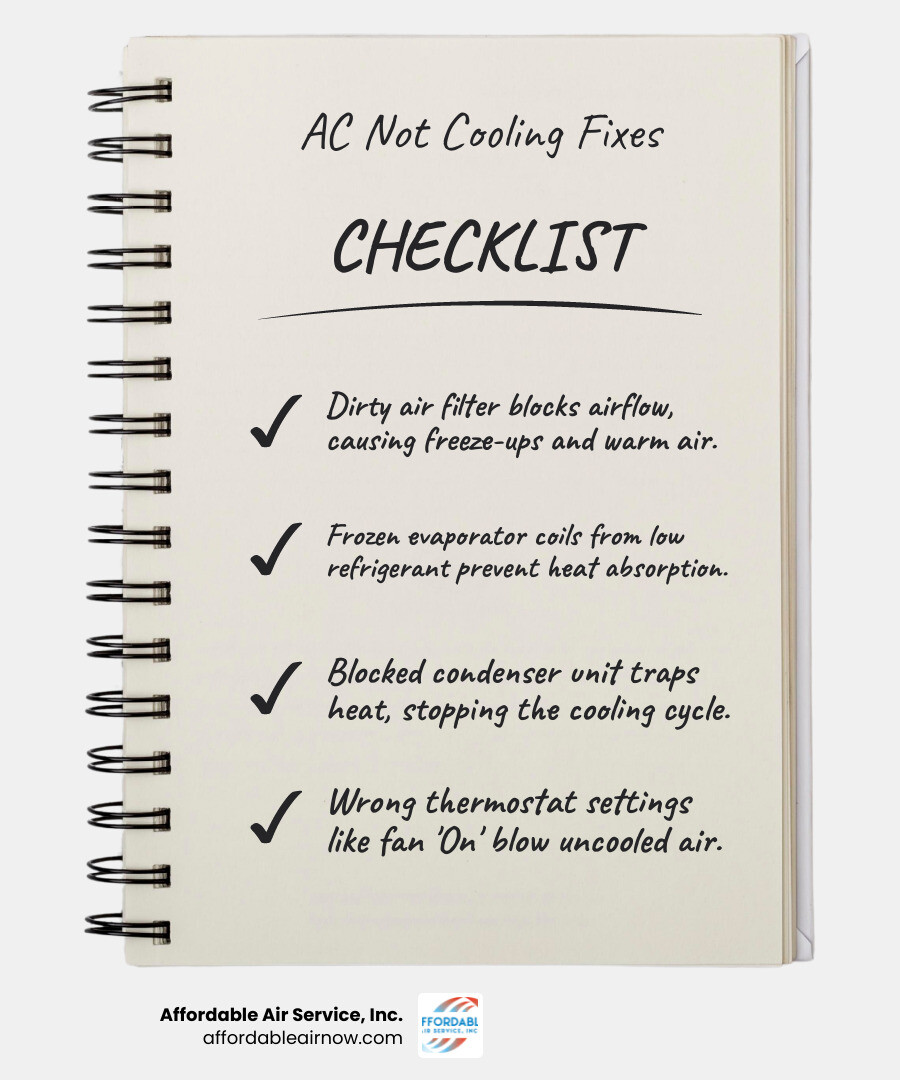
- Dirty air filter — A clogged filter blocks airflow and can cause the system to freeze up or blow warm air
- Wrong thermostat settings — Fan set to “On” instead of “Auto,” or the system accidentally left in heat mode
- Frozen evaporator coils — Ice buildup on the indoor coil prevents heat transfer
- Low refrigerant (refrigerant leak) — The system can’t absorb heat without enough refrigerant
- Dirty or blocked outdoor condenser unit — Debris and overgrown vegetation stop heat from escaping
- Faulty capacitor or condenser fan — The compressor may not be starting or running properly
- Leaky ductwork — Cooled air escapes into attics or crawlspaces before reaching your rooms
- Undersized or aging system — A unit that’s too small or too old simply can’t keep up
Some of these you can check yourself right now. Others need a licensed technician. This guide walks you through both, so you know exactly what to do next.
Common Reasons Why Your AC Is Running But Not Cooling
It is April 2026, and as the temperatures start to climb in Santa Rosa Beach and Destin, we begin to see more calls from homeowners experiencing cooling failures. When your air conditioner stays on but the temperature inside won’t budge, it usually means the refrigeration cycle has been interrupted.
The refrigeration cycle is a delicate balance. Your indoor unit (the evaporator) absorbs heat from your home’s air, and the outdoor unit (the condenser) releases that heat into the Florida air. If any part of this loop fails—whether due to a refrigerant leak or a mechanical issue—you’ll notice AC running constantly but not cooling. Identifying the top signs you need AC repair early can save you from a total system breakdown during a mid-summer heatwave.
Why is my ac running but not cooling due to thermostat settings?
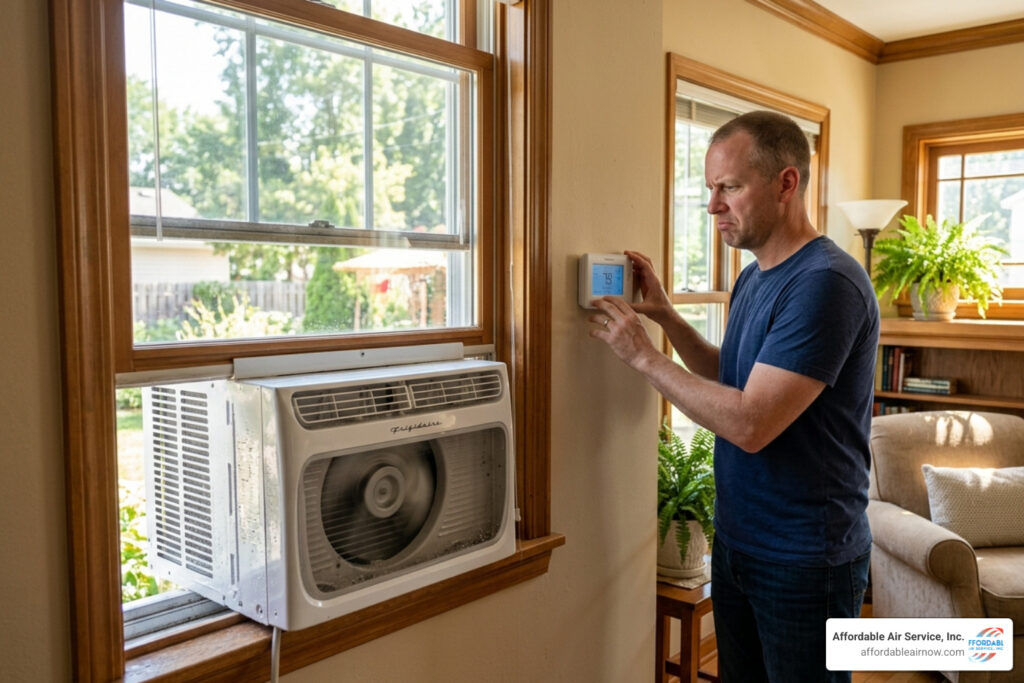
Sometimes the “fix” is as simple as a button press. Before you panic, we always recommend checking the thermostat. It is the brain of your HVAC system, and if it’s miscommunicating, the rest of the unit won’t work correctly.
First, check the Fan Mode. If your fan is set to “On” instead of “Auto,” the blower will run 24/7, even when the outdoor compressor isn’t cooling the air. This results in lukewarm air blowing through your vents during the “off” cycles. Switching it to “Auto” ensures the fan only blows when the air is actually being cooled.
Second, verify the Cooling Mode. It sounds silly, but after a mild spring in Miramar Beach, many systems are accidentally left in “Heat” or “Fan” mode. Ensure it is firmly set to “Cool” and that the temperature is set at least 5 degrees below the current room temperature. If the screen is blank or flashing, it might just need a battery replacement. Lastly, consider the sensor placement; if your thermostat is near a sunny window or a heat-producing lamp, it will misread the room’s temperature and cycle incorrectly. For more details, see our guide on troubleshooting common AC issues.
Why is my ac running but not cooling with frozen coils?
It seems contradictory, but your air conditioner can actually freeze solid in the middle of a 90-degree afternoon. When your AC evaporator coil is freezing, a layer of ice forms over the metal fins. This ice acts as an insulator, preventing the refrigerant inside the coils from absorbing heat from your home.
This usually happens for two reasons: restricted airflow (like a dirty filter) or low refrigerant levels. When airflow is blocked, the coil gets too cold and moisture from our humid Emerald Coast air turns into ice. If you see frost on the copper lines or water pooling around your indoor unit, turn the system off immediately to let it thaw. Continuing to run it can cause “slugging,” where liquid refrigerant returns to the compressor and destroys it.
Essential DIY Maintenance for Better Airflow

Most of the “lukewarm air” calls we receive can be prevented with simple, routine maintenance. Airflow is the lifeblood of your HVAC system. When air can’t move freely, the system works harder, uses more electricity, and eventually stops cooling altogether. Taking a few minutes to walk through these AC repair solutions can often restore your comfort immediately.
Inspecting and Replacing Clogged Air Filters
The number one reason for an AC running without cooling is a dirty air filter. Over time, filters trap dust, pet dander, and pollen. If left too long, that filter becomes a “gray felt blanket” that chokes your system.
We recommend checking your filter every 30 days, especially during the peak cooling season in Destin and Fort Walton Beach. While some high-efficiency MERV-rated filters claim to last 90 days, our local humidity and salt air can cause them to clog faster. If you hold your filter up to a light and can’t see through it, it’s time for a new one. A clean filter ensures high airflow velocity, which keeps your coils at the right temperature and your home cool.
Clearing the Outdoor Condenser Unit
Your outdoor unit needs to “breathe” to dump the heat it collected from inside your home. If the metal fins on the condenser are coated in dirt, grass clippings, or pollen, the heat stays trapped.
Take a walk outside and inspect the area around your unit. We suggest maintaining at least two feet of clearance from plants, shrubs, and debris. If the unit looks dirty, you can gently rinse it with a garden hose on a low-pressure setting. Never use a pressure washer, as it can easily bend the delicate aluminum fins and block airflow permanently. If you notice the AC fan is not working but the unit is still running, the motor may be overheated or blocked by debris.
Mechanical Failures and Electrical Components
Sometimes, the issue is deeper than a dirty filter. Your AC relies on several heavy-duty electrical components to function. If one of these fails, the indoor fan might still blow air, but the outdoor unit won’t be able to provide any cooling.
Signs of a Faulty Compressor or Capacitor
The compressor is the heart of your system, and the capacitor is like the “battery” that gives it the jolt of energy it needs to start. If you hear a faint humming sound coming from your outdoor unit but the fan isn’t spinning, you likely have a failed start or run capacitor. These components are particularly prone to failure in the high heat of Florida summers.
A faulty compressor is a more serious issue. Signs include loud grinding noises, the system frequently tripping the circuit breaker, or “hard starting,” where the unit struggles to kick on.
| Feature | DIY Troubleshooting | Professional Repair Required |
|---|---|---|
| Thermostat | Check batteries & settings | Wiring or sensor replacement |
| Air Filter | Replace every 30-90 days | N/A |
| Condenser Unit | Clear debris & rinse | Fan motor replacement |
| Refrigerant | N/A (Illegal/Unsafe) | Leak detection & recharge |
| Capacitor | N/A (High Voltage) | Testing & replacement |
| Compressor | N/A | Complex mechanical repair |
Identifying Leaky Ductwork and Blocked Vents
You could have the most efficient AC in Santa Rosa Beach, but if your ducts are leaking, that cold air is cooling your attic instead of your bedroom. The Department of Energy estimates that the typical home loses 20% to 30% of conditioned air through duct leaks.
Check your supply registers (where the air comes out) and return grilles (where air goes in). Ensure they aren’t blocked by furniture or curtains. If some rooms are much warmer than others, you may have a disconnected or collapsed duct in the crawlspace or attic. Sealing these gaps can significantly improve your system’s ability to cool your home.
When to Call a Professional for AC Repair in Santa Rosa Beach
While we love empowering homeowners to handle basic maintenance, certain tasks require specialized tools and training. If you’ve changed your filter and checked your thermostat but the air is still warm, it’s time to call in the experts.
Handling refrigerant, for example, requires EPA Section 608 certification. Refrigerant doesn’t get “used up” like gas in a car; if it’s low, you have a leak that must be found and sealed. Similarly, testing high-voltage capacitors or working with complex circuit boards can be dangerous without the proper equipment. If you need AC repair in Santa Rosa Beach or emergency service in Destin, we are here to help 7 days a week.
Evaluating System Sizing and Performance
If your AC runs all day but only struggles when the afternoon sun hits your Miramar Beach home, the unit might be undersized. An AC’s capacity is measured in BTUs (British Thermal Units). If the heat load of your home—determined by square footage, insulation, and window placement—is higher than the system’s capacity, it will never reach the set temperature on a hot day. Regular HVAC service includes performance testing to see if your system is actually meeting its design specifications.
Deciding Between Repair and Replacement
Most AC systems have a lifespan of 10 to 15 years. If your unit is approaching its second decade and requires frequent, expensive repairs, it may be more cost-effective to consider a replacement. Modern systems, like the Daikin Fit, offer much higher efficiency ratings and better humidity control than older models. We can help you determine when to consider AC replacement versus when a simple repair will suffice.
Frequently Asked Questions about AC Cooling Issues
Should I turn off my AC if it is running but not blowing cold air?
Yes. If your system is running but not cooling, it is likely straining the compressor or running with frozen coils. Turning it off prevents further mechanical damage. You can switch the thermostat to “Fan Only” mode to keep air circulating while you wait for a technician to arrive.
How do I know if my AC has a refrigerant leak?
Common signs of a refrigerant leak include hissing or bubbling sounds near the indoor air handler, ice buildup on the copper refrigerant lines, and a noticeable drop in cooling efficiency even though the fan is running. Only a professional can legally test and repair refrigerant leaks.
Why does my AC work in the morning but struggle in the afternoon?
This is common on the Emerald Coast. In the morning, the “heat load” on your home is low. As the sun rises and the humidity increases, an undersized system, a dirty condenser, or a unit low on refrigerant will fall behind. It’s not necessarily “broken,” but it is likely inefficient or struggling with the peak Florida heat.
Conclusion
At Affordable Air Service, we know that a broken AC is more than just an inconvenience—it’s a threat to your comfort and your home’s air quality. Whether you’re in Santa Rosa Beach, Freeport, or Fort Walton Beach, we are committed to providing the Emerald Coast with reliable, 7-day service.
From simple filter changes to complex Daikin Fit installations, our team is here to ensure you don’t have to sweat through the summer. We offer free estimates and stand behind our work with the Daikin Comfort Promise. If your air conditioner is running but failing to keep you cool, don’t wait for the problem to get worse. Contact us today to get your home back to the perfect temperature.