


I’m trying to decide if I should repair or replace my AC in Santa Rosa Beach. How does the 5000 dollar rule for ac replacement work?
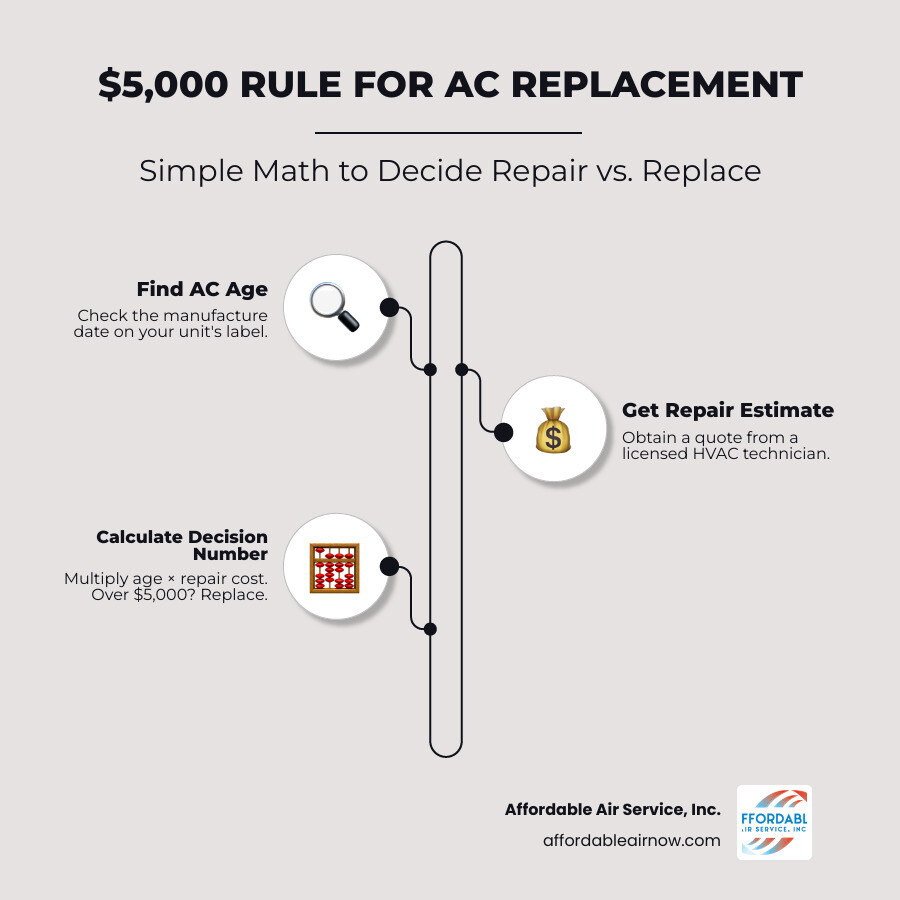
The 5000 dollar rule for ac replacement is a simple formula that helps homeowners decide whether to repair or replace their air conditioner: multiply your unit’s age (in years) by the scope of the repair. If the result is over 5,000, replacement is usually the smarter move. If it’s under 5,000, a repair is likely worth it.
Quick Answer: How the $5,000 Rule Works
| Step | What to Do |
|---|---|
| 1 | Find out how old your AC unit is |
| 2 | Have a licensed technician diagnose the repair needed |
| 3 | Multiply: Age x Repair Factor = Decision Number |
| 4 | If Decision Number is over 5,000 – consider replacement |
| 5 | If Decision Number is under 5,000 – repair is likely fine |
When your AC breaks down on a sweltering summer day along Florida’s Emerald Coast, the pressure to make a fast call is real. Do you move forward with a repair and hope it holds? Or do you replace the whole system? Most homeowners freeze up – not because they’re bad decision-makers, but because nobody gave them a clear framework.
That’s exactly where the $5,000 rule comes in. It’s a trusted benchmark that removes much of the guesswork and emotion from what can feel like an overwhelming home-comfort decision. And for homeowners in Santa Rosa Beach, Destin, and across the 30A corridor – where coastal humidity and heat put extra stress on AC systems – having a reliable rule of thumb isn’t just helpful. It can keep you from putting more time and effort into a system that’s already on its way out.
What is the 5000 Dollar Rule for AC Replacement?
In the HVAC world, homeowners often get stuck in a cycle of repeated repairs. The 5000 dollar rule for ac replacement acts as a mathematical benchmark designed to help stop that cycle.
Think of it as your “Decision Number.” This standard serves as a practical tool to help you avoid investing more time and effort into a system that is nearing the end of its useful life. By using a hard number rather than a gut feeling, you can look at the health of your unit more objectively. While it isn’t a strict law of physics, it is a useful way to identify AC Replacement Key Indicators before your system becomes a bigger headache.
Calculating Your Decision Number with the 5000 Dollar Rule for AC Replacement
Applying the rule is straightforward. You only need two pieces of information: the age of your unit and the scope of the current repair.
- Find the Age: Look at the manufacturer’s label on your outdoor condenser. It usually lists the manufacture date. If it only lists a serial number, you can often look that up online to find the year it was built.
- Get the Diagnosis: Have a professional technician provide a clear explanation of the necessary repair.
- Do the Math: Multiply the age (years) by the repair factor.
If the resulting Decision Number is greater than 5,000, the rule suggests that a replacement is the more practical long-term path. This calculation helps remove emotion from the decision and gives you a clear guideline.
Real-Life Examples of the 5000 Dollar Rule for AC Replacement
Let’s look at how this plays out in common scenarios we see here in Santa Rosa Beach and Destin.
- Scenario A (The Aging “Old Timer”): You have an older unit that requires a major repair, such as a new blower motor. When the age of the unit is multiplied by the scale of the repair, the resulting number often exceeds the 5,000 threshold, indicating that replacement is likely the wiser move.
- Scenario B (The Mid-Life Glitch): You have a relatively young unit with a minor component failure. In this case, the age multiplied by the repair factor typically stays well under the threshold, suggesting that a repair makes the most sense.
Why System Age and Efficiency Matter Beyond the Math
While the math is a great starting point, we also have to look at the reality of living on the Emerald Coast. Nationally, AC systems might last 15 to 20 years. However, in our humid coastal climate, the average lifespan is often closer to 10 to 15 years. This is what we call The 10-Year Itch: Average AC Lifespan in Humid Coastal Climates.
As a system ages, it doesn’t just break down more often; it can also become less efficient to run. Modern systems are held to SEER2 (Seasonal Energy Efficiency Ratio) standards that were unimaginable a decade ago. If your current unit is over 10 years old, it is likely running at a much lower efficiency than a modern model, which can lead to noticeably higher monthly utility use.
The Impact of Coastal Salt Air on Longevity
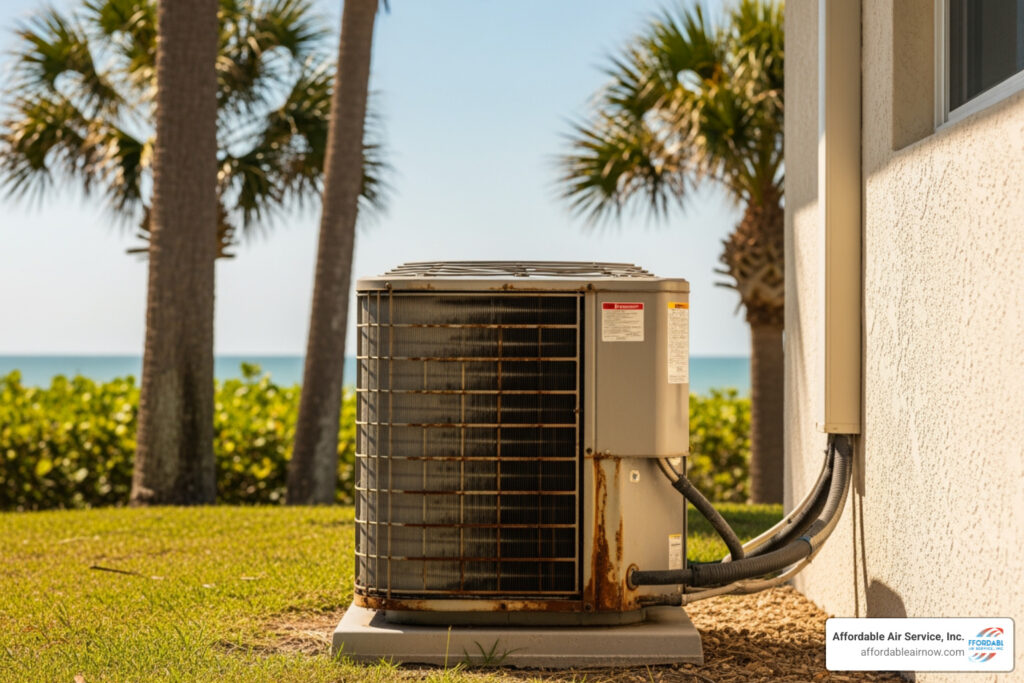
Living near the Gulf is beautiful, but the salt air is brutal on HVAC equipment. Salt spray causes corrosion on the delicate aluminum fins and copper coils of your outdoor unit. This corrosion forces the system to work harder to dissipate heat, which shortens its lifespan.
If you are in Destin or Miramar Beach, a 12-year-old unit might have the internal wear and tear of a much older unit in a landlocked state. This is why maintenance history matters so much. A well-maintained unit can fight off corrosion longer, but once the salt takes hold, the $5,000 rule becomes even more relevant. If you’re seeing signs of heavy rust and coil decay, it might be time to look into AC Replacement Services in Destin, FL.
Energy Efficiency and Utility Savings
One of the biggest arguments for replacement – even if your repair falls near the $5,000 mark – is the long-term benefit of improved efficiency. Modern technology, like variable-speed compressors found in Daikin Fit systems, allows the AC to adjust its cooling output precisely. Instead of being “all on” or “all off,” it uses only the energy needed to maintain a steady temperature.
Upgrading can improve comfort, humidity control, and overall system performance over the long run. Knowing When to Consider AC Replacement involves looking at your system’s efficiency and reliability just as much as the immediate repair need.
Critical Factors: Refrigerant Types and Repair History
Beyond the age and the scope of a single repair, we also have to look at what’s inside the machine. If your unit was manufactured before 2010, there is a high chance it uses R-22 refrigerant (often called Freon). The EPA phased out R-22 because it depletes the ozone layer, which means these older systems can be harder to keep going over time.
If you have an R-22 system with a refrigerant leak, the $5,000 rule often points toward replacement. A refrigerant-related issue on an older system can quickly become a sign that the unit is reaching the end of its service life. Furthermore, we use the “3-in-3 rule” as a secondary check: if your unit has required three significant repairs in the last three years, it’s telling you it’s ready to retire. Frequent breakdowns are one of the most common AC Replacement Warning Signs.
When to Break the Rule: Exceptions for Homeowners
Mathematics is a guide, not a master. There are times when the $5,000 rule suggests one thing, but common sense suggests another.
- Manufacturer Warranties: If your unit is 9 years old but still under a 10-year parts warranty, the repair may still be attractive even if the age is high.
- Moving Soon: If you plan to sell your home in the next six months, you might opt for a repair just to keep the system functional for the sale, though a new system can also improve buyer appeal.
- Minor Fixes: If the issue is just a clogged drain line or a faulty thermostat, these are maintenance issues rather than systemic failures.
- Safety Hazards: If your technician finds a cracked heat exchanger (in a furnace/heat pump) or dangerous electrical arcing, safety trumps math. You should replace the unit immediately to protect your family.
In these cases, it Makes More Sense to Replace Your AC Than Fix It regardless of what the multiplication says.
Frequently Asked Questions about AC Replacement Decisions
How long do AC systems typically last in Santa Rosa Beach?
Due to the intense heat and the corrosive salt air, most systems in Santa Rosa Beach last between 10 and 15 years. Annual maintenance is the single most important factor in reaching that 15-year mark. Without it, coastal units can fail in as little as 8 years. If you’re unsure where your unit stands, check out our guide on How to Tell if Your AC is About to Quit.
Does the 5000 dollar rule apply to heat pumps or furnaces?
Yes. The logic of weighing age against the seriousness of a repair applies across the HVAC spectrum. Since heat pumps in Florida often run year-round (cooling in summer, heating in our brief winters), they actually accumulate “mileage” faster than a furnace in colder regions might. The $5,000 threshold remains a solid benchmark for these systems as well.
What are the long-term benefits of upgrading to a new system?
Beyond improved efficiency, a new system brings peace of mind. Affordable Air Service offers Daikin systems along with the Daikin Comfort Promise and the Daikin Worry-Free 12-Year Warranty. You’ll also enjoy better indoor air quality, quieter operation, and stronger humidity control – which is especially valuable for Emerald Coast summers.
Conclusion: Get a Professional Evaluation You Can Trust
Deciding whether to keep repairing an older AC or invest in a new one is a major milestone in homeownership. While the 5000 dollar rule for ac replacement provides a helpful mathematical safety net, it works best when paired with a professional evaluation.
At Affordable Air Service, we’ve spent years helping our neighbors in Santa Rosa Beach, Fort Walton Beach, and Destin navigate these tough calls. We offer easy financing through GoodLeap to make the transition to a new, efficient system as stress-free as possible. Don’t let HVAC problems ruin your summer. Let us help you review the condition of your system and find the solution that keeps your home cool and comfortable.
For a deeper dive into the process, read Everything You Need to Know About AC Replacement in Destin and contact us to schedule your 7-day service.