


Why HVAC Condition Affects Home Appraisals More Than Most Homeowners Realize
How HVAC condition affects home appraisals is one of the most financially significant factors homeowners along Florida’s Emerald Coast overlook when preparing to sell, refinance, or apply for a home equity line of credit. A failing or outdated system can quietly cost you thousands in appraised value — sometimes before you even know there’s a problem.
Here is a quick summary of how your HVAC system influences your home’s appraised value:
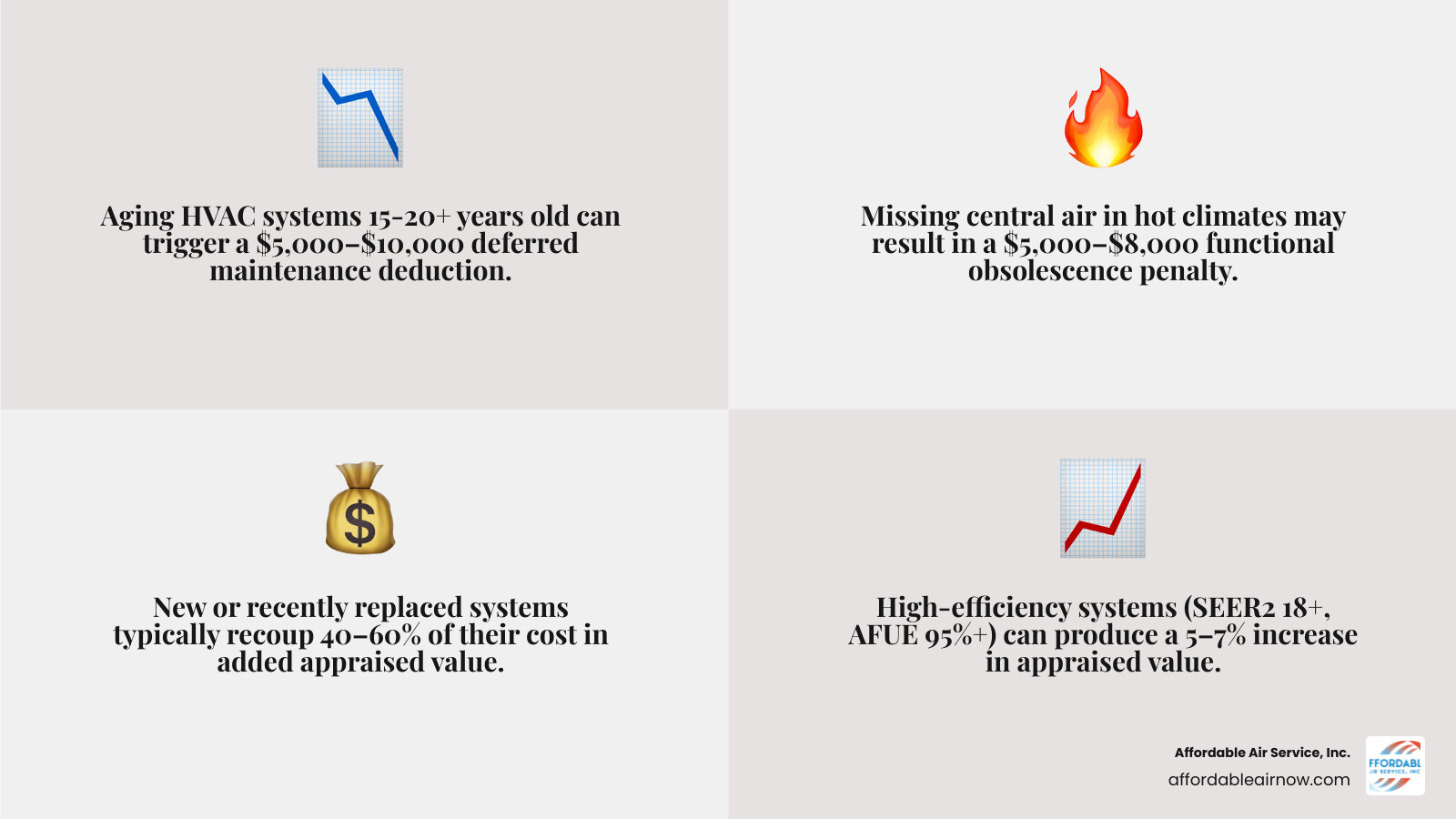
- Aging systems (15-20+ years old): Can trigger a $5,000–$10,000 deferred maintenance deduction
- Missing central air in a hot climate: May result in a $5,000–$8,000 functional obsolescence penalty
- New or recently replaced system: Typically recoups 40–60% of its cost in added appraised value
- High-efficiency system (SEER2 18+, AFUE 95%+): Can produce a 5–7% increase in appraised value with 50–80% ROI
- Well-documented, well-maintained system: Protects your existing equity and supports a favorable condition rating
Appraisers evaluate your heating and cooling system as a core functional component of your home — right alongside the roof, plumbing, and electrical systems. They are not performing a deep technical inspection. Instead, they look at visible condition, age, basic operation, and remaining useful life. What they see — or don’t see — directly shapes your home’s overall condition rating and final appraised value.
On the Emerald Coast, where summer heat and coastal humidity put HVAC systems under serious stress year-round, the stakes are even higher. A system that struggles or shows visible wear sends a clear signal to appraisers and buyers alike.
The good news is that with the right preparation — proper maintenance, smart upgrades, and solid documentation — your HVAC system can be an asset rather than a liability when the appraiser walks through your door.
How Appraisers Evaluate Heating and Cooling Systems
To understand how hvac condition affects home appraisals, we must first look at the process through the eyes of a professional appraiser. Appraisers are bound by the Uniform Standards of Professional Appraisal Practice (USPAP). Under these guidelines, they must evaluate the overall physical condition and functional utility of the property.
Unlike a home inspector, an appraiser does not dismantle your outdoor condenser or run diagnostic tests on your compressor. Instead, they rely on a combination of visual inspection, functional testing, and historical data verification.
During their evaluation, they document:
- Manufacturer Data Plates: Appraisers locate the metal data plates on both the indoor air handler and the outdoor condenser unit. They record the brand, model number, and serial number.
- Decoded Serial Numbers: Using specialized industry databases, appraisers decode these serial numbers to determine the exact month and year of manufacture.
- Remaining Useful Life (RUL): Based on the system’s chronological age and visible wear, the appraiser estimates how many years of reliable service the system has left. If a system is past its expected lifespan, its RUL may be listed as zero, turning an essential home feature into an immediate financial liability.
How hvac condition affects home appraisals during the walkthrough
As the appraiser moves through your home, they perform a basic functional check. They will walk over to your thermostat, turn on the air conditioning or heating, and verify that the system responds promptly without unusual delays, loud clicks, or screeching noises.
They also pay close attention to:
- Airflow Quality and Temperature: They will feel the air coming from the registers to ensure the system is blowing strong, conditioned air.
- Physical Wear and Tear: They look for visible signs of neglect, such as heavy dust buildup on vents, rusted drain pans, or a clogged, dirty air filter.
A dirty air filter might seem like a minor issue, but to an appraiser, it acts as a warning sign. It suggests that the homeowner has neglected routine maintenance, which can lead to a more critical evaluation of other home systems. Furthermore, a severely clogged filter can restrict airflow so badly that the system short-cycles or fails to cool properly during the walkthrough, resulting in an unfavorable mark. This is why keeping up with regular care is so important; you can read more about this in our guide on Why Regular HVAC Service is Essential.
Deciphering the Appraiser’s Physical Condition Rating
Your HVAC system plays a major role in determining your home’s overall “Condition Rating” on standard appraisal forms (such as the Fannie Mae 1004 form). These ratings range from C1 (excellent/brand new) to C6 (severe physical deficiencies).
If your home has a neglected, aging HVAC system, it is incredibly difficult to secure a top-tier C2 or C3 rating. Instead, the appraiser may flag the system as “deferred maintenance.” This shifts the system from an equity-building asset to a liability, potentially dragging your entire home down to a C4 or C5 rating.
Lenders look at these ratings closely. A lower rating can negatively affect your loan approval or refinancing options. Taking steps to keep your equipment in peak shape is key to protecting your property’s overall score. To keep your system running smoothly and looking its best for the appraiser, check out our practical tips to Extend the Life of Your Air Conditioner.
How HVAC Condition Affects Home Appraisals: Red Flags and Value Penalties

When an appraiser identifies major problems with your heating and cooling setup, they don’t just note it in the report—they apply direct value penalties. These deductions can easily wipe out thousands of dollars of your hard-earned equity.
Here are the most common HVAC red flags that trigger appraisal deductions:
- Phased-Out R-22 Refrigerant: If your air conditioner was manufactured before 2010, there is a high chance it operates on R-22 (Freon). Because the EPA has completely phased out this ozone-depleting chemical, repairing these older units is incredibly expensive. Appraisers know this and often treat R-22 systems as having zero remaining useful life, triggering an immediate deferred maintenance penalty.
- Visible Rust and Corrosion: On the Emerald Coast, salty sea air can quickly eat away at outdoor equipment. If your condenser’s fins are crumbling or the cabinet is covered in heavy rust, the appraiser will note this as a sign of advanced wear and impending failure.
- Leaky or Damaged Ductwork: According to the U.S. Department of Energy, leaky ducts can reduce system efficiency by 20% to 30%. If an appraiser spots collapsed ducts in an attic or crawlspace, they will penalize the home’s functional utility.
- Code Violations and Unpermitted Work: Installing a new system without pulling the required local permits is a major risk. Appraisers often cross-reference municipal records. If they discover unpermitted HVAC work, or notice safety issues like improper furnace venting or a missing sediment trap on a gas line, they will flag the property. This can delay your sale or refinance until a licensed professional corrects the issue and secures the proper permits.
The Cost of Missing Central Air in Hot Climates
In our hot, humid local market, central air conditioning has transitioned from a luxury to a baseline expectation. If your home relies on window units or portable air conditioners instead of a dedicated central system, appraisers will apply a “functional obsolescence” penalty.
In communities like Destin, Miramar Beach, or Santa Rosa Beach, missing central air can trigger an automatic value deduction of $5,000 to $8,000. The appraiser must adjust your home’s value downward to match the local market standards, as buyers expect turn-key comfort.
Furthermore, our intense coastal humidity can quickly lead to indoor air quality issues if a home lacks proper climate control. For vacation rentals and permanent residences alike along the Emerald Coast, the ocean air takes a unique toll on equipment. To understand how our local environment affects your system’s lifespan, read about The 10-Year Itch: Average AC Lifespan in Humid Coastal Climates.
Efficiency Metrics and Their Impact on Property Valuation
Modern appraisals increasingly recognize the value of green building practices and high-efficiency mechanical systems. High-efficiency systems cut monthly utility bills by 10% to 30%, which translates directly into lower operating costs—a feature appraisers can highlight as a positive adjustment.
When assessing your system’s efficiency, appraisers look at three core metrics:
- SEER2 (Seasonal Energy Efficiency Ratio 2): Measures cooling efficiency. Standard systems typically range from 14.3 to 15 SEER2, while premium high-efficiency units reach 18 SEER2 or higher.
- AFUE (Annual Fuel Utilization Efficiency): Measures heating efficiency for gas furnaces, with premium systems scoring 95% or higher.
- ENERGY STAR Certification: Tells the appraiser and potential buyers that the system meets strict energy efficiency guidelines set by the EPA.
To see how these different efficiency levels can influence an appraiser’s adjustments compared to a standard, older system, review the general market trends below:
| HVAC System Type & Efficiency | Typical Appraisal Adjustment | Buyer Appeal & Marketability Impact |
|---|---|---|
| Aging / Failing System (R-22, 15+ years old) | -$5,000 to -$10,000 | Extremely Low (Flagged as immediate repair cost) |
| Missing Central Air (Window units only) | -$5,000 to -$8,000 | Low (Functional obsolescence penalty applied) |
| Standard Replacement (14-15 SEER2) | Baseline / Neutral | Stable (Meets basic neighborhood standards) |
| Mid-Range Efficient (16-17 SEER2) | +$1,000 to +$2,000 | Good (Attractive lower utility costs) |
| High-Efficiency Premium (18+ SEER2, 95%+ AFUE) | +$3,000 to +$5,000+ | Excellent (Premium asset, green home appeal) |
Transitioning to high-efficiency equipment, such as modern heat pump conversions or variable-speed systems, can elevate your home’s value above comparable properties that only feature standard, builder-grade units.
Maximizing ROI: When to Repair vs. Replace Before an Appraisal
If your heating and cooling system is showing its age, you face a common dilemma: should you pay for repairs or invest in a full replacement before the appraiser arrives?
While a complete HVAC replacement is a significant investment, it typically recoups 40% to 60% of its cost in immediate added home value. When you factor in the prevention of a $5,000 to $10,000 deferred maintenance penalty, the real-world return on investment is often much higher.
To help make your decision, consider these guidelines:
- When to Repair: If your system is under 10 to 12 years old, has a documented history of regular professional maintenance, and only requires a minor fix (like a new capacitor or fan motor), repairing is usually the smartest path. A clean, fully functional system will receive a neutral rating, protecting your home’s existing value.
- When to Replace: If your system is over 15 years old, uses R-22 refrigerant, or has a cracked heat exchanger or failing compressor, replacement is almost always the more strategic move. Leaving a broken or dying system in place guarantees a steep penalty on your appraisal report.
Investing in a modern, reliable system removes the negative condition flag entirely, giving the appraiser a reason to rate your home’s physical condition favorably. If you are trying to decide which route is best for your current situation, read our expert advice on When It Makes More Sense to Replace Your AC Than Fix It.
How hvac condition affects home appraisals for home equity lines of credit
If you are applying for a Home Equity Line of Credit (HELOC) or a cash-out refinance, the appraisal is the single most important factor determining your borrowing power. Lenders calculate your credit limit based on your Loan-to-Value (LTV) ratio.
If a failing HVAC system causes a $10,000 deduction in your home’s appraised value, it can shrink your available equity cushion. In some cases, this drop in value can push your LTV ratio past the lender’s maximum threshold, leading to a reduced credit limit or even a complete loan denial.
Replacing a failing system before applying for a HELOC acts as an equity safeguard. It ensures you don’t leave borrowing power on the table. To learn how upgrading your equipment stops equity drain, check out our guide on how to Stop Pouring Money Down the Drain and Replace Your AC.
Essential Documentation to Provide During the Appraisal Process
Do not rely on the appraiser to notice your high-efficiency system or guess its age during their brief walkthrough. Appraisers appreciate clear, verifiable facts. The best way to ensure your heating and cooling upgrades are properly credited is by preparing an “HVAC Portfolio” and handing it directly to the appraiser when they arrive.
Your portfolio should be organized in a neat folder and include the following documents:
- Installation Invoices: Showing the exact date of installation, the name of the licensed contractor, and the total scope of work.
- Manufacturer Specifications: Documenting the exact model numbers, serial numbers, and official efficiency ratings (such as SEER2, AFUE, or HSPF2).
- Permit Records: Proof that all required local municipal permits were pulled, signed off, and closed by local building inspectors.
- Warranty Documentation: Proof of any active equipment warranties, especially if they are transferable to a new homeowner.
- Service History Logs: A dated log of all professional maintenance visits, safety inspections, and filter replacements. This proves to the appraiser that the system has been cared for throughout its life.
Providing this level of detail makes it incredibly easy for the appraiser to verify your system’s value. It leaves no room for conservative estimates or “unknown” age marks on your appraisal report.
Frequently Asked Questions about HVAC and Appraisals
Will a new HVAC system increase my HELOC credit limit?
While a brand-new heating and cooling system won’t single-handedly skyrocket your home’s value, it acts as an essential equity safeguard. By preventing steep “deferred maintenance” deductions of $5,000 to $10,000, a new system protects your home’s maximum appraised value.
Keeping your valuation high keeps your Loan-to-Value (LTV) ratio in a favorable range, allowing you to access the maximum credit limit possible. Additionally, a new, worry-free system dramatically boosts your home’s marketability if you decide to sell in the future. For an honest look at how these upgrades impact a sale, check out Does a New HVAC Help Sell Your Home Faster? The Cold Hard Truth.
How old does an HVAC system need to be before it hurts my appraisal?
Generally, the 15-year mark is when heating and cooling systems transition from assets to liabilities in the eyes of an appraiser. However, “effective age” often matters more than chronological age.
A well-maintained, clean 16-year-old system with a documented service history may receive a neutral rating. Conversely, a neglected, rusted 10-year-old system showing signs of struggle will likely trigger immediate value penalties.
Is getting my HVAC serviced before an appraisal worth it?
Yes, absolutely. Scheduling a professional maintenance visit before your appraisal is highly recommended.
A fresh service sticker on your indoor air handler, a clean outdoor condenser coil free of leaves and debris, and a brand-new air filter send a clear message. It shows the appraiser that you are a responsible homeowner who takes care of the property, building their confidence in the overall condition of your home.
Conclusion
Understanding how hvac condition affects home appraisals is key to protecting your home’s equity, whether you are planning to sell, refinance, or secure a HELOC. Your heating and cooling system is a core pillar of your home’s functional value. Leaving its condition to chance can lead to unexpected and costly value penalties.
At Affordable Air Service, we have been helping homeowners and property managers along Florida’s Emerald Coast protect their comfort and their property value for years. Based at 116 Bishop-Tolbert Road, Santa Rosa Beach, FL 32459, we proudly serve Santa Rosa Beach, DeFuniak Springs, Fort Walton Beach, Okaloosa Island, Miramar Beach, Destin, and Freeport.
Whether you need a quick pre-appraisal system tune-up, a prompt repair, or a complete system upgrade, our experienced team is here to help. As an authorized Daikin dealer, we specialize in high-efficiency Daikin Fit systems that deliver quiet, energy-saving performance perfect for our coastal climate. We offer:
- 7-day service availability to fit your busy schedule
- Free estimates on system replacements
- Flexible financing options through our partnership with GoodLeap
- Peace of mind with the Daikin Comfort Promise
Don’t let an aging or neglected system drag down your home’s value.
Schedule your professional HVAC evaluation today with Affordable Air Service