



Why Heat Pump Advantages Over Traditional HVAC Matter for Emerald Coast Homeowners
If you’re weighing the heat pump advantages over traditional HVAC systems, here’s the short answer: heat pumps heat and cool your home using a fraction of the energy that furnaces, electric resistance heaters, or central AC units require — and they do it with a single system.
Quick answer — top heat pump advantages over traditional HVAC:
- Higher efficiency — Heat pumps deliver 2 to 4 times more energy than they consume, compared to 80–98% efficiency for gas furnaces
- Dual functionality — One system handles both heating and cooling year-round
- Lower energy bills — Average households save $370–$1,000 per year after switching
- Reduced carbon footprint — Air-source heat pumps cut household CO2 emissions by roughly 40% compared to gas furnaces
- Better comfort — Variable-speed technology maintains steadier temperatures and improved humidity control
- Longer lifespan — Heat pumps can last 15 to 25 years with proper maintenance
- Financial incentives — Federal tax credits and utility rebates are available in 2026
For homeowners along Florida’s Emerald Coast, this is especially relevant. The mild winters and long, humid summers here make heat pumps a near-perfect fit — you get powerful cooling with high SEER2 ratings and efficient heating without the need for a gas furnace. In 2024, heat pumps outsold traditional gas furnaces in the U.S. for the first time, with more than 5 million units sold. That shift isn’t just a trend — it reflects real savings and real performance gains that homeowners are experiencing.
Whether your current system is aging, your energy bills keep climbing, or you’re simply looking for a smarter setup for your Santa Rosa Beach home or vacation rental, understanding how heat pumps stack up against traditional HVAC is a great place to start.
Understanding the Heat Pump Advantages Over Traditional HVAC

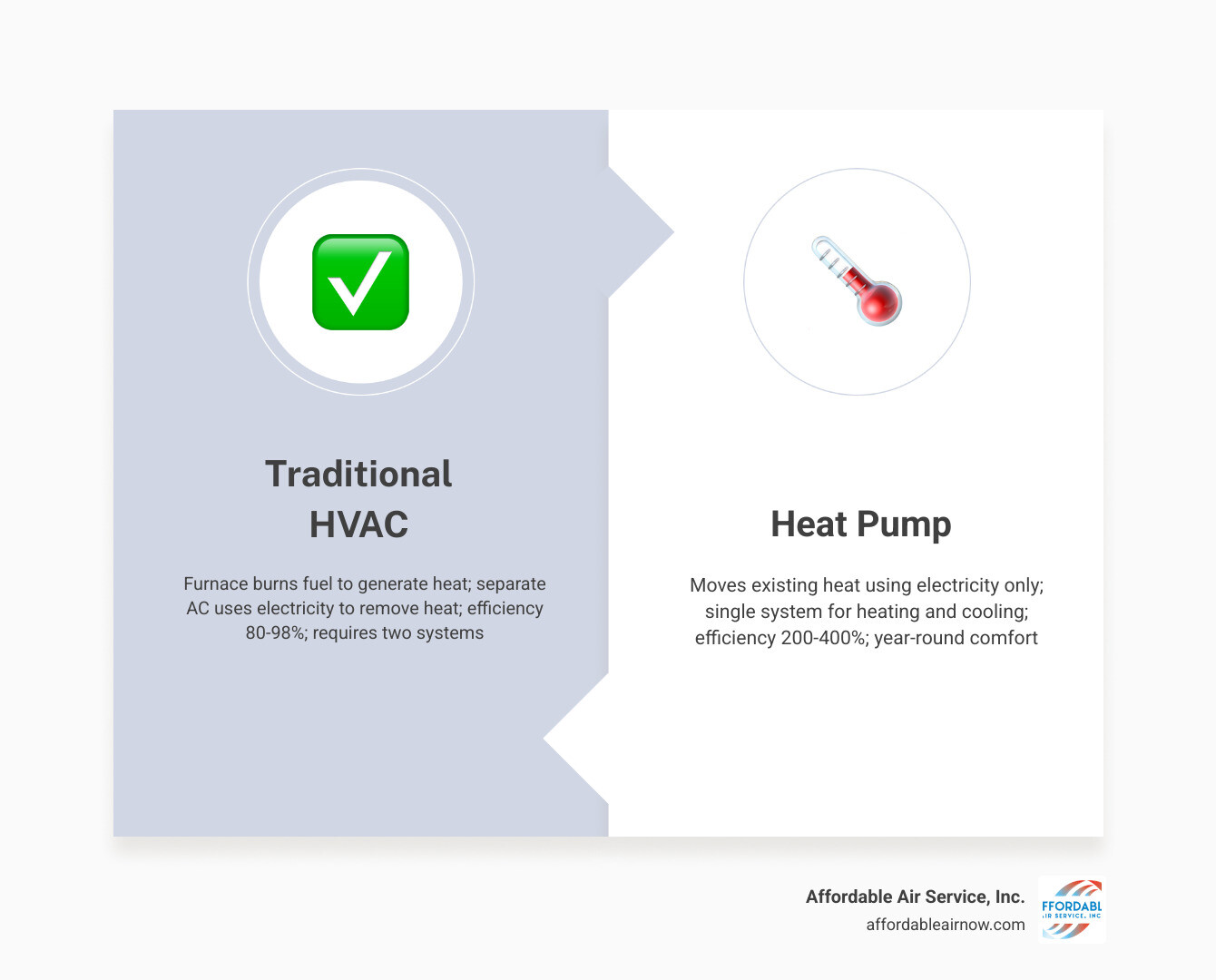
To understand why so many of our neighbors in Destin and Miramar Beach are making the switch, we first have to look at how these systems differ from what we’ve used for decades. A traditional HVAC setup usually consists of two separate machines: a furnace (which burns fuel to create heat) and an air conditioner (which uses electricity to move heat out of your home).
A heat pump is different because it is a “heat mover” rather than a “heat maker.” It uses a refrigerant cycle and a clever component called a reversing valve. In the summer, it works exactly like an air conditioner, pulling heat from inside your home and dumping it outside. In the winter, the valve reverses the flow, allowing the system to extract heat from the outdoor air and bring it inside. Even when it feels “cold” to us, there is still thermal energy in the air that a heat pump can harvest.
This dual functionality provides year-round comfort with a single piece of equipment. You can explore essential heating system types for optimal comfort to see how these compare to older boilers or furnaces.
| Feature | Heat Pump | Traditional HVAC (Furnace + AC) |
|---|---|---|
| Primary Function | Heats and Cools | Separate units for each |
| Energy Source | Electricity | Electricity + Gas/Oil/Propane |
| Efficiency | 200% – 400% | 80% – 98% |
| Environmental Impact | Low (No on-site combustion) | Higher (Fossil fuel burning) |
| Lifespan | 15 – 25 Years | 15 – 20 Years |
Key heat pump advantages over traditional hvac for energy savings
The most staggering of the heat pump advantages over traditional hvac is the efficiency rating. While a high-efficiency gas furnace might reach 98% efficiency (meaning 2% of the energy is wasted), a well-maintained air-source heat pump can deliver three times the heat energy as the electric power that goes into it. That is a 300% to 400% efficiency rating.
In practical terms, the average U.S. household can save about $370 per year by switching. However, for those of us in Florida who might be switching from older, inefficient electric resistance heat strips or propane systems, those savings can climb closer to $1,000 annually. You can read more about the top reasons to install a heat pump to see how these savings stack up over time.
Operational differences in modern systems
Modern heat pumps, like the Daikin Fit systems we install, often utilize variable-speed compressors. Unlike traditional systems that blast on at 100% and then shut off completely—creating “hot spots” and “cold spots”—variable-speed systems run continuously at lower, quieter levels.
This results in superior temperature stability and, more importantly for the Emerald Coast, exceptional humidity control. By running longer cycles at a lower speed, the system has more time to pull moisture out of the air, making your home feel cooler at a higher temperature setting. For a deeper dive, check out the Emerald Coast guide to heat pump efficiency and benefits.
Maximizing Environmental Impact and Home Safety
One of the biggest heat pump advantages over traditional hvac is the positive impact on the planet and your family’s safety. Because heat pumps don’t burn fossil fuels like natural gas, propane, or oil to generate heat, they eliminate the risk of carbon monoxide leaks from the heating process.
From an environmental standpoint, switching to a heat pump is the single most effective way to reduce your home’s carbon footprint. Studies show that 98% of homes in the US will reduce their emissions by switching. Air-source heat pumps typically trim household CO2 emissions by about 40% compared to gas furnaces. In regions with “cleaner” electrical grids, that reduction can be as high as 75%. If you’re wondering why you should consider heat pump installation in Ft. Walton Beach FL, the combination of safety and sustainability is usually at the top of the list.
Why heat pump advantages over traditional hvac matter for Florida homeowners
In places like Santa Rosa Beach and Okaloosa Island, we don’t deal with sub-zero blizzards, but we do deal with “the swamp.” Our winters are mild, which is where heat pumps perform at their absolute peak efficiency.
When shopping for a system in May 2026, you’ll want to look at two main ratings:
- SEER2 (Seasonal Energy Efficiency Ratio): This measures cooling efficiency. Higher is better.
- HSPF2 (Heating Seasonal Performance Factor): This measures heating efficiency.
Because a heat pump is an all-in-one solution, you get the latest in high-SEER2 cooling technology while simultaneously upgrading your heating. We often see professional heat pump installation benefits manifest as lower summer bills and significantly lower winter bills compared to traditional setups.
Performance in Diverse Climates and Cold Weather
A common myth is that heat pumps only work in the South. While they are perfect for Florida, modern cold-climate heat pumps are now used in some of the coldest places on Earth. In fact, heat pumps heat roughly half the homes in Norway, Finland, and Sweden.
Newer models can extract heat from outdoor air even when temperatures drop to -20°F. While we rarely see temperatures below freezing in Destin, it’s comforting to know that your system is engineered to handle extreme shifts. For homes in slightly cooler inland areas like DeFuniak Springs, we sometimes recommend hybrid systems (or dual-fuel systems) that pair a heat pump with a gas furnace for the few nights a year it gets truly frigid. You can learn how to master heat pump installation and maintenance in Ft. Walton Beach to ensure your system is ready for any weather.
Long-term reliability and system lifespan
When we talk about heat pump advantages over traditional hvac, we have to mention longevity. A well-maintained heat pump typically lasts between 15 and 25 years. Ground-source (geothermal) systems can last even longer, with indoor components lasting 24 years and ground loops lasting over 50.
To get the most out of your investment, bi-annual tune-ups are essential. Because the system works year-round (cooling in summer, heating in winter), it doesn’t get a “season off” like a furnace does. Regular maintenance prevents “dirty sock syndrome” and keeps the variable-speed motors running smoothly. Check out our Santa Rosa Beach guide to heat pump installation and maintenance for more tips on durability.
Financial Incentives and Installation Considerations
As of May 2026, the financial landscape for heat pumps has never been better. Under the Inflation Reduction Act, homeowners can claim a federal tax credit of 30% of the total cost of buying and installing a heat pump, up to $2,000 annually.
When you add in local utility rebates and the long-term energy savings, the “payback period” for a heat pump is significantly shorter than it used to be. Many homeowners find that finding the best heat pump installation services in Santa Rosa Beach without breaking a sweat involves looking for contractors who understand these incentives.
Evaluating the heat pump advantages over traditional hvac for your property
Before we install a system, we perform detailed load calculations to ensure the unit is perfectly sized for your home. We also look at your ductwork requirements. Since heat pumps move a high volume of air at a lower temperature than a gas furnace, your ducts need to be sized correctly to prevent noise and efficiency loss.
For homes without existing ducts, multi-split (ductless) options are a fantastic alternative. These allow for zoning controls, meaning you can cool the living room during the day and only the bedrooms at night, further driving down your energy use. You can find more details on HVAC in Santa Rosa Beach and heat pump installation on our service pages.
Frequently Asked Questions about Heat Pumps
Do heat pumps actually work in freezing temperatures?
Yes! While older models struggled below 40°F, modern cold-climate technology allows air-source heat pumps to operate efficiently down to -5°F or even -20°F. In Florida, they remain incredibly efficient throughout our entire winter season. If you need local experts, we are among the top rated heat pump installation system contractors in Destin.
Can a heat pump replace both my air conditioner and furnace?
Absolutely. It is an all-in-one system. By replacing two pieces of equipment with one, you save space in your garage or attic and simplify your maintenance schedule. It’s the primary reason many choose HVAC/Destin FL/Heat Pump Installation when their old AC or furnace fails.
Are there specific tax credits available in 2026?
Yes, the federal government offers a 30% tax credit (up to $2,000) for ENERGY STAR certified heat pumps. There are also various state-level rebates and utility programs that can further reduce the initial investment. We can help you navigate these when finding the best heat pump installation services in Ft. Walton Beach.
Conclusion
The heat pump advantages over traditional HVAC are clear: you get better efficiency, lower bills, a smaller carbon footprint, and a more comfortable home. At Affordable Air Service, Inc., we’ve seen how these systems transform the comfort of homes across the Emerald Coast.
As a dedicated Daikin dealer, we stand behind the Daikin Comfort Promise and offer the Daikin Worry-Free 12-Year Warranty on qualifying systems. Whether you are in Santa Rosa Beach, Destin, or Fort Walton Beach, we are here to provide 7-day service, free estimates, and easy GoodLeap financing to make your upgrade as smooth as possible.
Ready to see how much you could save? Explore our full range of HVAC services or contact us today to schedule your free estimate. Let’s bring modern, efficient comfort to your Florida home.