


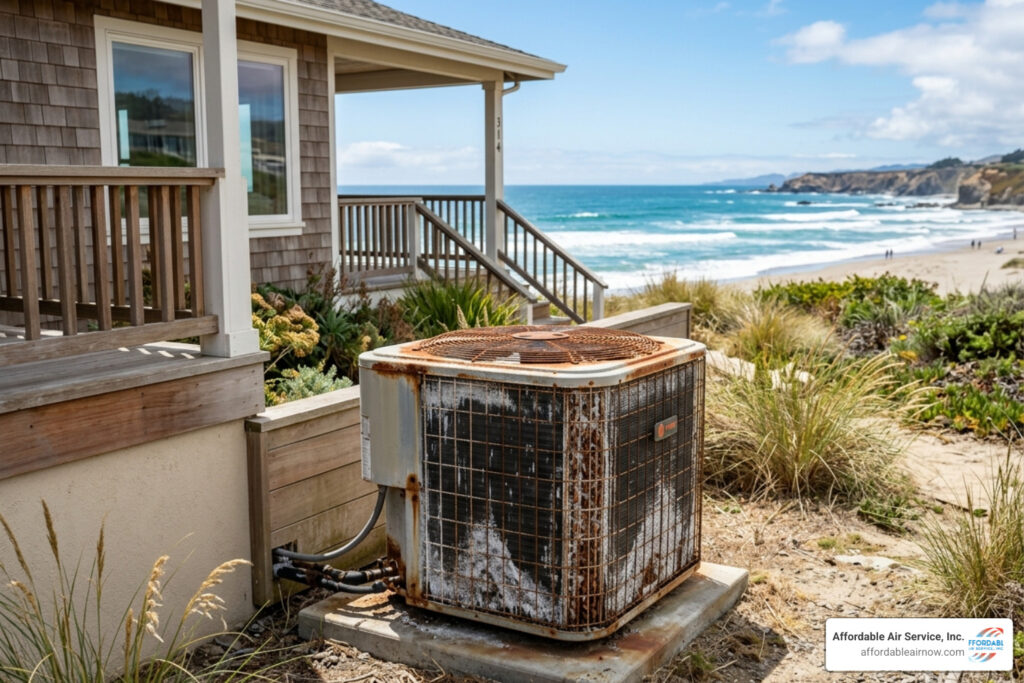
Why Salt Air Is Harder on Your HVAC Equipment Than You Think
How salt air affects your HVAC equipment near the coast is something every Emerald Coast homeowner needs to understand — because the damage is real, it starts fast, and it often goes unnoticed until something breaks down.
Here is a quick summary of what salt air does to your system:
- Corrodes metal components — aluminum fins, copper coils, and steel frames break down faster than in inland environments
- Damages electrical parts — salt conducts electricity and accelerates corrosion on wiring, circuit boards, and connections
- Reduces efficiency — corroded coils can no longer transfer heat properly, so your system works harder and uses more energy
- Shortens system lifespan — a neglected coastal unit may last only 5 to 7 years, compared to 12 to 15 years for a well-maintained inland system
- Reaches homes miles from the shore — airborne salt particles can travel well beyond the immediate coastline, especially during storms
Salt air is simply a mix of sodium chloride and water vapor carried inland by ocean breezes. What makes it so destructive is that salt attracts moisture, and that combination creates a corrosive environment on every exposed metal surface of your HVAC system. In Santa Rosa Beach and across the Emerald Coast, that threat is present year-round — not just during summer or storm season.
As of April 2026, more Emerald Coast homeowners are learning the hard way that standard HVAC maintenance schedules are not enough when you live this close to the Gulf.
How salt air affects your hvac equipment near the coast
Living in beautiful areas like Destin or Miramar Beach means enjoying the Gulf breeze, but for your air conditioner, that breeze is a delivery system for microscopic destruction. When we talk about how salt air affects your hvac equipment near the coast, we are really talking about a relentless chemical process.
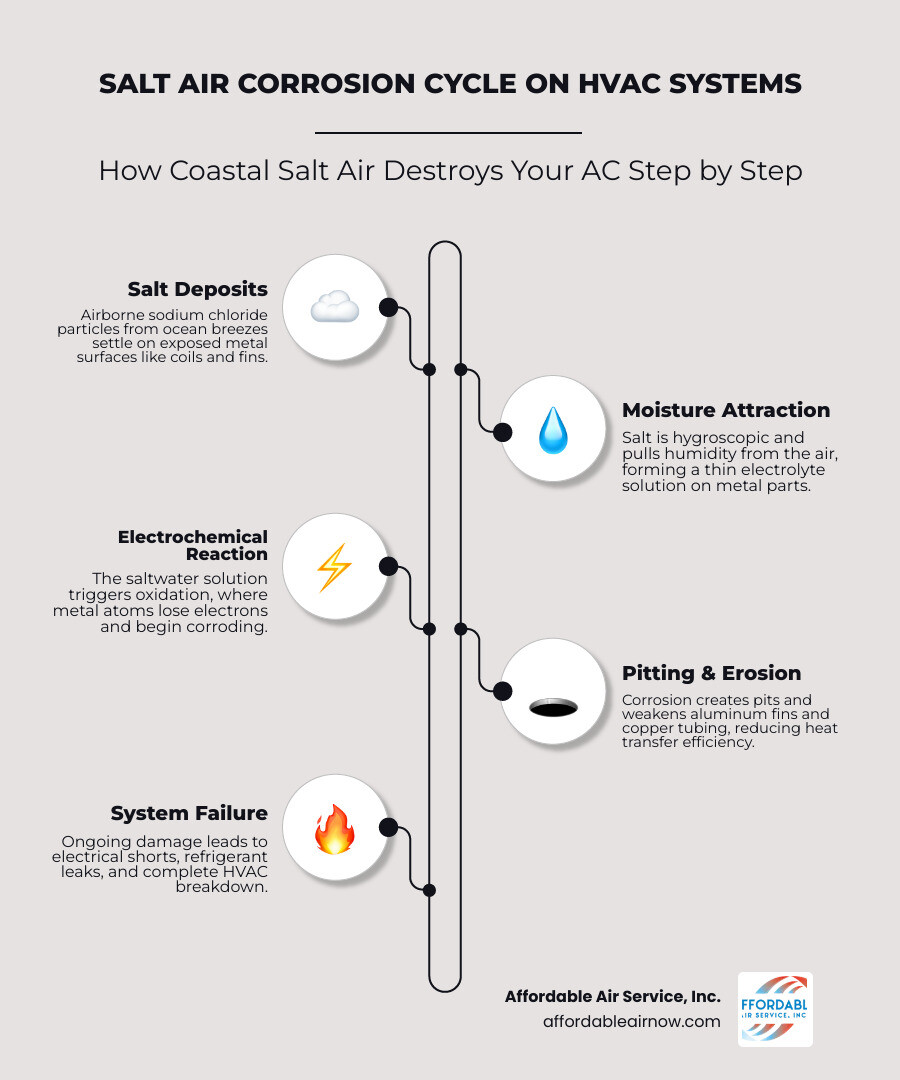
The primary culprit is a process that turns your outdoor unit into a giant battery—in the worst way possible. Salt particles settle on the metal surfaces of your condenser. Because salt is hygroscopic (meaning it loves to pull moisture out of the air), it creates a damp, salty film. In our high-humidity Florida climate, this film becomes an “electrolyte solution.”
This solution facilitates a chemical reaction called oxidation. On steel parts, this looks like red rust. On aluminum and copper, it leads to pitting and “formicary corrosion.” This isn’t just a cosmetic issue; it’s a structural one. As the metal eats away, the signs of HVAC system repair needs become obvious: your unit struggles to breathe, your electricity bill spikes, and eventually, the system simply gives up.
The Science of how salt air affects your hvac equipment near the coast
To get technical, the sodium chloride in the sea spray acts as a catalyst. Your HVAC system relies on heat exchange, which happens through the aluminum fins and copper tubing in your outdoor condenser unit.
When salt sits on these fins, it causes the aluminum to literally turn into dust. You might notice the fins becoming brittle or “flaking” off when touched. Once the fins disappear, the copper tubing is left exposed. When copper and aluminum are in contact in a salty environment, “galvanic corrosion” occurs. This often leads to microscopic pinhole leaks in the refrigerant lines. Once your refrigerant starts leaking, your system loses its ability to cool your home, leading to a frozen evaporator coil and a very warm living room.
Why salt air affects your hvac equipment near the coast even miles inland
A common mistake we see homeowners in places like Freeport or DeFuniak Springs make is thinking they are “safe” because they aren’t right on the beach. However, salt air doesn’t stop at the Highway 98 boundary.
Wind patterns along the Emerald Coast can carry salt particles up to 50 miles inland. While the concentration is highest within the first five miles, major storms and high-wind events can push that corrosive mist deep into the interior. If you live in Santa Rosa Beach, FL, even if you are a few miles from the Gulf, your unit is still breathing in salt every single day.
What are the signs that salt air is ruining my HVAC in Santa Rosa Beach?
Early detection is the difference between a simple cleaning and a multi-thousand-dollar replacement. We recommend checking your outdoor unit monthly for these red flags:
- Visible Rust: Look for orange or reddish-brown spots on the outer cabinet, base pan, or fan blades.
- White Ashy Residue: This is often a sign of aluminum oxidation on the coils. If the fins look like they have a “dusty” white coating that doesn’t wash off easily, corrosion has started.
- Pockmarks and Pitting: Small “craters” in the metal surfaces or copper lines indicate that the salt is eating through the material.
- Disintegrating Fins: If the thin metal slats on your coils crumble when touched, the heat exchange capacity is already compromised.
- Rising Energy Bills: If your April 2026 power bill is significantly higher than last year without a change in usage, your corroded coils are likely making the compressor work overtime.
- Unusual Noises: Salt buildup on fan blades can cause them to become imbalanced, leading to buzzing or vibrating sounds.
For a deeper dive into what to look for, check out our HVAC resources for Santa Rosa Beach homeowners.
How can I protect my Emerald Coast AC from salt damage?
The good news is that you aren’t helpless against the ocean. Protecting your system requires a combination of “Low-Tech” DIY habits and “High-Tech” professional interventions.
DIY vs. Professional Care: A Comparison
| Feature | DIY Maintenance | Professional Service |
|---|---|---|
| Coil Cleaning | Surface rinsing with fresh water | Deep chemical cleaning and salt neutralizers |
| Protection | Clearing debris and vegetation | Applying specialized anti-corrosion coatings |
| Inspection | Checking for visible rust | Testing electrical loads and refrigerant levels |
| Frequency | Monthly | Every 6 months (Bi-annual) |
One of the most effective preventative HVAC maintenance tips we can give is the “Fresh Water Rinse.” Once a month, use a garden hose on low pressure to gently rinse the salt off your outdoor unit. Avoid high-pressure washers, as these can bend the delicate aluminum fins.
Furthermore, regular HVAC service is essential because professionals can apply “Coastal Coatings.” These are specialized epoxy or polymer barriers (like Bronz-Glow) applied to the coils that prevent salt from ever touching the metal. If you are looking for specialized care for your unit in Destin, FL, ensuring your technician uses salt-resistant treatments is a must.
Frequently Asked Questions about Coastal HVAC Care
How often should I rinse my outdoor unit near the coast?
We recommend a gentle rinse at least once a month. If we’ve had a particularly windy week or a tropical storm, give it an extra rinse as soon as the weather clears. Always use fresh water and aim the spray downward to help the salt drain out of the bottom of the unit.
Can salt air reach my home if I live five miles inland?
Yes, absolutely. While the “corrosion zone” is most intense within 3,000 feet of the ocean, salt spray is windborne. In Florida, where the land is flat and the winds are consistent, those particles can travel miles. Homeowners in Freeport or inland Santa Rosa Beach should still follow coastal maintenance protocols to be safe.
What is the typical lifespan of an AC unit on the Emerald Coast?
In an inland environment, a well-maintained AC might last 15 years. On the Emerald Coast, a neglected unit often fails in just 5 to 7 years. However, with proactive rinsing, professional coatings, and bi-annual maintenance, we can often extend that lifespan to 10–12 years, saving you significant money in the long run.
Conclusion
At the end of the day, living near the water is a dream, but it requires a different approach to home maintenance. Understanding how salt air affects your hvac equipment near the coast is the first step in protecting your investment. By staying vigilant for rust, rinsing your unit regularly, and partnering with a team that knows the local climate, you can keep your home cool and your energy bills low.
At Affordable Air Service, we specialize in keeping Emerald Coast homes comfortable. Whether you need a free estimate on a new salt-resistant Daikin system or a thorough cleaning to wash away the season’s salt buildup, we are here to help. Check out our guide for Emerald Coast homeowners getting their HVAC ready for vacation for more localized tips, or browse our full range of HVAC services to see how we can help you beat the salt this year. Don’t let the sea air sour your comfort—give us a call today!