


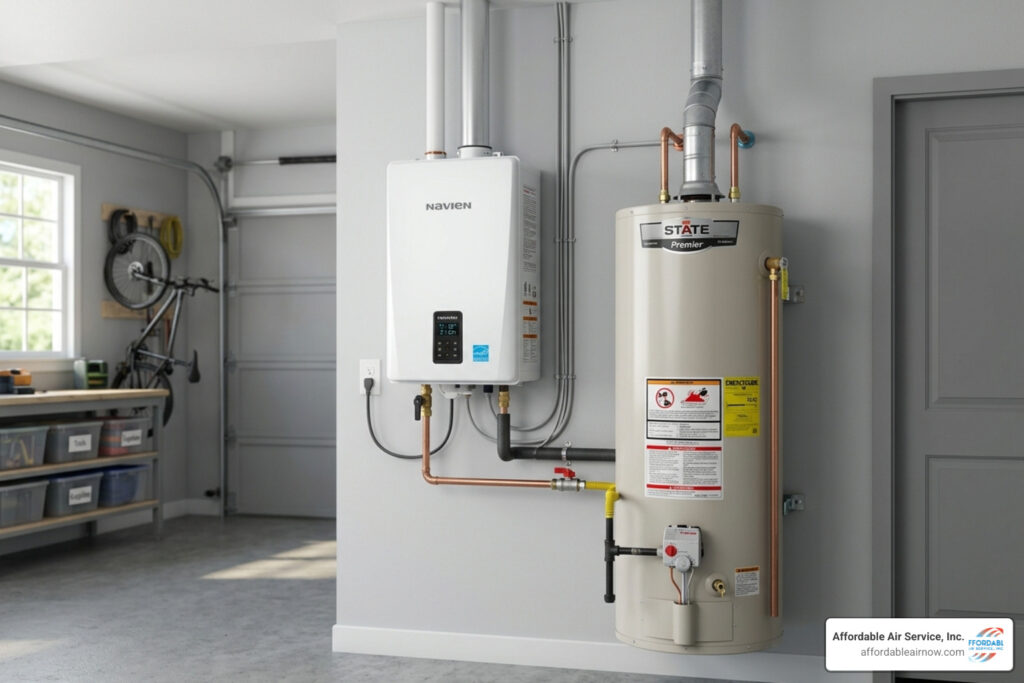
Is the Tankless Water Heater Cost vs Value Long Term Actually Worth It?
Tankless water heater cost vs value long term is one of the smartest questions a homeowner can ask before making this upgrade. Here’s the short answer:
For most homeowners who plan to stay in their home long-term, tankless water heaters deliver real value — but the math depends on your household size, infrastructure, and how long you plan to stay.
Here’s a quick breakdown to help you decide:
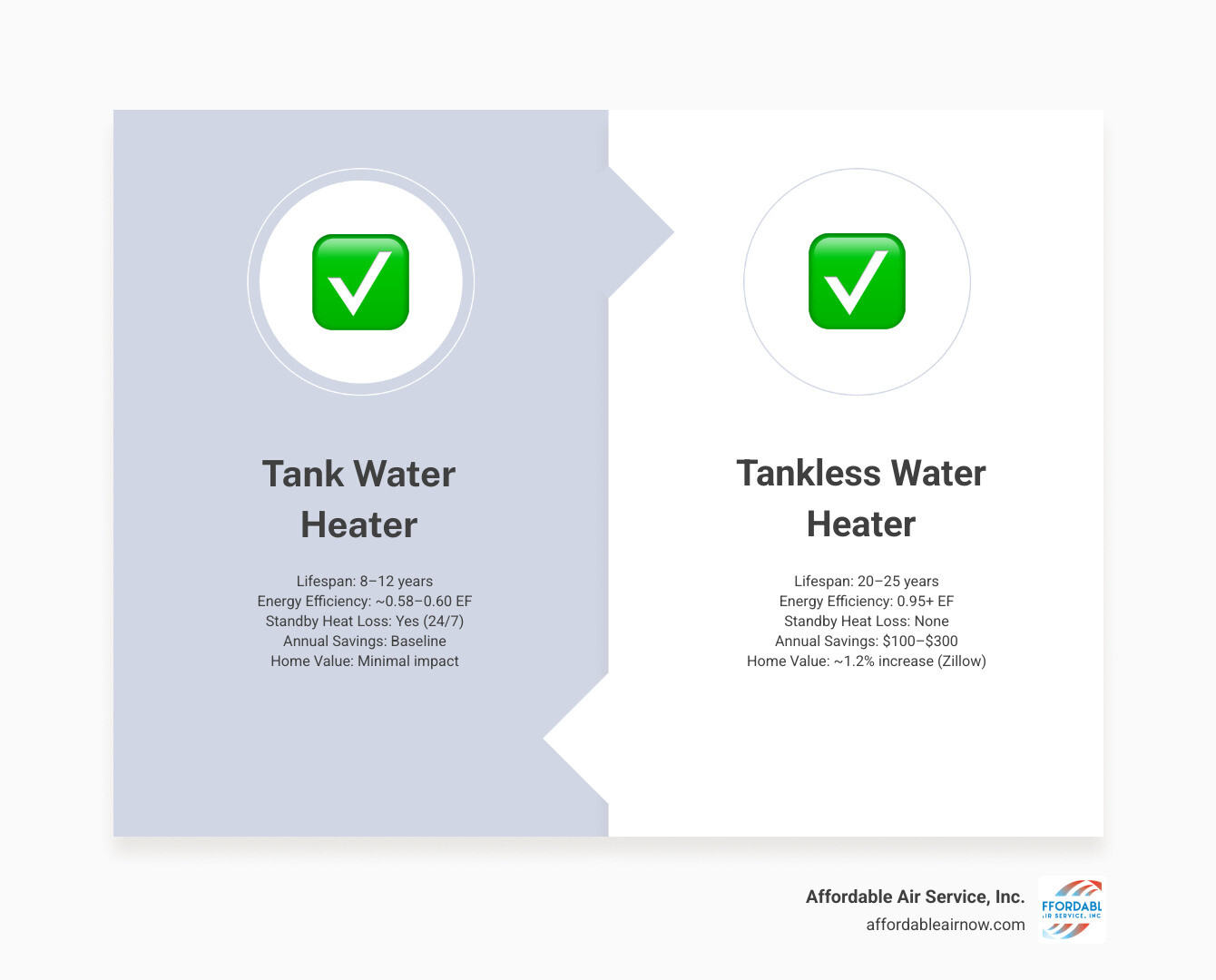
| Factor | Tank Water Heater | Tankless Water Heater |
|---|---|---|
| Lifespan | 8–12 years | 20–25 years |
| Energy Efficiency | ~0.58–0.60 EF | 0.95+ EF |
| Standby Heat Loss | Yes (24/7 heating) | None |
| Annual Energy Savings vs. Tank | — | $100–$300/year |
| Home Value Impact | Minimal | ~1.2% increase (Zillow) |
| Federal Tax Credit Available | No | Up to $600 (through 2032) |
So what does this mean in practice? A traditional tank heater keeps 40–50 gallons of water hot around the clock — even at 3 AM when nobody needs it. That constant reheating is called standby heat loss, and it quietly drains energy and money every single day. A tankless system only fires up when you actually turn on the tap.
According to the U.S. Department of Energy, homes that use 41 gallons or less of hot water daily can see tankless systems run 24%–34% more efficiently than conventional tank models. Even higher-use households using around 86 gallons per day can still see 8%–14% better efficiency.
The tradeoff? Tankless units cost more upfront — both for the equipment and the installation, which may require gas line upgrades, new venting, or electrical work. That’s a real consideration for homeowners here in Santa Rosa Beach, and it’s exactly why understanding the full cost-versus-value picture matters before you commit.
This guide will walk you through everything: energy savings, lifespan comparisons, hidden installation costs, maintenance needs, resale value, and when tankless genuinely makes sense — and when it might not.
Understanding the Tankless Water Heater Cost vs Value Long Term
When we talk about the tankless water heater cost vs value long term, we have to look past the initial purchase. In 2026, many homeowners in Santa Rosa Beach and Miramar Beach are moving away from the “storage” mindset. A traditional tank is essentially a giant kettle that never stops boiling. This leads to massive “standby loss,” where energy is wasted keeping water hot while you’re at work or sleeping.
Tankless units, often called demand-type heaters, operate with a much higher Energy Factor (EF). While a standard tank might hover around 0.60 EF, high-efficiency tankless models can reach 0.95 or higher. This jump in thermal efficiency is the engine behind your operational savings. By eliminating the need to store 50 gallons of water, you stop paying for “just in case” heat. There are numerous Benefits of Tankless Water Heaters that go beyond the bill, but the financial “long game” is rooted in this efficiency.
Furthermore, the Tankless Water Heaters Installation Benefits include more than just lower bills; they include the peace of mind that comes from a system designed to last twice as long as its predecessor.
Energy Savings and the Tankless Water Heater Cost vs Value Long Term
The primary driver of the tankless water heater cost vs value long term is the reduction in monthly utility expenses. Because these units use high-powered burners or heavy-duty electric elements to flash-heat water only when a faucet is opened, they use significantly less fuel over a year.
In our experience serving the Florida Panhandle, gas-fired tankless systems can save a household between $100 and $200 annually, while electric models typically save between $50 and $100. Over a 20-year period, those small monthly wins add up to $2,000–$4,000 in energy savings. If you want to Improve Efficiency Tankless Water Heater performance even further, pairing the unit with low-flow fixtures can maximize the “on-demand” advantage.
Resale Value and the Tankless Water Heater Cost vs Value Long Term
Does a tankless unit actually make your home worth more? According to data from Zillow, the answer is a resounding yes. Homes with tankless water heaters can see a price premium of approximately 1.2% at the time of sale. For a $400,000 home in Destin or Santa Rosa Beach, that translates to a value increase of roughly $4,800.
Modern buyers are increasingly looking for “green” features and energy-efficient upgrades. When a buyer sees a sleek, wall-mounted unit instead of a rusted 50-gallon tank taking up valuable closet space, it signals that the home has been well-maintained with modern technology. You can learn more about how these systems integrate into modern homes by exploring our guide on Tankless Water Heaters.
Maximizing Lifespan and Efficiency in Santa Rosa Beach
One of the strongest arguments for the tankless water heater cost vs value long term is the sheer durability of the equipment. While a traditional tank is a ticking time bomb of corrosion—usually failing within 8 to 12 years when the glass lining cracks—a tankless system is built differently.
Most tankless units are designed to last 20 to 25 years. They don’t have a giant tank to rust out. Instead, they use durable heat exchangers and modular parts that can often be replaced individually. This means you aren’t just buying one water heater; you’re potentially avoiding the cost and hassle of two separate tank replacements over the same two-decade period.
Maintenance and the Tankless Water Heater Cost vs Value Long Term
To hit that 20-year milestone, maintenance is non-negotiable. In our coastal Florida region, we often deal with varying water quality that can lead to scaling. This is where calcium and magnesium deposits “bake” onto the heat exchanger, forcing the unit to work harder and eventually causing it to shut down.
Addressing Tankless Water Heater Scaling Issues involves an annual descaling flush. We like to tell our customers that it’s like a spa day for your plumbing. Without this routine care, the efficiency of the unit drops, and the lifespan can be cut short. For a deeper dive into why this matters, check out our lighthearted look at Why Your Miramar Beach Tankless Heater Needs a Spa Day.
Infrastructure and Installation Requirements
The “cost” side of the tankless water heater cost vs value long term equation often involves the home’s infrastructure. You can’t always just “swap” a tank for a tankless unit without some preparation.
- Gas Lines: A tankless gas heater needs a lot of power quickly. While a standard tank uses about 30,000 to 40,000 BTUs, a tankless unit might require 150,000 to 200,000 BTUs. This often means upgrading your gas line from a half-inch to a three-quarter-inch pipe.
- Venting: High-efficiency condensing units often use PVC venting, but they must be vented correctly to handle the exhaust.
- Electrical: Whole-house electric tankless units are power-hungry, often requiring 100 to 150 amps of capacity. If your Santa Rosa Beach home only has a 100-amp total panel, you might need an electrical upgrade.
Our The Homeowners Guide to Tankless Water Heaters Installation in Miramar Beach provides a detailed look at these physical requirements.
Professional Installation Standards
Because of the high BTU requirements and complex venting, professional installation is a must. Sizing the unit correctly is the difference between a luxury experience and a cold shower. We calculate your “peak demand”—how much hot water you need if the shower, dishwasher, and washing machine are all running at once—to ensure the unit can keep up.
For residents in our service area, we offer localized expertise. You can find more details in our Tankless Water Heaters Installation Guide Destin FL or learn Why You Need Expert Tankless Water Heaters Installation in Ft Walton Beach FL.
Frequently Asked Questions about Tankless Value
How long do tankless water heaters last compared to tank models in 2026?
In 2026, the technology has reached a point where 20 to 25 years is the standard expectation for a well-maintained tankless unit. Traditional tank models still generally fail between 8 and 12 years due to unavoidable tank corrosion. This means a tankless unit effectively outlasts two generations of tank heaters.
Are there federal tax credits available for tankless upgrades this year?
Yes! Under current 2026 guidelines, eligible natural gas tankless water heaters can receive a federal tax credit of 30%, up to a maximum of $600. This credit is available through 2032, making right now an excellent time to invest in the upgrade.
Can a tankless system handle multiple showers simultaneously?
Absolutely, provided it is sized correctly for your climate. In Florida, where our “groundwater” isn’t as cold as it is up north, a large whole-house unit can easily handle two or even three simultaneous showers. The key is choosing a unit with a high enough flow rate (measured in gallons per minute) to meet your family’s peak usage.
Conclusion
At Affordable Air Service, Inc., we’ve seen how the tankless water heater cost vs value long term plays out for families in Santa Rosa Beach, Fort Walton Beach, and Destin. While the upfront transition requires a bigger commitment, the rewards of endless hot water, reclaimed floor space, and 20 years of lower energy bills are hard to ignore.
A tankless system isn’t just a home appliance; it’s a long-term investment in your home’s efficiency and resale value. Whether you are building a new home in Freeport or upgrading an aging system in Miramar Beach, we are here to provide the expertise and affordable pricing you need to make the switch.
Ready to stop paying to heat water you aren’t using? More info about our services is just a click away. Let us help you play the long game with a system that delivers comfort for decades.